Loading...
Done
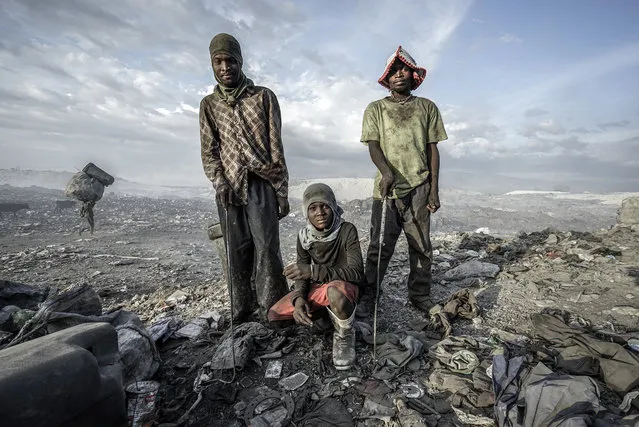
In a 200-acre-plus dump 5 kilometers north of Haiti’s capital, Port-au-Prince, hundreds of men, women and children scavenge day and night through the burning wasteland. They earn $12 to $15 a day – on a good day – for recycling plastics as well as clothing, household items and aluminum (for smelting). Some 5,000 tons of waste is created each day in the Port-au-Prince area. (Photo and caption by Giles Clarke/Getty Images Reportage)

In a 200-acre-plus dump 5 kilometers north of Haiti’s capital, Port-au-Prince, hundreds of men, women and children scavenge day and night through the burning wasteland. They earn $12 to $15 a day – on a good day – for recycling plastics as well as clothing, household items and aluminum (for smelting). Some 5,000 tons of waste is created each day in the Port-au-Prince area. (Photo and caption by Giles Clarke/Getty Images Reportage)
Details
02 Feb 2015 11:21:00
A woman carries a piglet as she runs on ice during a running challenge in Changsha, Hunan province February 8, 2015. A total of 20 people participated in the challenge requiring them to choose a pig ranging between 15 kg and 115 kg in weight, and carrying it while running on a 20.15-metre-long ice track. The participants that complete the challenge will be rewarded with the pig they carried, local media reported. (Photo by Darwin Zhou/Reuters)

A woman carries a piglet as she runs on ice during a running challenge in Changsha, Hunan province February 8, 2015. A total of 20 people participated in the challenge requiring them to choose a pig ranging between 15 kg and 115 kg in weight, and carrying it while running on a 20.15-metre-long ice track. The participants that complete the challenge will be rewarded with the pig they carried, local media reported. (Photo by Darwin Zhou/Reuters)
Details
14 Feb 2015 12:31:00
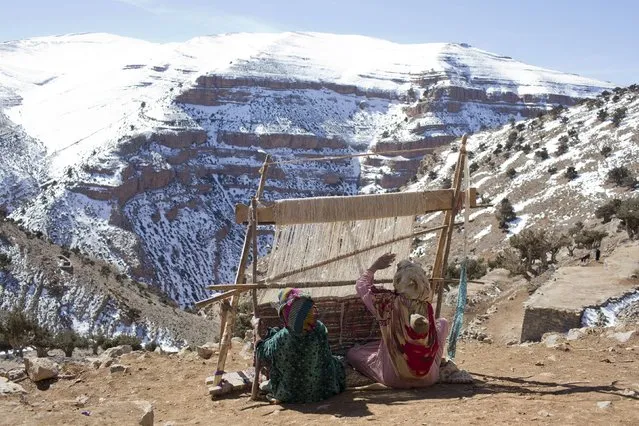
Berber women weave traditional carpets in the village of Ait Sghir in the High Atlas region of Morocco February 15, 2015. The snowy foothills of the High Atlas mountains in Morocco are home to several Berber villages where the inhabitants make their living by farming, baking bread in traditional ovens, herding cattle, and the making and selling of honey, olive oil and pottery. Extreme weather fluctuations and erosion that causes flooding and landslides have led to a drop in agricultural productivity, the United Nations said. (Photo by Youssef Boudlal/Reuters)

Berber women weave traditional carpets in the village of Ait Sghir in the High Atlas region of Morocco February 15, 2015. The snowy foothills of the High Atlas mountains in Morocco are home to several Berber villages where the inhabitants make their living by farming, baking bread in traditional ovens, herding cattle, and the making and selling of honey, olive oil and pottery. Extreme weather fluctuations and erosion that causes flooding and landslides have led to a drop in agricultural productivity, the United Nations said. (Photo by Youssef Boudlal/Reuters)
Details
26 Feb 2015 06:07:00
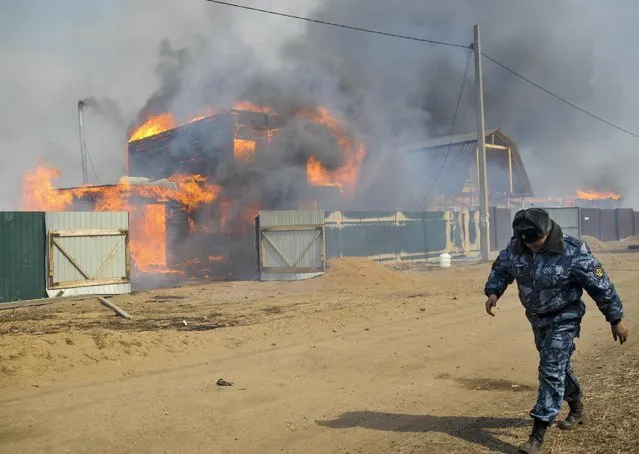
A police officer walks along a street of the burning village of Smolenka near Chita on Monday, April 13, 2015. Russian authorities say out-of-control agricultural fires have killed at least 15 people, injured hundreds more and destroyed or damaged more than 1,000 homes in Siberia. The fires were started by farmers burning the grass in their fields, but spread quickly because of strong winds. (Photo by Evgeny Yepanchintsev/AP Photo)

A police officer walks along a street of the burning village of Smolenka near Chita on Monday, April 13, 2015. Russian authorities say out-of-control agricultural fires have killed at least 15 people, injured hundreds more and destroyed or damaged more than 1,000 homes in Siberia. The fires were started by farmers burning the grass in their fields, but spread quickly because of strong winds. (Photo by Evgeny Yepanchintsev/AP Photo)
Details
14 Apr 2015 11:04:00
Andrew Parkinson, animal behaviour category winner: Crepuscular Contentment, Derbyshire. “In 15 years of working with badgers I’ve never seen a badger sit out in the open to have a scratch. I was sat concealed behind a tree and downwind so it was especially nice that the badger had his back to me, demonstrating just how inconspicuous and inconsequential my presence was”. (Photo by Andrew Parkinson/British Wildlife Photography Awards 2017)

Andrew Parkinson, animal behaviour category winner: Crepuscular Contentment, Derbyshire. “In 15 years of working with badgers I’ve never seen a badger sit out in the open to have a scratch. I was sat concealed behind a tree and downwind so it was especially nice that the badger had his back to me, demonstrating just how inconspicuous and inconsequential my presence was”. (Photo by Andrew Parkinson/British Wildlife Photography Awards 2017)
Details
10 Nov 2017 09:01:00
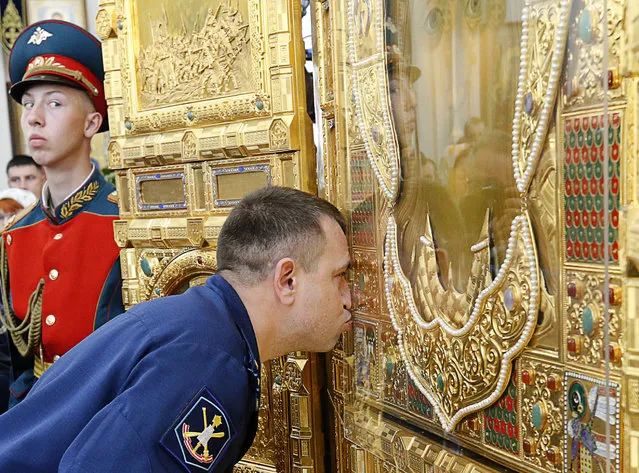
A serviceman kisses the main icon for the Russian Armed Forces' main cathedral, delivered at the Church of Our Lady the Healer in Rostov-On-Don, Russia on May 15, 2018. The Russian Armed Forces' main cathedral is to be built in Patriot Military Park in Kubinka outside Moscow by 2020, the year of the 75th anniversary of the victory of the Soviet Red Army over Nazi Germany in the 1941-45 Great Patriotic War, the Eastern Front of World War II. (Photo by Valery Matytsin/TASS)

A serviceman kisses the main icon for the Russian Armed Forces' main cathedral, delivered at the Church of Our Lady the Healer in Rostov-On-Don, Russia on May 15, 2018. The Russian Armed Forces' main cathedral is to be built in Patriot Military Park in Kubinka outside Moscow by 2020, the year of the 75th anniversary of the victory of the Soviet Red Army over Nazi Germany in the 1941-45 Great Patriotic War, the Eastern Front of World War II. (Photo by Valery Matytsin/TASS)
Details
17 May 2019 00:07:00
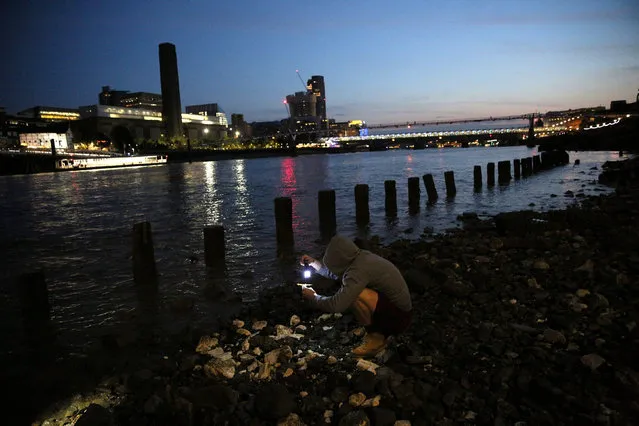
A mudlark uses a torch to look for items on the bank of the River Thames in London, Britain June 06, 2016. Mudlarking is believed to trace its origins to the 18th and 19th century, when scavengers searched the Thames' shores for items to sell. These days, history and archaeology fans are the ones hoping to find old relics such as coins, ceramics, artifacts or everyday items from across centuries. They wait for the low tide and then scour specific areas of exposed shores. "If you're in a field you could be out all day long, with the river you're restricted to about two or three hours," mudlark Nick Stevens said. While many just use the naked eye for their searches, others rely on metal detectors for which a permit from the Port of London Authority is needed. Digging also requires consent. (Photo by Neil Hall/Reuters)

A mudlark uses a torch to look for items on the bank of the River Thames in London, Britain June 06, 2016. Mudlarking is believed to trace its origins to the 18th and 19th century, when scavengers searched the Thames' shores for items to sell. These days, history and archaeology fans are the ones hoping to find old relics such as coins, ceramics, artifacts or everyday items from across centuries. their finds with the Portable Antiquities Scheme. Any item over 300 years old must be recorded. (Photo by Neil Hall/Reuters)
Details
27 Aug 2016 10:43:00
Wall Street Protests In Canada

A protester wears a pig mask as he marches through the streets of downtown Vancouver with thousands of people participating in the Occupy Vancouver protest on October 15, 2011 in Vancouver, British Columbia, Canada. Thousands of people are taking to the streets in cities across the world today in demonstrations inspired by the Occupy Wall Street protest in New York City. An estimated 2,000 people participated in the Vancouver occupation. (Photo by Jeff Vinnick/Getty Images)
Details
16 Oct 2011 11:09:00