Loading...
Done
An empty camp is shown beneath a colourful sky in Siberia, December 2016. (Photo by Timothy Allen/Barcroft Productions)

A British photographer has captured life at the “edge of the world”. Timothy Allen, best known for his work on BBC's Human Planet, trekked through the freezing Siberian wilderness for 16 days as he joined part of an 800km migration of reindeer in the Yamal-Nenets region – a name that roughly translates to “edge of the world”. The stunning pictures feature the nomadic Nenets tribe, who drink blood to survive in -45°C temperatures. Timothy's epic journey, which will be revealed in an eight-minute documentary on Animal Planet USA, saw him travel across the bleak terrain of the frozen Ob River with the Nenets people in December last year. Here: An empty camp is shown beneath a colourful sky in Siberia, December 2016. (Photo by Timothy Allen/Barcroft Productions)
Details
19 Sep 2017 07:48:00
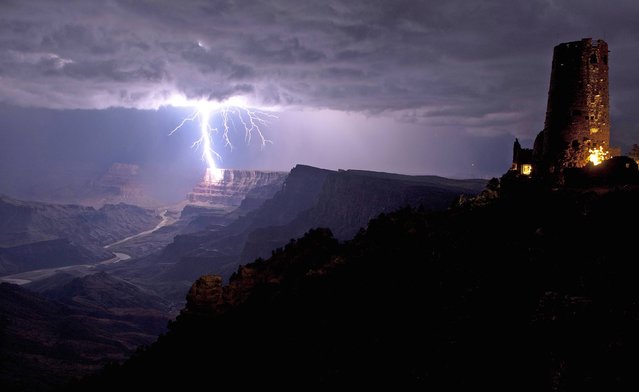
This is the incredible moment a fierce lightning bolt crashed against the Grand Canyon illuminating the steep canyon walls. Shrouded in darkness, the breath-taking landscape was shocked into life as mother nature sent the bolt storming down to Earth. (Photo by Travis Roe/U.S. Dept. of the Interior/Caters News)

This is the incredible moment a fierce lightning bolt crashed against the Grand Canyon illuminating the steep canyon walls. Shrouded in darkness, the breath-taking landscape was shocked into life as mother nature sent the bolt storming down to Earth. As it cracked against the rocks the bright blue bolt illuminated the South Rim of the canyon, considered one of the Seven Natural Wonders of the World. With just the Desert View Watchtower in the foreground, the lightning was perfectly framed by the canyon which is located in Arizona, USA. (Photo by Travis Roe/U.S. Dept. of the Interior/Caters News)
Details
14 May 2013 11:00:00
A Hawker Hurricane Mk XIIa 5711 (G-HURI) fighter aircraft prepares to perform an aerobatic display at the IWM Duxford on October 18, 2012 in Duxford, England. The aeroplane, similar to those that defended British shores during the Battle of Britain in World War II, is due to be auctioned by Bonhams in their sale of “Collectors' Motor Cars and Automobilia” at Mercedes-Benz World Brooklands on December 3, 2012. The plane was built in 1942 and joined the Royal Canadian Air Force the following year, where it remained for the duration of the war, it is expected to fetch up to 17 million GBP.  (Photo by Oli Scarff)

A Hawker Hurricane Mk XIIa 5711 (G-HURI) fighter aircraft prepares to perform an aerobatic display at the IWM Duxford on October 18, 2012 in Duxford, England. The aeroplane, similar to those that defended British shores during the Battle of Britain in World War II, is due to be auctioned by Bonhams in their sale of “Collectors' Motor Cars and Automobilia” at Mercedes-Benz World Brooklands on December 3, 2012. The plane was built in 1942 and joined the Royal Canadian Air Force the following year, where it remained for the duration of the war, it is expected to fetch up to 17 million GBP. (Photo by Oli Scarff)
Details
20 Oct 2012 09:11:00
A mudlark uses a torch to look for items on the bank of the River Thames in London, Britain June 06, 2016. Mudlarking is believed to trace its origins to the 18th and 19th century, when scavengers searched the Thames' shores for items to sell. These days, history and archaeology fans are the ones hoping to find old relics such as coins, ceramics, artifacts or everyday items from across centuries. They wait for the low tide and then scour specific areas of exposed shores. "If you're in a field you could be out all day long, with the river you're restricted to about two or three hours," mudlark Nick Stevens said. While many just use the naked eye for their searches, others rely on metal detectors for which a permit from the Port of London Authority is needed. Digging also requires consent. (Photo by Neil Hall/Reuters)

A mudlark uses a torch to look for items on the bank of the River Thames in London, Britain June 06, 2016. Mudlarking is believed to trace its origins to the 18th and 19th century, when scavengers searched the Thames' shores for items to sell. These days, history and archaeology fans are the ones hoping to find old relics such as coins, ceramics, artifacts or everyday items from across centuries. their finds with the Portable Antiquities Scheme. Any item over 300 years old must be recorded. (Photo by Neil Hall/Reuters)
Details
27 Aug 2016 10:43:00
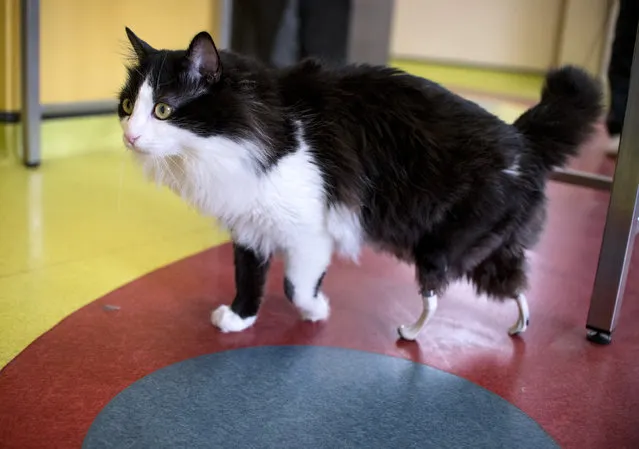
Pooh, a one-year-old cat, who lost his hind legs in an accident and has been given bionic paws, walks in a vet clinic in Sofia on January 31, 2017. Pooh, who is thought to have lost his legs in a car or train accident last April, is back on the prowl thanks to Bulgarian veterinary surgeon Vladislav Zlatinov. He is the first vet in Europe to successfully apply the pioneering method of Irish neuro-orthopaedic surgeon Noel Fitzpatrick, who shot to fame in 2009 when making Oscar the first bionic cat by fitting him with new hind legs in Britain. (Photo by Nikolay Doychinov/AFP Photo)

Pooh, a one-year-old cat, who lost his hind legs in an accident and has been given bionic paws, walks in a vet clinic in Sofia on January 31, 2017. Pooh, who is thought to have lost his legs in a car or train accident last April, is back on the prowl thanks to Bulgarian veterinary surgeon Vladislav Zlatinov. He is the first vet in Europe to successfully apply the pioneering method of Irish neuro-orthopaedic surgeon Noel Fitzpatrick, who shot to fame in 2009 when making Oscar the first bionic cat by fitting him with new hind legs in Britain. (Photo by Nikolay Doychinov/AFP Photo)
Details
03 Feb 2017 07:35:00
From Britain to China to Mali, new maps showing travel times to the nearest urban centre reveal huge differences between countries. Using Open Street Map and Google, a University of Oxford team have created a visual breakdown that suggests major inequalities when it comes to commuting. Here: China. The dataset used for China was unique as it relied solely on Open Street Map, due to restrictions on accessing Google data. The population is densely concentrated in the east and accessibility is increased, whereas rural provinces in the west remain remote. (Photo by Daniel Weiss/Jennifer Rozier/Malaria Atlas Project/University of Oxford )

From Britain to China to Mali, new maps showing travel times to the nearest urban centre reveal huge differences between countries. Using Open Street Map and Google, a University of Oxford team have created a visual breakdown that suggests major inequalities when it comes to commuting. Here: China. The dataset used for China was unique as it relied solely on Open Street Map, due to restrictions on accessing Google data. The population is densely concentrated in the east and accessibility is increased, whereas rural provinces in the west remain remote. (Photo by Daniel Weiss/Jennifer Rozier/Malaria Atlas Project/University of Oxford)
Details
12 Jan 2018 06:43:00
Lebanese students dance during “The Big Dance” event in downtown Beirut, near the parliament May 9, 2015. Around 900 students took part in the annual event organised by British Council's global project, which aims to develop connections between schools in Britain and Lebanon. (Photo by Aziz Taher/Reuters)

Lebanese students dance during “The Big Dance” event in downtown Beirut, near the parliament May 9, 2015. About 1000 students from all over Lebanon gather and take part in a joint dance with the aim of encouraging people to get into dance and increase fitness levels. This initiative is part of the British Council's project, Connecting Classrooms which aims at building links between schools in the UK and Lebanon. (Photo by Aziz Taher/Reuters)
Details
10 May 2015 11:29:00
A festival goer uses a hula hoop, as revelers gather ahead of this weekends Glastonbury Festival of Music and Performing Arts on Worthy Farm in Somerset. (Photo by Leon Neal/AFP Photo)

A festival goer uses a hula hoop, as revelers gather ahead of this weekends Glastonbury Festival of Music and Performing Arts on Worthy Farm in Somerset, southwest England, on June 25, 2014. US metal giants Metallica will play this year's coveted Saturday night headline spot at Britain's Glastonbury festival, organisers announced Thursday. It will be the “Master of Puppets” four-piece's first appearance at the legendary festival, held in south west England, following on from The Rolling Stones' Worthy Farm debut last year. (Photo by Leon Neal/AFP Photo)
Details
26 Jun 2014 11:33:00