Loading...
Done
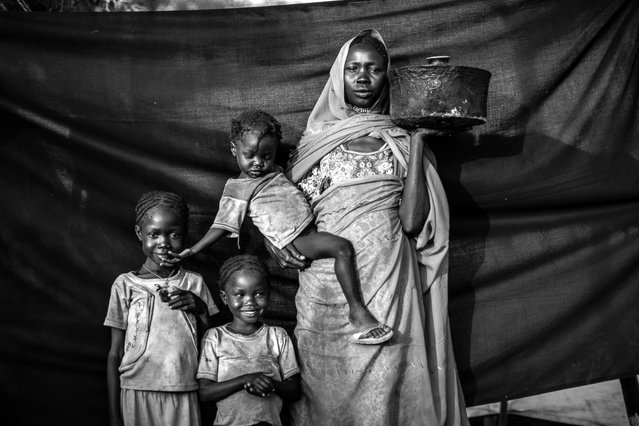
Magbola Alhadi, 20, and her three children pose for a portrait in Jamam refugee camp in Maban County, South Sudan on August 11th, 2012. Magboola and her family weathered aerial bombing raids for several months, but decided it was time to leave their village of Bofe the night that soldiers arrived and opened fire. (Photo by Brian Sokol/Panos Pictures)

Magbola Alhadi, 20, and her three children pose for a portrait in Jamam refugee camp in Maban County, South Sudan on August 11th, 2012. Magboola and her family weathered aerial bombing raids for several months, but decided it was time to leave their village of Bofe the night that soldiers arrived and opened fire. With her three children, she travelled for 12 days from Bofe to the town of El Fudj, on the South Sudanese border. The most important thing that Magboola was able to bring with her is the saucepan she holds in this photograph. It wasn't the largest pot that she had in Bofe, but it was small enough she could travel with it, yet big enough to cook sorghum for herself and her three daughters (from left: Aduna Omar, 6, Halima Omar, 4, and Arfa Omar, 2) during their journey. (Photo by Brian Sokol/Panos Pictures)
Details
18 Sep 2015 15:04:00
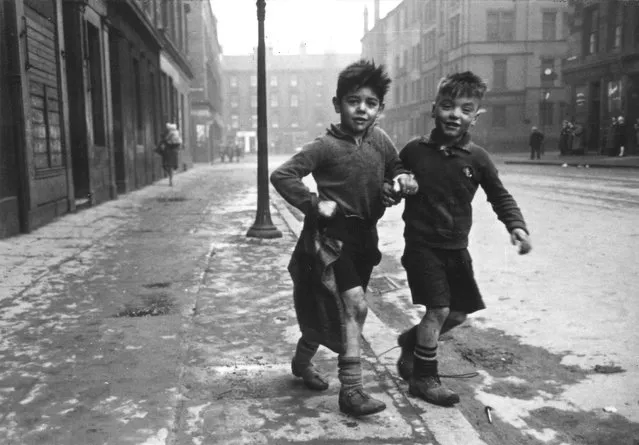
Two boys in the Gorbals area of Glasgow, UK on January 31, 1948. The Gorbals tenements were built quickly and cheaply in the 1840s, providing housing for Glasgow's burgeoning population of industrial workers. Conditions were appalling; overcrowding was standard and sewage and water facilities inadequate. The tenements housed about 40,000 people with up to eight family members sharing a single room, 30 residents sharing a toilet and 40 sharing a tap. By the time this photograph was taken 850 tenements had been demolished since 1920. Redevelopment of the area began in the late 1950s and the tenements were replaced with a modern tower block complex in the sixties. (Photo by Bert Hardy/Getty Images)

Two boys in the Gorbals area of Glasgow, UK on January 31, 1948. The Gorbals tenements were built quickly and cheaply in the 1840s, providing housing for Glasgow's burgeoning population of industrial workers. Conditions were appalling; overcrowding was standard and sewage and water facilities inadequate. The tenements housed about 40,000 people with up to eight family members sharing a single room, 30 residents sharing a toilet and 40 sharing a tap. By the time this photograph was taken 850 tenements had been demolished since 1920. Redevelopment of the area began in the late 1950s and the tenements were replaced with a modern tower block complex in the sixties. (Photo by Bert Hardy/Getty Images)
Details
09 Mar 2017 00:03:00
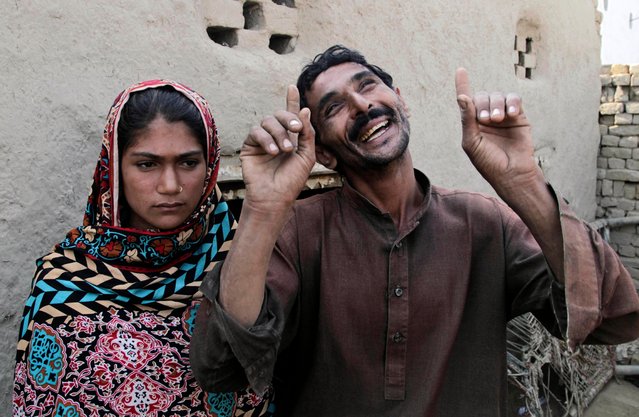
In this Tuesday, December 20, 2016 photo, Mohammad Ramzan, right, reacts while talking to The Associated Press with his young bride Saima in Jampur, Pakistan. Saima was given as a bride to the older man by her father so he could marry the groom’s sister, a practice of exchanging girls that is entrenched in conservative regions of Pakistan. It even has its own name in Urdu: Watta Satta, “give and take”. A mix of interests – family obligations, desire for sons, a wish to hand off a girl to a husband – can lead to a young teen in an a marriage she never sought. (Photo by K.M. Chaudhry/AP Photo)

In this Tuesday, December 20, 2016 photo, Mohammad Ramzan, right, reacts while talking to The Associated Press with his young bride Saima in Jampur, Pakistan. Saima was given as a bride to the older man by her father so he could marry the groom’s sister, a practice of exchanging girls that is entrenched in conservative regions of Pakistan. It even has its own name in Urdu: Watta Satta, “give and take”. A mix of interests – family obligations, desire for sons, a wish to hand off a girl to a husband – can lead to a young teen in an a marriage she never sought. (Photo by K.M. Chaudhry/AP Photo)
Details
31 Dec 2016 10:08:00
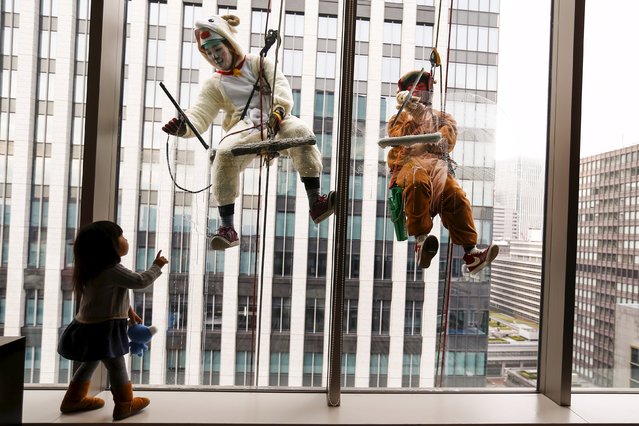
A child looks at window cleaners work while dressed in sheep (C) and monkey costumes, denoting animal signs of the Chinese zodiac calendar, during an event marking the upcoming end of the year at a hotel in Tokyo, Japan, December 21, 2015. According to the zodiac calendar, 2015 is the year of the sheep and 2016 is the year of the monkey. (Photo by Thomas Peter/Reuters)

A child looks at window cleaners work while dressed in sheep (C) and monkey costumes, denoting animal signs of the Chinese zodiac calendar, during an event marking the upcoming end of the year at a hotel in Tokyo, Japan, December 21, 2015. According to the zodiac calendar, 2015 is the year of the sheep and 2016 is the year of the monkey. (Photo by Thomas Peter/Reuters)
Details
22 Dec 2015 14:12:00
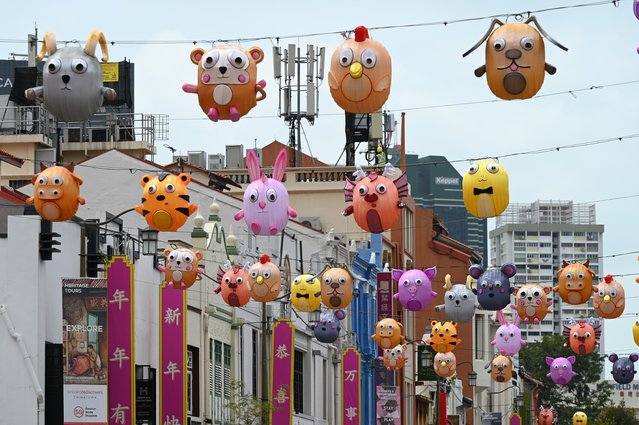
Figurative lanterns for Lunar New Year hang over a road to mark the upcoming Year of the Ox in Singapore on January 19, 2021. (Photo by Roslan Rahman/AFP Photo)

Figurative lanterns for Lunar New Year hang over a road to mark the upcoming Year of the Ox in Singapore on January 19, 2021. (Photo by Roslan Rahman/AFP Photo)
Details
20 Jan 2021 12:33:00
Raining on their New Year's Eve parade. Revellers in Leeds, United Kingdom get ready ready for the new year on December 31, 2022. (Photo by Nb press ltd)

Raining on their New Year's Eve parade. Revellers in Leeds, United Kingdom get ready ready for the new year on December 31, 2022. (Photo by Nb press ltd)
Details
02 Jan 2023 06:30:00
A child marches in the Lunar New Year Parade in the Chinatown neighborhood of Washington, DC, on January 22, 2023. 2023 is the year of the rabbit in the Chinese horoscope. (Photo by Stefani Reynolds/AFP Photo)

A child marches in the Lunar New Year Parade in the Chinatown neighborhood of Washington, DC, on January 22, 2023. 2023 is the year of the rabbit in the Chinese horoscope. (Photo by Stefani Reynolds/AFP Photo)
Details
30 Jan 2023 23:26:00
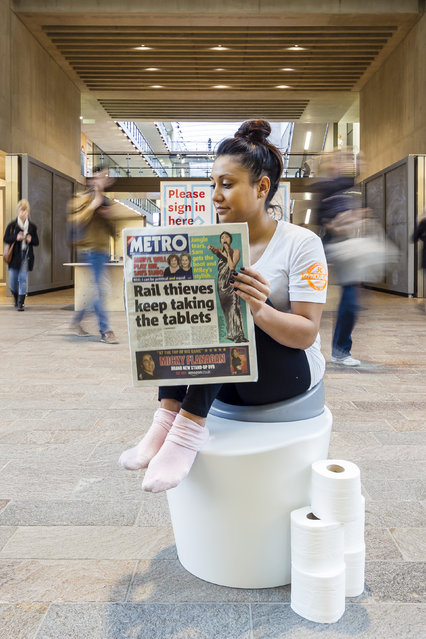
A model poses with “The Wellbeing Toilet” the winning entry from a Dyno-Rod Initiative to create a new design for the domestic toilet at Central Saint Martins on November 18, 2013 in London, England. The concept was commissioned to mark 50 years of Dyno-Rod and World Toilet Day on November 19th, 2013 The “Wellbeing Toilet” looks at the health and wellbeing aspect of getting rid of your bodily waste by being sculpted to enhance the position of your body by enabling you to squat rather than sit. (Photo by Miles Willis/Getty Images for Dyno-Rod)

A model poses with “The Wellbeing Toilet” the winning entry from a Dyno-Rod Initiative to create a new design for the domestic toilet at Central Saint Martins on November 18, 2013 in London, England. The concept was commissioned to mark 50 years of Dyno-Rod and World Toilet Day on November 19th, 2013 The “Wellbeing Toilet” looks at the health and wellbeing aspect of getting rid of your bodily waste by being sculpted to enhance the position of your body by enabling you to squat rather than sit. (Photo by Miles Willis/Getty Images for Dyno-Rod)
Details
20 Nov 2013 07:54:00