Loading...
Done
Artist Leiomy performs at the Sissy Ball in Sydney, Australia on February 24, 2018. The Sissy Ball is a celebration of voguing – a style of modern dance, a form of self-expression, and a powerful movement that has become a representation for the sociopolitical struggles of the LGBTQI+ community. (Photo by Ken Leanfore/Red Bull Music)

Artist Leiomy performs at the Sissy Ball in Sydney, Australia on February 24, 2018. The Sissy Ball is a celebration of voguing – a style of modern dance, a form of self-expression, and a powerful movement that has become a representation for the sociopolitical struggles of the LGBTQI+ community. (Photo by Ken Leanfore/Red Bull Music)
Details
27 Feb 2018 08:30:00
A Virgin Atlantic passenger plane flies in the sky with the moon seen in the background, in London, Britain January 19, 2016. (Photo by Toby Melville/Reuters)

A Virgin Atlantic passenger plane flies in the sky with the moon seen in the background, in London, Britain January 19, 2016. (Photo by Toby Melville/Reuters)
Details
24 May 2016 09:40:00
People look at damaged trees after a tornado hit Funing on Thursday, in Yancheng, Jiangsu province, China June 24, 2016. (Photo by Aly Song/Reuters)

People look at damaged trees after a tornado hit Funing on Thursday, in Yancheng, Jiangsu province, China June 24, 2016. (Photo by Aly Song/Reuters)
Details
25 Jun 2016 11:48:00
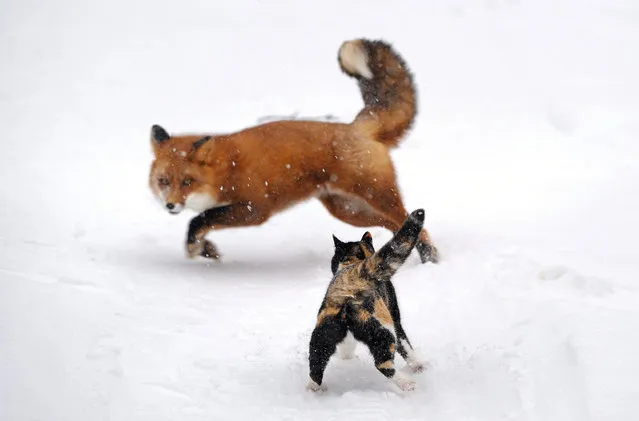
Respect, Kronotsky nature reserve, Russia. The photographer’s cat, Ryska – her name means little lynx in Russian – stands outside their cabin and with aggressive posturing warns off a fox. In winter, foxes would regularly visit the cabin searching for food. If one peered in at the window, possible when the snow was deep, Ryska would sit on the other side, fur raised, and growl. When outside, she would hold her ground. The foxes were not always frightened and so encounters could be a sort of dance. (Photo by Igor Shpilenok/Unforgettable Behaviour/NHM)

Respect, Kronotsky nature reserve, Russia. The photographer’s cat, Ryska – her name means little lynx in Russian – stands outside their cabin and with aggressive posturing warns off a fox. In winter, foxes would regularly visit the cabin searching for food. If one peered in at the window, possible when the snow was deep, Ryska would sit on the other side, fur raised, and growl. When outside, she would hold her ground. The foxes were not always frightened and so encounters could be a sort of dance. (Photo by Igor Shpilenok/Unforgettable Behaviour/NHM)
Details
08 Apr 2017 09:14:00
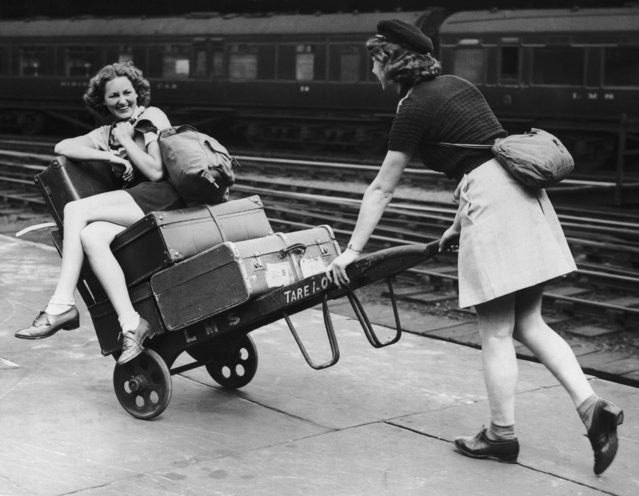
Two holidaymakers amuse themselves with a porter's trolley whilst waiting for their train at Euston Station, London, 5th August 1939. (Photo by A. J. O'Brien/Fox Photos/Getty Images)

Two holidaymakers amuse themselves with a porter's trolley whilst waiting for their train at Euston Station, London, 5th August 1939. (Photo by A. J. O'Brien/Fox Photos/Getty Images)
Details
17 Apr 2017 07:48:00
Racegoers in fashionable hats attend Ladies Day at Cheltenham Festival on March 15, 2017 in Cheltenham, England. (Photo by David Davies/PA Wire)

Racegoers in fashionable hats attend Ladies Day at Cheltenham Festival on March 15, 2017 in Cheltenham, England. (Photo by David Davies/PA Wire)
Details
21 Apr 2017 07:45:00
A child dressed as a Roman centurion poses during a parade to mark the anniversary of the foundation of Rome in 753 BC, on April 23, 2017 in Rome. (Photo by Alberto Pizzoli/AFP Photo)

A child dressed as a Roman centurion poses during a parade to mark the anniversary of the foundation of Rome in 753 BC, on April 23, 2017 in Rome. (Photo by Alberto Pizzoli/AFP Photo)
Details
24 Apr 2017 09:19:00
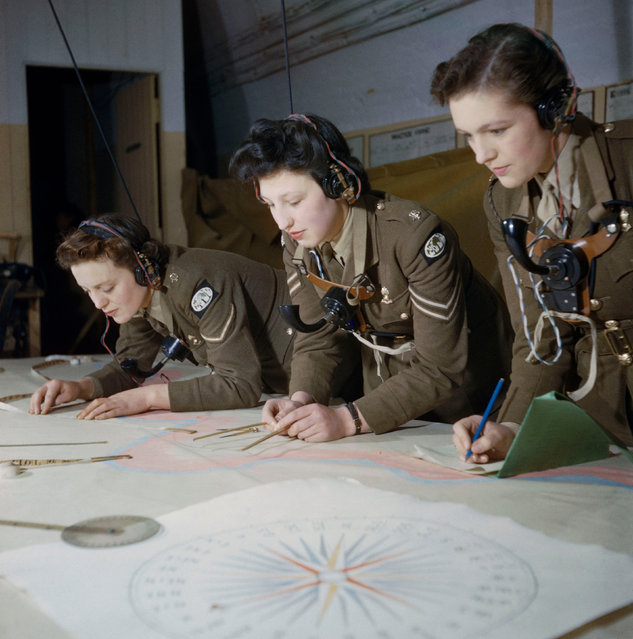
Auxiliary Territorial Service (ATS) plotters at work at Coastal Artillery Headquarters in Dover, December 1942. (Photo by Ted Dearberg/IWM/PA Wire)

Auxiliary Territorial Service (ATS) plotters at work at Coastal Artillery Headquarters in Dover, December 1942. The Auxiliary Territorial Service was the women's branch of the British Army during the Second World War. It was formed on 9 September 1938, initially as a women's voluntary service, and existed until 1 February 1949, when it was merged into the Women's Royal Army Corps. The ATS had its roots in the Women's Auxiliary Army Corps (WAAC), which was formed in 1917 as a voluntary service. During the First World War its members served in a number of jobs including clerks, cooks, telephonists and waitresses. The WAAC was disbanded after four years in 1921. (Photo by Ted Dearberg/IWM/PA Wire)
Details
13 Jul 2017 07:52:00