Paris Jackson, left, and Caroline D'Amore kiss in the press room at the MTV Video Music Awards at The Forum on Sunday, August 27, 2017, in Inglewood, Calif. (Photo by Jordan Strauss/Invision/AP Photo)
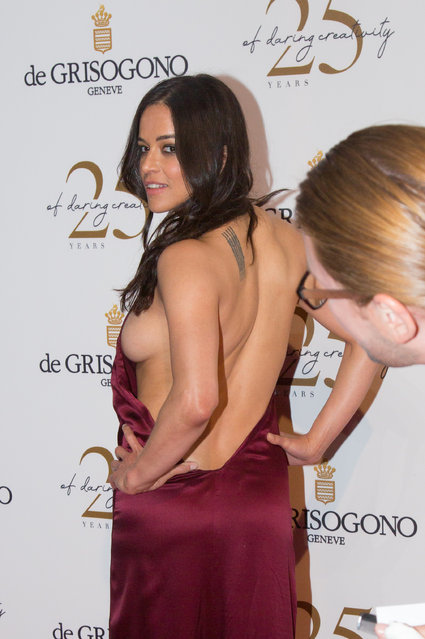
Michelle Rodriguez attends the De Grisogono Party during the 71st annual Cannes Film Festival at on May 15, 2018 in Antibes, France. (Photo by INSTARimages.com)
Disguised revellers parade on the occasion of the Cortege during the Carnival in Basel, Switzerland, February 17, 2016. (Photo by Georgios Kefalas/EPA)
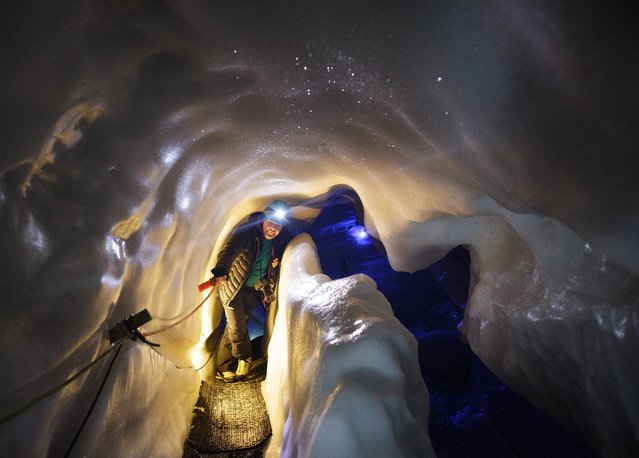
A tourist walks inside the Ice Palace glacier hollow at Hintertux glacier, located at around 3250 meters above sea level, in Zillertal, Austria, 02 March, 2016. The hollow's temperature remains constant at 0 degrees Celsius, in summer and winter alike, and is also used by the University of Innsbruck for scientific research projects. (Photo by Lisi Niesner/EPA)
A masked reveller parades through the streets on the first day of the carnival season in Lucerne, Switzerland, 12 February 2015. In the background the well known Kappellbruecke bridge. (Photo by Alexandra Wey/EPA)
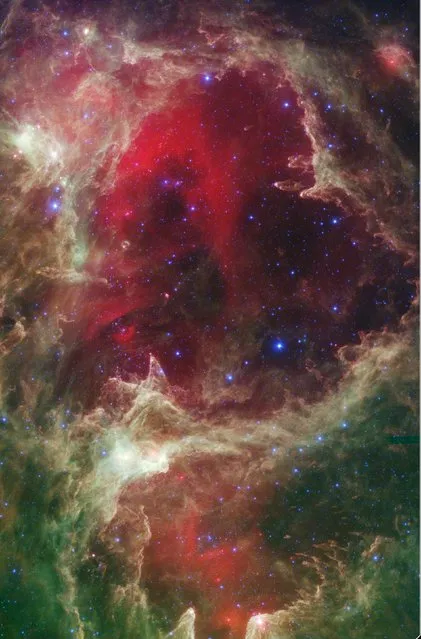
An infrared portrait from NASA's Spitzer Space Telescope which shows generations of stars is seen in this undated NASA handout image released February 14, 2013. In this wispy star-forming region, called W5, the oldest stars can be seen as blue dots in the centers of the two hollow cavities (other blue dots are background and foreground stars not associated with the region). Red shows heated dust that pervades the region's cavities, while green highlights dense clouds. (Photo by NASA/Reuters/JPL-Caltech/Harvard-Smithsonian/Handout)
Grumpy Cat attends the “Grumpy Cat: A Grumpy Book” Book Event at Bookends Bookstore on October 16, 2013 in Ridgewood, New Jersey. (Photo by Michael N. Todaro/WireImage)
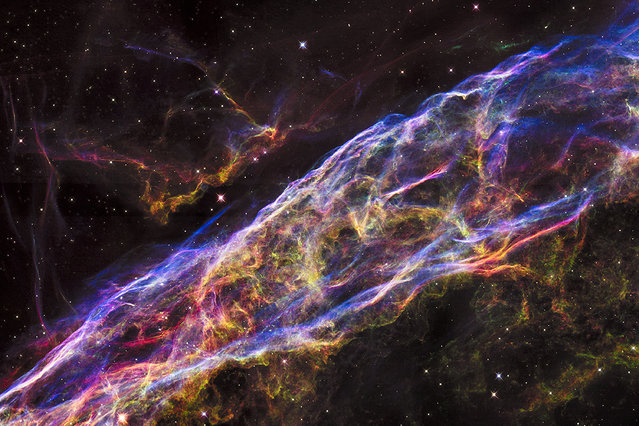
A small section of the expanding remains of the Veil Nebula, a massive star that exploded about 8,000 years ago. The entire nebula is 110 light-years across, covering six full moons on the sky as seen from Earth, and resides about 2,100 light-years away in the constellation Cygnus, the Swan. Image taken by NASA's Hubble Space Telescope. Released September 24, 2015. (Photo by Reuters/NASA/ESA/Hubble Heritage Team)