Loading...
Done
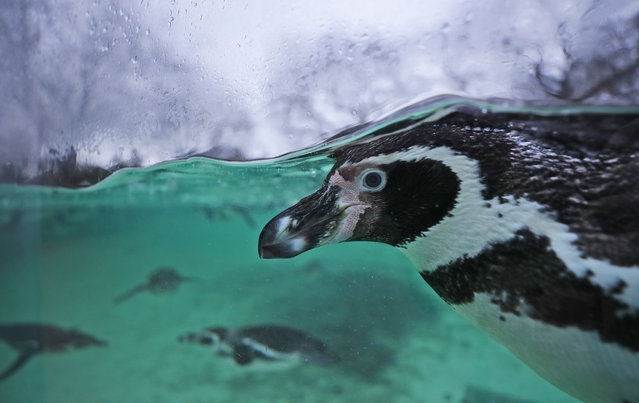
A Humboldt penguin swims in a pool during the annual stock take at ZSL London Zoo in London, Thursday, January 2, 2020. Caring for more than 500 different species, ZSL London Zoo's keepers face the challenging task of tallying up every animal large and small, every mammal, bird, reptile, fish and invertebrate at the Zoo. (Photo by Frank Augstein/AP Photo)

A Humboldt penguin swims in a pool during the annual stock take at ZSL London Zoo in London, Thursday, January 2, 2020. Caring for more than 500 different species, ZSL London Zoo's keepers face the challenging task of tallying up every animal large and small, every mammal, bird, reptile, fish and invertebrate at the Zoo. (Photo by Frank Augstein/AP Photo)
Details
05 Jan 2020 00:03:00
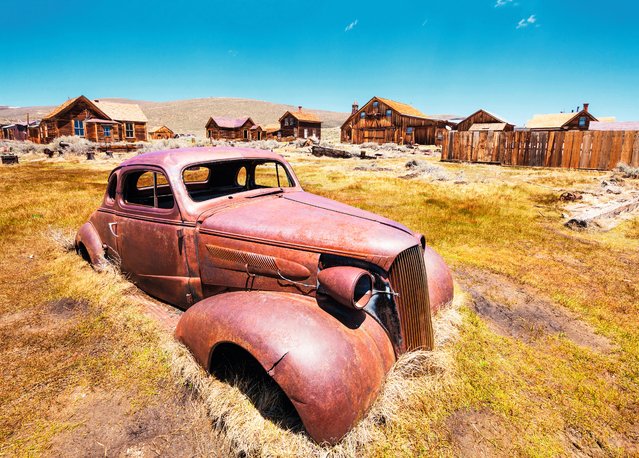
Bodie, Mono County, California. Gold was discovered at Bodie in 1859 (just after the initial California gold rush) and it went from mining camp to boomtown. Its decline began in 1880, when word spread of new boomtowns elsewhere. The Standard Consolidated Mine closed in 1913, and four years later the Bodie Railway was abandoned. By 1940 the population was down to 40. Today, Bodie is maintained in a state of arrested decay as a visitor attraction. (Photo by Alamy Stock Photo)

Kieron Connolly’s new book of photographs of more than 100 once-busy and often elegant buildings gives an idea of how the world might look if humankind disappeared. Here: Bodie, Mono County, California. Gold was discovered at Bodie in 1859 (just after the initial California gold rush) and it went from mining camp to boomtown. Its decline began in 1880, when word spread of new boomtowns elsewhere. The Standard Consolidated Mine closed in 1913, and four years later the Bodie Railway was abandoned. By 1940 the population was down to 40. Today, Bodie is maintained in a state of arrested decay as a visitor attraction. (Photo by Alamy Stock Photo)
Details
07 Sep 2016 09:50:00
The maned wolf is among the large mammals in the Brazilian Cerrado that are threatened by the increasing conversion of grasslands into farmland for grazing and growing crops. (Photo by Ben Cranke/Nature Picture Library/Alamy Stock Photo)

Global wildlife populations will decline by 67% by 2020 unless urgent action is taken to reduce human impact on species and ecosystems, warns the biennial Living Planet Index report from WWF (World Wide Fund for Nature) and ZSL (Zoological Society of London). From elephants to eels, here are some of the wildlife populations most affected by human activity. Here: The maned wolf is among the large mammals in the Brazilian Cerrado that are threatened by the increasing conversion of grasslands into farmland for grazing and growing crops. (Photo by Ben Cranke/Nature Picture Library/Alamy Stock Photo)
Details
28 Oct 2016 10:47:00
In this Thursday, November 1, 2018, photo, a girl uses a hammer to crack open shells for edible seeds to sell as snacks in Yangon, Myanmar. A United Nations report says some 486 million people are malnourished in Asia and the Pacific, and progress in alleviating hunger is stalling. (Photo by Thein Zaw/AP Photo)

In this Thursday, November 1, 2018, photo, a girl uses a hammer to crack open shells for edible seeds to sell as snacks in Yangon, Myanmar. A United Nations report says some 486 million people are malnourished in Asia and the Pacific, and progress in alleviating hunger is stalling. (Photo by Thein Zaw/AP Photo)
Details
20 Jul 2019 00:01:00
Tour guides wearing traditional Chinese dress practice smiling by biting chopsticks at Qingming Grand-River Park in Kaifeng, central China's Henan Province on March 2, 2017, aiming to provide better service for visitors. (Photo by IPA Asia via ZUMA Wire)

Tour guides wearing traditional Chinese dress practice smiling by biting chopsticks at Qingming Grand-River Park in Kaifeng, central China's Henan Province on March 2, 2017, aiming to provide better service for visitors. (Photo by IPA Asia via ZUMA Wire)
Details
03 Mar 2017 11:03:00
Stork-billed kingfisher during rain in Bintan, Indonesia. The tree species is sparsely distributed in the tropical Indian subcontinent and south-east Asia, from India to Indonesia. (Photo by Sijori Images/Barcroft Images)

A stork-billed kingfisher (Pelargopsis capensis) is seen perched on a tree during monsoon rain on July 25, 2016 in Bintan, Indonesia. The stork-billed kingfisher is a tree species which is widely but sparsely distributed in the tropical Indian subcontinent and Southeast Asia, from India to Indonesia. This kingfisher is resident throughout its range. It is very large, measuring 35 to 38 cm (14 to 15 in) in length. The adult has a green back, blue wings and tail, and grey head. (Photo by Sijori Images/Barcroft Images)
Details
27 May 2017 07:47:00
Sepak Takraw, ISTAF Super Series Finals Thailand 2014/2015, Nakhon Pathom Municipal Gymnasium, Huyjorake Maung, Nakonprathom, Thailand on October 20, 2015: Thailand's Sudaporn Palang in action during the group stage. (Photo by Asia Sports Ventures/Action Images via Reuters)

Sepak Takraw, ISTAF Super Series Finals Thailand 2014/2015, Nakhon Pathom Municipal Gymnasium, Huyjorake Maung, Nakonprathom, Thailand on October 20, 2015: Thailand's Sudaporn Palang in action during the group stage. (Photo by Asia Sports Ventures/Action Images via Reuters)
Details
23 Oct 2015 08:05:00
Pallas' s cat kittens with theit mother in an enclosure at the Novosibirsk Zoo, Novosibirsk, Russia on July 11, 2018. Pallas' s cat, also known as manul, is a small wild cat native to montane steppes of the Central Asia and listed as an endangered species. (Photo by Kirill Kukhmar/TASS)

Pallas' s cat kittens with theit mother in an enclosure at the Novosibirsk Zoo, Novosibirsk, Russia on July 11, 2018. Pallas' s cat, also known as manul, is a small wild cat native to montane steppes of the Central Asia and listed as an endangered species. (Photo by Kirill Kukhmar/TASS)
Details
15 Jul 2018 00:03:00