Loading...
Done
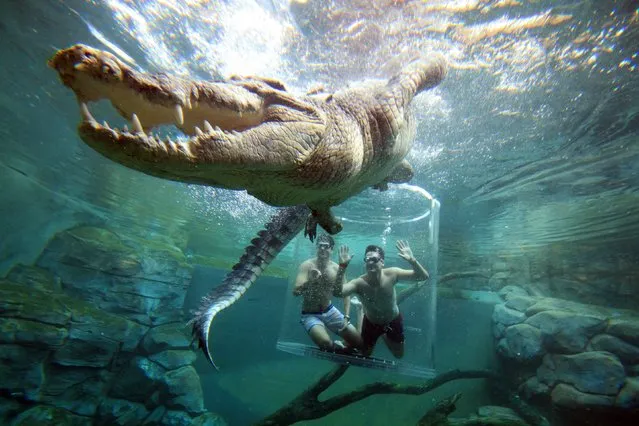
The Cage of Death at Crocosaurus Cove in Darwin City, Australia. The Cage of Death starts out above the water where the two tourists in it can see the huge crocodile below before the cage is lowered into the pen. The tourists are then inches from the 16-foot-long Saltwater crocodile as it greedily snaps its jaws over meaty treats that are being dangled right in front of the cage. (Photo by Crocosaurus Cove/Media Drum World/Profimedia)

The Cage of Death at Crocosaurus Cove in Darwin City, Australia. The Cage of Death starts out above the water where the two tourists in it can see the huge crocodile below before the cage is lowered into the pen. The tourists are then inches from the 16-foot-long Saltwater crocodile as it greedily snaps its jaws over meaty treats that are being dangled right in front of the cage. (Photo by Crocosaurus Cove/Media Drum World/Profimedia)
Details
20 Nov 2022 06:06:00
A member of the “Exit Point” amateur rope-jumping group jumps from a 44-metre high (144-feet high) waterpipe bridge in the Siberian Taiga area outside Krasnoyarsk, September 28, 2014. (Photo by Ilya Naymushin/Reuters)

A member of the “Exit Point” amateur rope-jumping group jumps from a 44-metre high (144-feet high) waterpipe bridge in the Siberian Taiga area outside Krasnoyarsk, September 28, 2014. Fans of rope-jumping, a kind of extreme sport involving a jump from a high point using an advanced system of amortization including mountaineering and rope safety equipment, attended the Golden Autumn group's jumping season. (Photo by Ilya Naymushin/Reuters)
Details
04 Oct 2014 11:12:00
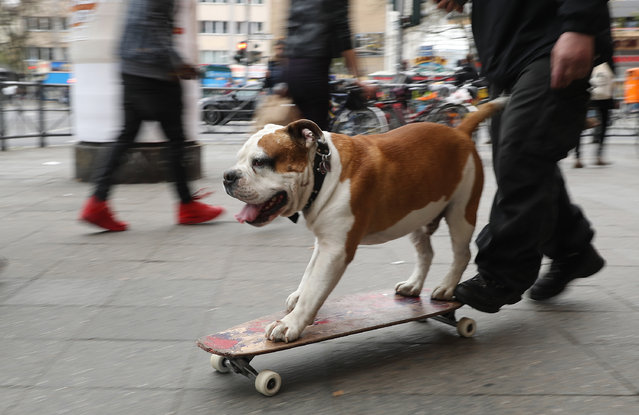
A dog, at the behest of his owner, rides a skatebaord on April 3, 2017 in Berlin, Germany. The dog's owner, who looked like he might be homeless, coaxed the dog to ride the skatebaord and asked passersby who stopped to watch for money. (Photo by Sean Gallup/Getty Images)

A dog, at the behest of his owner, rides a skatebaord on April 3, 2017 in Berlin, Germany. The dog's owner, who looked like he might be homeless, coaxed the dog to ride the skatebaord and asked passersby who stopped to watch for money. (Photo by Sean Gallup/Getty Images)
Details
04 Apr 2017 10:06:00
Travellers wait in queue to test for COVID-19 at a train station in Mumbai, India, Tuesday, November 30, 2021. (Photo by Rafiq Maqbool/AP Photo)

Travellers wait in queue to test for COVID-19 at a train station in Mumbai, India, Tuesday, November 30, 2021. (Photo by Rafiq Maqbool/AP Photo)
Details
02 Dec 2021 09:43:00
Cheng Chen (R), a 27-year-old worker at a state-owned enterprise, poses for a photograph with his nephew who is wearing his home-made Iron Man armour, in Xuzhou, Jiangsu province April 13, 2015. (Photo by Reuters/Stringer)

Cheng Chen (R), a 27-year-old worker at a state-owned enterprise, poses for a photograph with his nephew who is wearing his home-made Iron Man armour, in Xuzhou, Jiangsu province April 13, 2015. It cost Cheng about 500 yuan ($81 USD) to make the armour, which weighs about 4 kilograms, with plastic boards and LED lights, local media reported. (Photo by Reuters/Stringer)
Details
18 Apr 2015 10:12:00
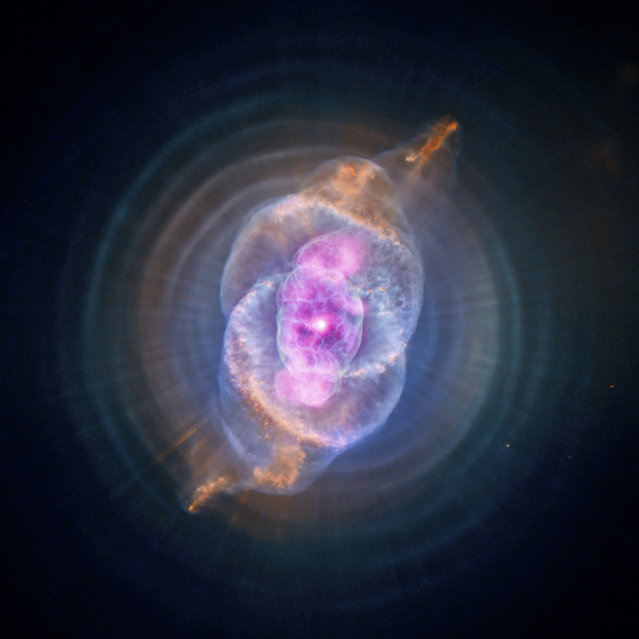
This image is NGC 6543 known as the Cat's Eye Nebula as it appears to the Chandra X-Ray Observatory and Hubble Telescope. A planetary nebula is a phase of stellar evolution that the sun should experience several billion years from now, when it expands to become a red giant and then sheds most of its outer layers, leaving behind a hot core that contracts to form a dense white dwarf star. This image was released October 10, 2012. (Photo by J. Kastner/NASA/CXC/RIT)

This image is NGC 6543 known as the Cat's Eye Nebula as it appears to the Chandra X-Ray Observatory and Hubble Telescope. A planetary nebula is a phase of stellar evolution that the sun should experience several billion years from now, when it expands to become a red giant and then sheds most of its outer layers, leaving behind a hot core that contracts to form a dense white dwarf star. This image was released October 10, 2012. (Photo by J. Kastner/NASA/CXC/RIT)
Details
15 Apr 2013 10:09:00
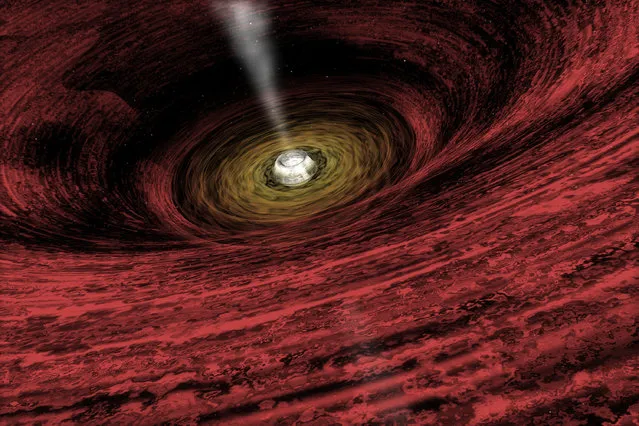
An artist's impression of a growing supermassive black hole located in the early Universe is seen in this NASA handout illustration released on June 15, 2011. Using the deepest X-ray image ever taken, astronomers found the first direct evidence that massive black holes were common in the early universe. This discovery from NASA's Chandra X-Ray Observatory shows that very young black holes grew more aggressively than previously thought, in tandem with the growth of their host galaxies. (Photo by Reuters/NASA/Chandra X-Ray Observatory/A.Hobart)

An artist's impression of a growing supermassive black hole located in the early Universe is seen in this NASA handout illustration released on June 15, 2011. Using the deepest X-ray image ever taken, astronomers found the first direct evidence that massive black holes were common in the early universe. This discovery from NASA's Chandra X-Ray Observatory shows that very young black holes grew more aggressively than previously thought, in tandem with the growth of their host galaxies. (Photo by Reuters/NASA/Chandra X-Ray Observatory/A.Hobart)
Details
11 Feb 2016 12:57:00
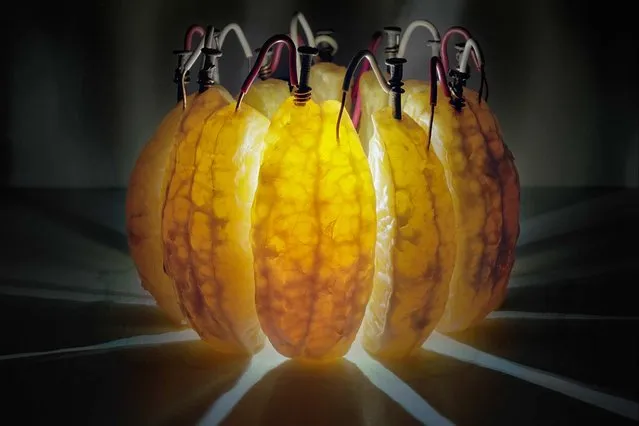
Wedges of an orange generate enough current and electrical juice – 3.5 volts – to power an LED. The fruit’s citric acid helps electrons flow from galvanized nails to copper wire in this 14-hour exposure. This image was published in September’s Visions of Earth, a trio of photos that appear in each issue of National Geographic. (Photo by Caleb Charland/National Geographic)

Wedges of an orange generate enough current and electrical juice – 3.5 volts – to power an LED. The fruit’s citric acid helps electrons flow from galvanized nails to copper wire in this 14-hour exposure. This image was published in September’s Visions of Earth, a trio of photos that appear in each issue of National Geographic. (Photo by Caleb Charland/National Geographic)
Details
06 Jan 2014 12:09:00