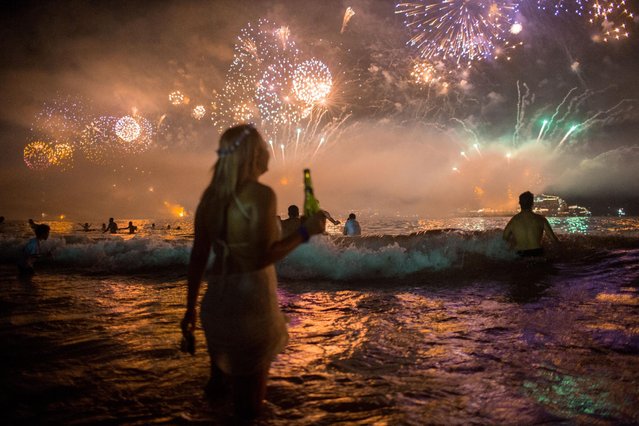
Fireworks light the sky over Copacabana beach during New Year's Eve celebrations in Rio de Janeiro, Brazil, Thursday, January 1, 2016. (Photo by Mauro Pimentel/AP Photo)
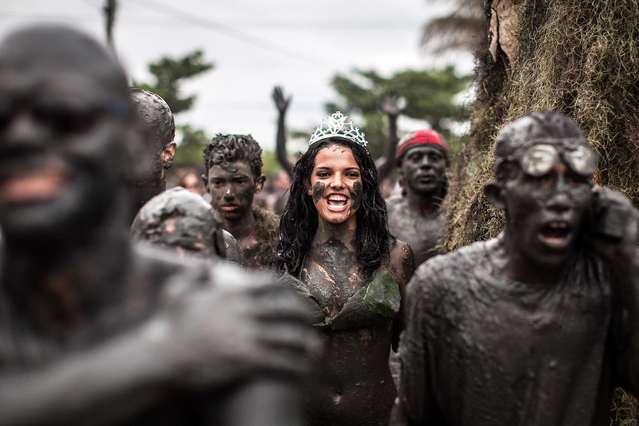
Revelers participate in the traditional Bloco da Lama (Mud block) carnival in Parati, Rio de Janeiro State, Brazil, on February 9, 2013. The event, which was begun by two men in a playful manner in 1986, has now become a traditional carnival in which participants disguised as primitives with rags, lianas or skulls and bones, dive in the mud. (Photo by Victor Moriyama/AFP Photo)
Ghanaian fans take a selfie prior to a Group G football match between Germany and Ghana at the Castelao Stadium in Fortaleza during the 2014 FIFA World Cup on June 21, 2014. (Photo by Patrik Stollarz/AFP Photo)
A member of the samba school of the Grupo Especial Academicos do Grande Rio parade during the Carnival celebration at the Marques de Sapucai sambadrome in Rio de Janeiro, Brazil, early 04 March 2019. The samba schools of the Rio de Janeiro Special Groups began their parades on 03 March at the sambadrome, considered the main attraction of the carnival in Brazil. (Photo by Marcelo Chello/EPA/EFE)
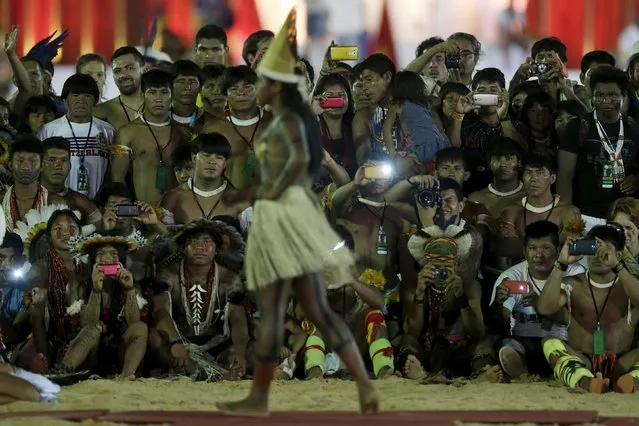
An indigenous woman participates in a parade called "International Indigenous Beauty" during the first World Games for Indigenous Peoples in Palmas, Brazil, October 24, 2015. Billed as the indigenous Olympics, the games are expected to attract nearly 2,000 athletes from dozens of Brazilian ethnicities, as well as from such far-flung nations as Ethiopia and New Zealand. (Photo by Ueslei Marcelino/Reuters)
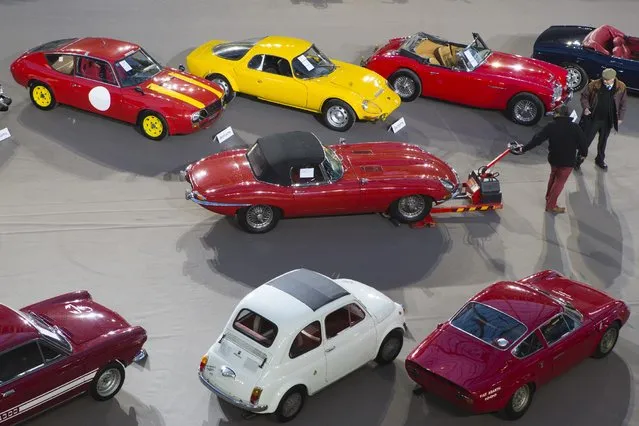
Visitors walk past vintage and classic cars displayed by Bonhams auction house, during an exhibition, at the Grand Palais in Paris, Wednesday, February 4, 2015. The Grand Palais is staging an exhibition of vintage cars, to be followed by a sale of historic cars by Bonhams auction house on Thursday. (Photo by Jacques Brinon/AP Photo)
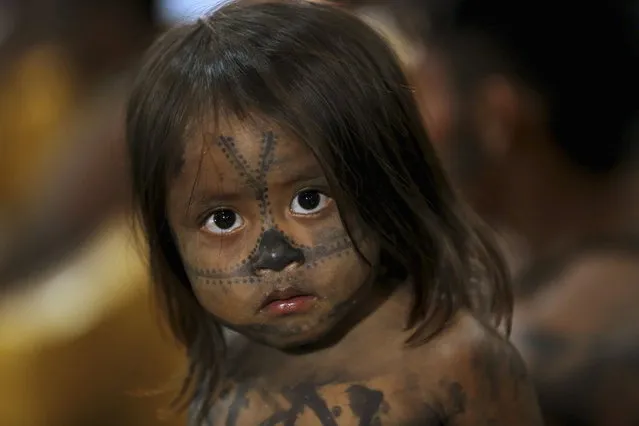
A Munduruku Indian child is pictured at the Planalto Palace, where a meeting with Minister of the General Secretariat of the Presidency of Brazil Gilberto Carvalho was being held with other Munduruku Indians, in Brasilia, June 4, 2013. President Dilma Rousseff's government sought on Tuesday to defuse mounting conflicts with indigenous groups over its decision to stop setting aside farm land for Indians and plans to build more hydroelectric dams in the Amazon. The government flew 144 Munduruku Indians to Brasilia for talks to end a week-long occupation of the controversial Belo Monte dam on the Xingu river, a huge project aimed at feeding Brazil's fast-growing demand for electricity. (Photo by Ueslei Marcelino/Reuters)