Loading...
Done
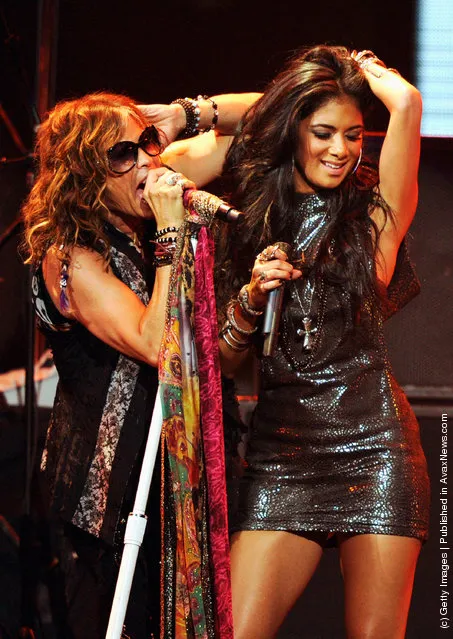
iHeartRadio Music Festival, Steven Tyler, Nicole Scherzinger

Singers Steven Tyler (L) and Nicole Scherzinger perform onstage at the iHeartRadio Music Festival held at the MGM Grand Garden Arena on September 24, 2011 in Las Vegas, Nevada. (Photo by Ethan Miller/Getty Images for Clear Channel)
Details
25 Sep 2011 11:20:00
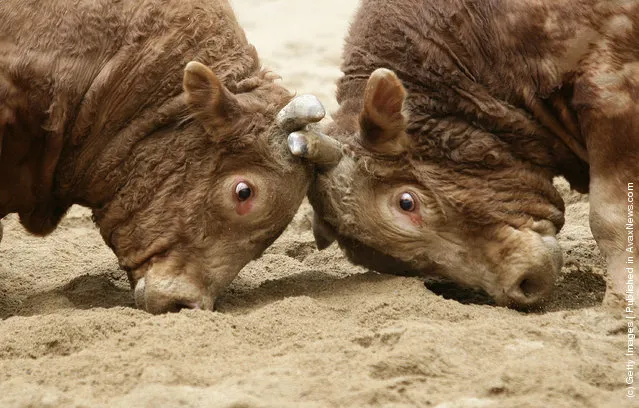
Cheongdo Bullfighting Festival

Bulls fight during the annual Bullfighting Festival on March 17, 2010 in Cheongdo, South Korea. More than 130 bulls from South Korea and abroad charge and lock horns in the annual festival which was run March 21, 2010. The bulls are grouped into three weight categories and fight head on until one of the bulls turns its head and runs away. (Photo by Chung Sung-Jun/Getty Images)
Details
21 Dec 2011 13:10:00
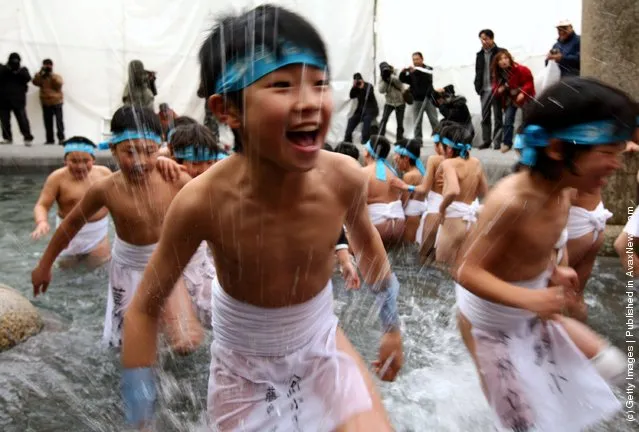
Japanese children wear loincloths as they splash about in freezing cold water during Saidaiji Naked Festival, at Saidaiji Temple

“A Hadaka Matsuri (“Naked Festival”) is a type of Japanese festival, or matsuri, in which participants wear a minimum amount of clothing; usually just a Japanese loincloth (called fundoshi), sometimes with a short happi coat, and rarely completely naked. Whatever the clothing, it is considered to be above vulgar, or everyday, undergarments, and on the level of holy Japanese shrine attire. Naked festivals are held in dozens of places throughout Japan every year, usually in the summer or winter. The most famous festival is held in Okayama, where the festival originated. Every year, over 9,000 men participate in this festival”. – Wikipedia

Photo: Japanese men wear loincloths as they splash about in freezing cold water during Saidaiji Naked Festival, at Saidaiji Temple on February 18, 2012 in Okayama, Japan. (Photo by Buddhika Weerasinghe/Getty Images)

Details
19 Feb 2012 12:18:00
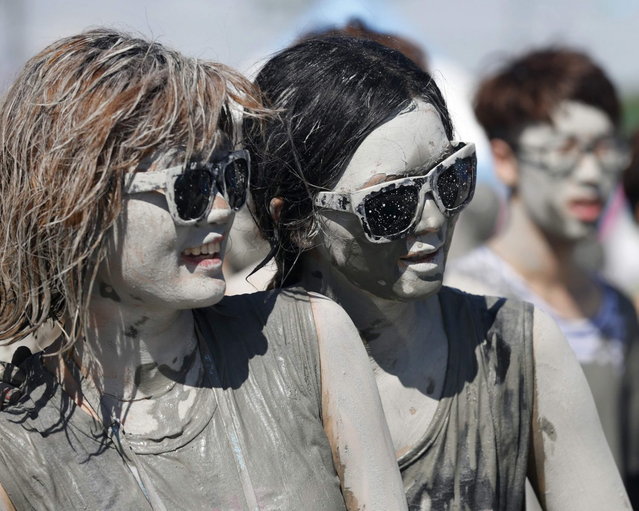
Tourists look at other festival-goers playing in the mud during the Boryeong Mud Festival at Daecheon beach in Boryeong, about 190 km (118 miles) southwest of Seoul, July 19, 2013. About 2 to 3 million domestic and international tourists visit the beach during the annual mud festival, according to the festival organisers. (Photo by Lee Jae-Won/Reuters)

Tourists look at other festival-goers playing in the mud during the Boryeong Mud Festival at Daecheon beach in Boryeong, about 190 km (118 miles) southwest of Seoul, July 19, 2013. About 2 to 3 million domestic and international tourists visit the beach during the annual mud festival, according to the festival organisers. (Photo by Lee Jae-Won/Reuters)
Details
21 Jul 2013 10:57:00
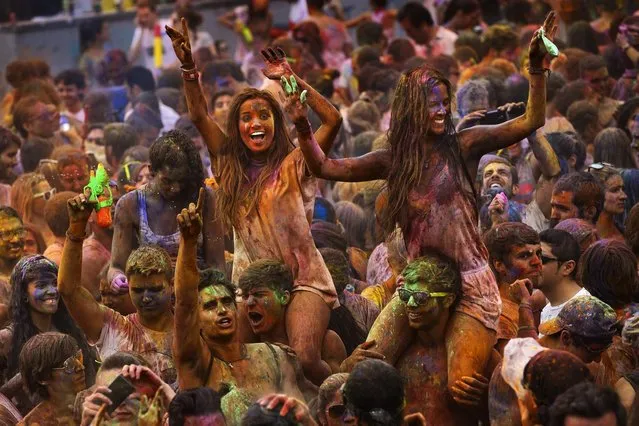
Revelers of the Holi Festival of Colors dance after throwing colored powders in the air in Madrid, Spain, Saturday, August 9, 2014. The festival is fashioned after the Hindu spring festival Holi, which is mainly celebrated in the north and east areas of India. (Photo by Daniel Ochoa de Olza/AP Photo)

Revelers of the Holi Festival of Colors dance after throwing colored powders in the air in Madrid, Spain, Saturday, August 9, 2014. The festival is fashioned after the Hindu spring festival Holi, which is mainly celebrated in the north and east areas of India. (Photo by Daniel Ochoa de Olza/AP Photo)
Details
11 Aug 2014 11:35:00
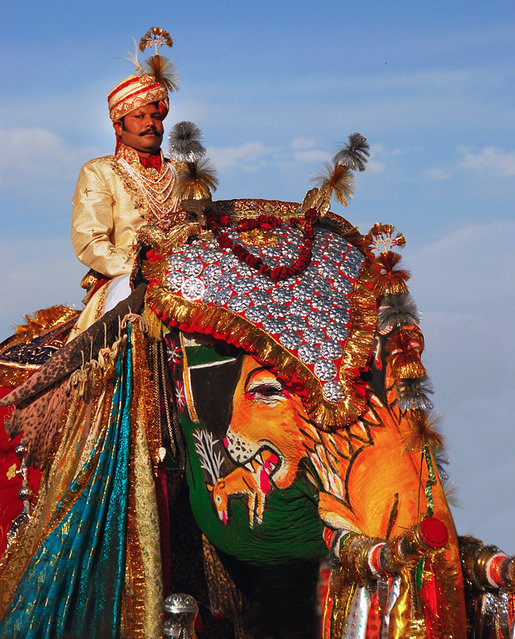
Elephant

Elephant Festival is a festival celebrated in Jaipur city in Rajasthan state in India. It is held on the day of Holi festival, usually in the month of March.The festival features Elephant polo and Elephant Dance. The Elephant Festival begins with a beautiful procession of bedecked elephants, camels, horses and folk dancers. The owners proudly embellish their elephants with vibrant colors, jhools (saddle cloth) and heavy jewellery. It is quite a treat to see female elephants wearing anklets, which tinkle as they walk. One can see people sprinkling 'gulaal' (colored powder) perched on top of the elephant. The most beautifully decorated elephant is awarded. Elephant polo, Elephant race, the tug-of-war between Elephant and 19 men and women are the featured events of the festival.
Details
30 Apr 2015 16:55:00
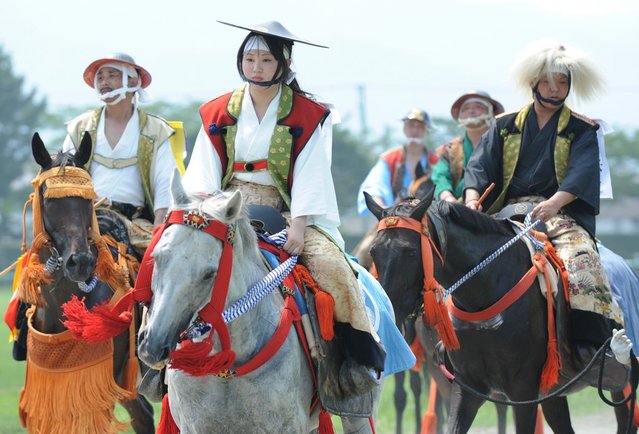
A young woman (C) clad in samurai costume leads other local poeple as she rides her horse during a parade at the annual Soma Nomaoi festival in Minamisoma, Fukushima Prefecture, on July 28, 2012.  The traditional full-scale festival kicked off for the first time after the accident of the Fukushima Dai-ichi Nuclear Power Plant following the massive earthquake and the tsunami on March 11, 2011. (Photo by Toru Yamanaka/AFP Photo)

Soma-Nomaoi is a festival that recreates a battle scene from more than 1,000 years ago. It is annually held for 4 days from July 22 to 25 in Haramachi City, Fukushima Prefecture, in the eastern part of Japan. In this historical event, 600 mounted samurai in traditional Japanese armor, with long swords at their side and ancestral flagstaffs streaming from their backs, ride across open fields. Soma-Nomaoi has been designated an Important Intangible Folk Cultural Property.

Photo: A young woman (C) clad in samurai costume leads other local poeple as she rides her horse during a parade at the annual Soma Nomaoi festival in Minamisoma, Fukushima Prefecture, on July 28, 2012. The traditional full-scale festival kicked off for the first time after the accident of the Fukushima Dai-ichi Nuclear Power Plant following the massive earthquake and the tsunami on March 11, 2011. (Photo by Toru Yamanaka/AFP Photo)
Details
02 Aug 2012 12:59:00
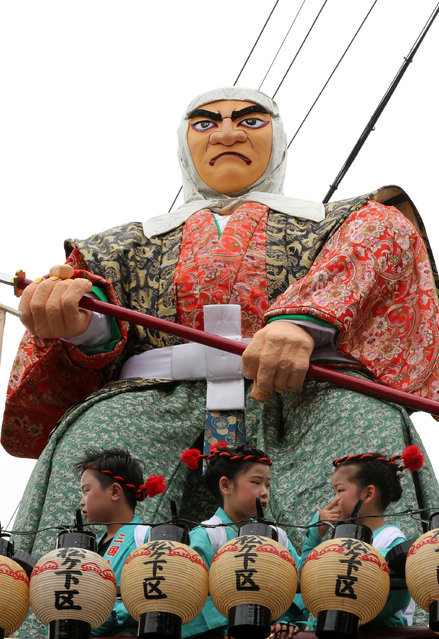
Children dressed in festival costume sit on the huge paper doll of historical Japanese figure named Hashi-Benkeii on the carts during the Mikuini annual festival on May 20, 2014 in Sakai, Japan. The annual festival takes place from May 19-21 and is attended by thousands of visitors. During the festival people dressed in traditional Japanese costumes pull carts carrying 6 meter high dolls of Japanese historical figures through the narrow streets. The origins of the festival are unclear but its history can be traced back more than 250 years. (Photo by Buddhika Weerasinghe/Getty Images)
Children dressed in festival costume sit on the huge paper doll of historical Japanese figure named Hashi-Benkeii on the carts during the Mikuini annual festival on May 20, 2014 in Sakai, Japan. The annual festival takes place from May 19-21 and is attended by thousands of visitors. During the festival people dressed in traditional Japanese costumes pull carts carrying 6 meter high dolls of Japanese historical figures through the narrow streets. The origins of the festival are unclear but its history can be traced back more than 250 years. (Photo by Buddhika Weerasinghe/Getty Images)
Details
21 May 2014 08:49:00