Loading...
Done
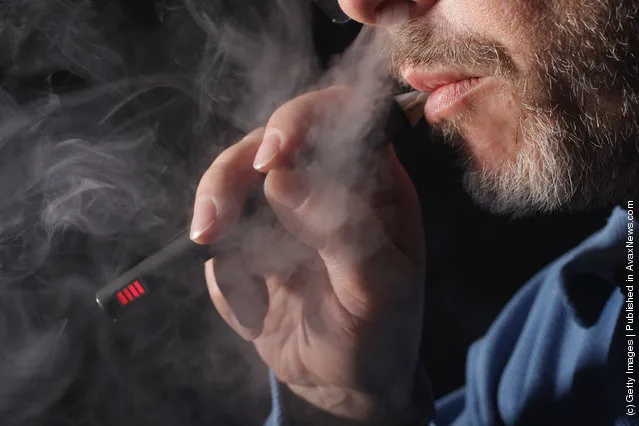
Owner of a shop that sells electronic cigarettes demonstrates how to use one

“An electronic cigarette, or e-cigarette, is an electrical device that simulates the act of tobacco smoking by producing an inhaled mist bearing the physical sensation, appearance, and often the flavor and nicotine content of inhaled tobacco smoke; though without its odor, and intended to omit its health risks. The device uses heat (or in some cases, ultrasonics) to vaporize a propylene glycol- or glycerin-based liquid solution into an aerosol mist, similar to the way a nebulizer or humidifier vaporizes solutions for inhalation”. – Wikipedia

Photo: Owner of a shop that sells electronic cigarettes demonstrates how to use one on March 1, 2012 in Berlin, Germany. The German government has announced that it classifies the liquids used in electronic cigarettes as pharmaceuticals because the liquids contain nicotine, and that sale of the liquids requires certification. (Photo Illustration by Sean Gallup/Getty Images)
Details
03 Mar 2012 10:01:00
Evan Leversage, who is terminally ill with brain cancer, is greeted by a Christmas decorated dog with his mother Nicole Wellwood (L), and his father Travis Leversage (2nd R) in St. George, Ontario, Canada October 24, 2015. (Photo by Mark Blinch/Reuters)

Evan Leversage, who is terminally ill with brain cancer, is greeted by a Christmas decorated dog with his mother Nicole Wellwood (L), and his father Travis Leversage (2nd R) in St. George, Ontario, Canada October 24, 2015. Evan Leversage is a seven-year-old boy who has been living with inoperable brain cancer since he was two years old. His family has organized a Christmas celebration in October complete with a full parade, in case Evan does not live to celebrate his last Christmas day on the traditional date of December 25, according to local media. (Photo by Mark Blinch/Reuters)
Details
28 Oct 2015 08:03:00
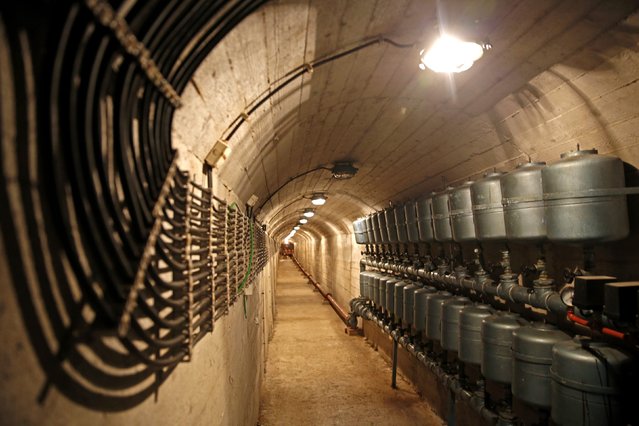
A tunnel with electric switches are seen in Josip Broz Tito's underground secret bunker (ARK) in Konjic, October 16, 2014. (Photo by Dado Ruvic/Reuters)

A tunnel with electric switches are seen in Josip Broz Tito's underground secret bunker (ARK) in Konjic, October 16, 2014. In the early 1950s, Josip Broz Tito, the late leader of the former Yugoslavia, ordered the building of the secret bunker, located 900 feet (270 m) underground and near the Bosnian town of Konjic, to safeguard the country's ruling class in case of a nuclear attack. Construction at the complex, which had a cost equivalent price tag of $4.6 billion, continued until 1979, the year before Tito died. (Photo by Dado Ruvic/Reuters)
Details
28 Nov 2014 12:14:00
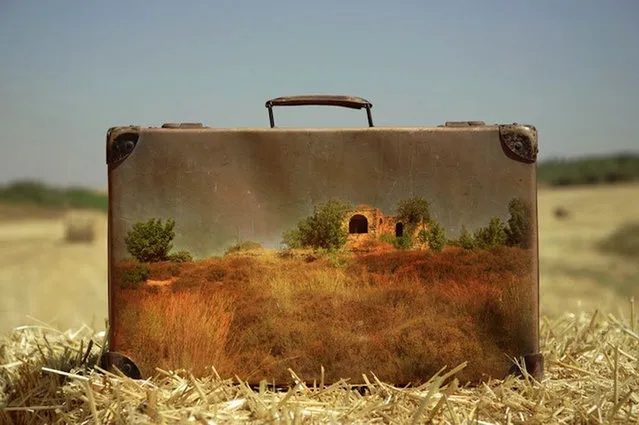
Memory Suitcase By Yuval Yairi

Memory Suitcases is a thought-provoking series by Israeli artist Yuval Yairi that uses old, worn suitcases as canvases for nostalgic landscapes. Like scenes out of one's memory, the propped up traveling cases feature a range of sepia-toned settings. The series presents the objects as though they are relics of a civilization from yesteryear, each with their own story to tell.
There's something both heartbreaking and sentimental about the images. It appears to tell a number of stories of leaving one lifestyle for another. The suitcases hold within them a picture show of memories from a life-altering journey. Like a number of his other works, Memory Suitcases "mimics the natural process of memory."
Details
22 Nov 2013 12:55:00
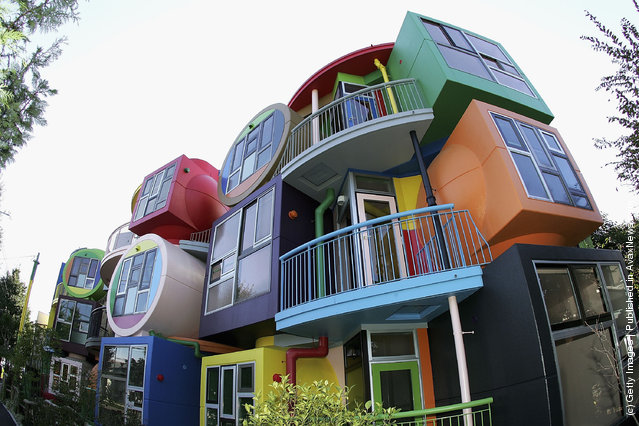
Concept Design Home Reversible Destiny Lofts MITAKA: In Memory Of Helen Keller By Reversible Destiny Foundation and Shusaku Arakawa

“The Reversible Destiny Lofts – Mitaka (In Memory of Helen Keller) is a nine-unit multiple dwelling. It was first completed example of procedural architecture put to residential use. These lofts reflexively articulate the residents’ operative tendencies and coordinating skills essential to and determinative of human thought and behavior; which means to say, the lofts manage, by virtue of how they are constructed, to reveal to their residents the ins and outs of what makes a person, in this case the resident. This is the same set of tendencies and skills to which Arakawa and Madeline Gins gave diagrammatic form in their decades-long research project The Mechanism of Meaning”. – Wikipedia

Photo: The exterior of the concept design home “Reversible Destiny Lofts MITAKA: In Memory of Helen Keller” is seen on October 27, 2005 in Tokyo, Japan. (Photo by Koichi Kamoshida/Getty Images)
Details
30 Nov 2011 11:58:00
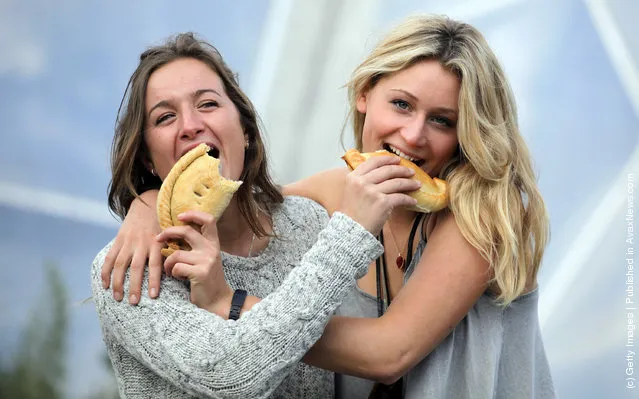
Cornish students (R) Nina Brooke, 21 and (L) Bonnie Mably, 20, laugh as they pose for a photograph as they try a Cornish pasty that has been baked as part of the World Cornish Pasty Championships at The Eden Project

“A Cornish pasty, sometimes known as a pastie or British pasty in the United States, is a filled pastry case, associated in particular with Cornwall in Great Britain. It is made by placing the uncooked filling on a flat pastry circle, and folding it to wrap the filling, crimping the edge at the side or top to form a seal. The result is a raised semicircular package”. – Wikipedia

Photo: Cornish students (R) Nina Brooke, 21 and (L) Bonnie Mably, 20, laugh as they pose for a photograph as they try a Cornish pasty that has been baked as part of the World Cornish Pasty Championships at The Eden Project on March 3, 2012 in St Austell, England. (Photo by Matt Cardy/Getty Images)
Details
04 Mar 2012 11:49:00
Where's the fish?/n. South Kamchatka Sanctuary<><>South Kamchatka Sanctuary; Kuril Lake; Kamchatka; bear; salmon; spawning

Igor Shpilenok works in the reserve at Kamchatka, Russia. Igor is a fellow of the International League of Conservation Photographers and a winner of the 2006 BBC Wildlife Photographer Competition. Igor’s work has been published in numerous international and Russian magazines, including Smithsonian, National Wildlife, Geo, and BBC Wildlife.

“How does a bear behave when encounter a human? In most cases he runs away. But before running he almost always would rise to stand on his rear feet. And this behavior does not indicate the attack, as many people think...” – Igor Shpilenok. (Photo by Igor Shpilenok via Wildlife Photo Russia)
Details
16 Sep 2012 12:54:00
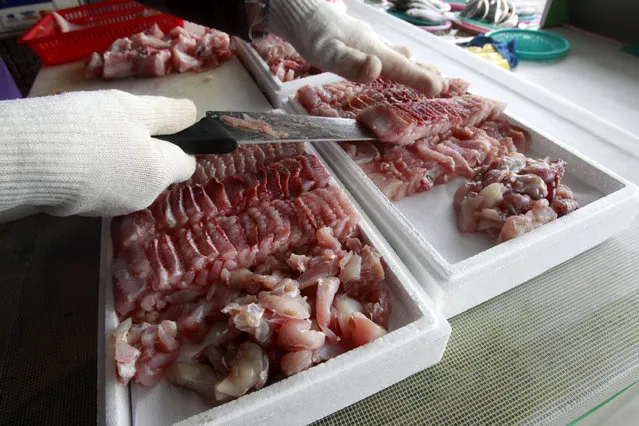
In this February 19, 2014 photo, a skate seller puts slices of skate into styrofoam boxes for shipment to customers around South Korea at a fish market in Mokpo, a port city on the southwestern tip of the Korean Peninsula. The aroma of one of southwestern South Korea's most popular delicacies regularly gets compared to rotting garbage and filthy bathrooms. (Photo by Ahn Young-joon/AP Photo)

In this February 19, 2014 photo, a skate seller puts slices of skate into styrofoam boxes for shipment to customers around South Korea at a fish market in Mokpo, a port city on the southwestern tip of the Korean Peninsula. The aroma of one of southwestern South Korea's most popular delicacies regularly gets compared to rotting garbage and filthy bathrooms. And that's by fans. The unusual dish is typically made by taking dozens of fresh skate, a cartilage-rich fish that looks like a stingray, stacking them up in a walk-in refrigerator and waiting. Up to a month in some cases. (Photo by Ahn Young-joon/AP Photo)
Details
11 Apr 2014 07:41:00