Loading...
Done
The Swarovski Crystal Head Fountain In Austria

A stone giant exhausted after his long travels decided to rest a while and drink from a pond far below. He lay down and started drinking from the crystal clear pond. So delicious was the water that he was unable to quench his thirst no matter how much he tried. Weeks have passed, months, years. The body of the stone giant became one with the hills and even his tongue has turned to water. This might seem like a fairy tale, yet you’ll be able to see this stone giant if you ever come to Wattens, Austria. He’s still there, guarding the entrance to Swarovski Kristallwelted, otherwise known as the Crystal Worlds. This is a one-of-a-kind theme park that was created by the people who first created Swarovski crystals.
Details
02 Mar 2015 08:30:00
What 200 Calories Looks Like In Different Foods Part 1

Some foods have significantly more Calories than others but what does the difference actually look like. Each of the photographs below represents 200 Calories of the particular type of food; the images are sorted from low to high calorie density. When you consider that an entire plate of broccoli contains the same number of Calories as a small spoonful of peanut butter, you might think twice the next time you decide what to eat. According to the U.S. Department of Agriculture, the average adult needs to consume about 2000 - 2500 Calories to maintain their weight. In other words, you have a fixed amount of Calories to "spend" each day; based on the following pictures, which would you eat?


See Also: Ppart 2 _ Part 3
Details
30 Jul 2014 10:18:00
The following “Utopian Tours” drawings are conceptual images of what tourism in North Korea might one day look like, created by North Korean architects. The images, curated by Nick Bonner, are on view as part of the exhibition at the Venice Architecture Biennale in the Korean Pavilion. Bonner runs the Beijing-based Koryo Tours – a company that organizes tours of outsiders into North Korea. (Photo by Nick Bonner/Kyle Vanhemert/Venice Architecture Biennale)

At this year’s Venice Bienniale in Italy, the Korean pavilion has a curious exhibit called “Commissions for Utopia”. It includes renderings from North Korea’s top architects and artists (all anonymous), many of whom studied at the Paekho Institute of Architecture, North Korea’s state-run architectural college, and none of whom have ever left the country. They were asked to create a vision of North Korea’s future sustainable architecture for its expanding tourism industry. Their final products are a glimpse into what it would be like to envision the future after being entirely cut off from the present for almost 70 years. (Photo by Nick Bonner/Kyle Vanhemert/Venice Architecture Biennale)
Details
08 Aug 2014 11:03:00
Perpetual Calendar By Arina Pozdnyak

We place too much value into something as elusive as time. This is the lesson that Arina Pozdnyak, the creator of Perpetual Calendar, is trying to teach us. Days fly by, and even months are mere speckles of sand in an hourglass of eternity. People do not realize that the time given to us by fate cannot be measured using months or even years. It is measured using emotions and impressions. If a person lives to be 150 years old without experiencing any emotions, he might as well have lived one day, for all it’s worth. On the other hand, a person who lived an exciting, fulfilling life, read countless books and cherished every moment that he had, is actually the one who lived a longer life, even if in reality his flame was snuffed out much too soon. (Photo by Arina Pozdnyak)
Details
30 Oct 2014 13:33:00
Legs Photography By Stacey Baker


When you look at the pictures created by Stacey Baker, you immediately think that these photos must have been staged by the photographer to convey some deep meaning. In reality, however, Stacy created her new series called “CitiLegs”, which has about 300 pictures of female legs, by asking passing girls and women in Manhattan, New York if she could photograph their legs. And that is when the realization hits you – “Some people actually dress like that!” What kind of a person would wear neon-green shorts over orange leggings with leopard-patterned boots, the toes of which are completely torn? Yes, there is a possibility that such a person might be insane; however, there are just too many “crazy” photos in this series! (Photo by Stacey Baker)
Details
19 Nov 2014 14:23:00
In this Friday, March 3, 2017 photo, a ribbon on a staff member's outfit blows in the breeze as she arrives for the opening session of the Chinese People's Political Consultative Congress (CPPCC) at the Great Hall of the People in Beijing. (Photo by Mark Schiefelbein/AP Photo)

In this Friday, March 3, 2017 photo, a ribbon on a staff member's outfit blows in the breeze as she arrives for the opening session of the Chinese People's Political Consultative Congress (CPPCC) at the Great Hall of the People in Beijing. The annual session of China's ceremonial legislature is designed to awe onlookers with its size and sweep, yet the experience is also made up of tiny moments, details that point to the personalities of the participants and the event's unique, sometimes quirky, traits that a casual observer might easily miss. (Photo by Mark Schiefelbein/AP Photo)
Details
15 Mar 2017 00:05:00
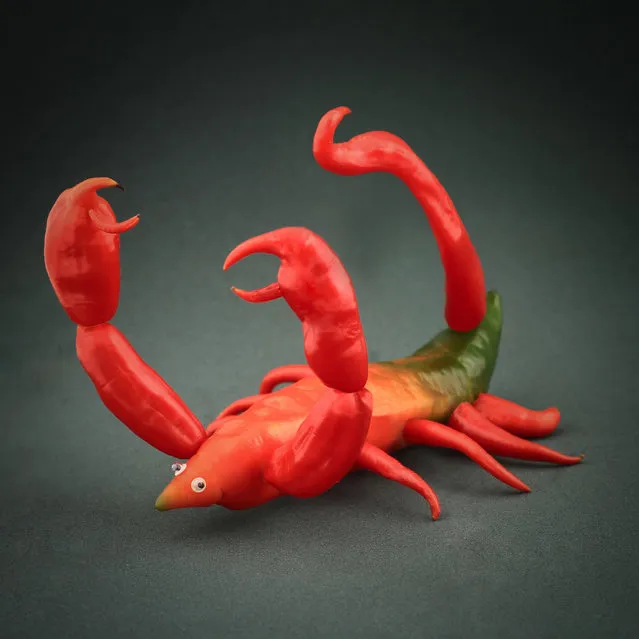
“Red Pepperpion. (Photo by Vanessa Dualib)

“Red Pepperpion. Red Pepperpions are secretive, nocturnal arachilli which can be spotted in kitchens of arid climates all around the world.

Red Pepperpions are equipped with a delicious (and depending on the quantity...deadly!) stinger at the end of its tail. If you happen to get bitten (or if you bite him!) it will produce a burning sensation on your taste nerves.

However, there is no need to worry, since the fact is that his potent stinger is usually only used when hunting or whenever the Pepperpion feels like he might become part of someones meal...

At daylight or when encountering a larger foe, such as a Saucier Chef, they retreat into burrows inside the fridge or hide beneath the oven”. (Photo and comment by Vanessa Dualib)


Details
08 Feb 2013 09:24:00
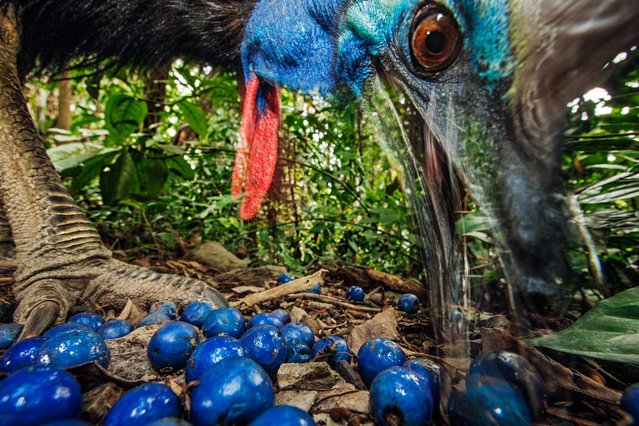
“Cassowaries are large, flightless birds related to emus and (more distantly) to ostriches, rheas, and kiwis”, writes Olivia Judson in the September issue of National Geographic magazine. (Photo by Christian Ziegler/National Geographic)

“Cassowaries are large, flightless birds related to emus and (more distantly) to ostriches, rheas, and kiwis”, writes Olivia Judson in the September issue of National Geographic magazine. How large? People-size: Adult males stand well over five foot five and top 110 pounds. Females are even taller, and can weigh more than 160 pounds. Dangerous when roused, they’re shy and peaceable when left alone. But even birds this big and tough are prey to habitat loss. The dense New Guinea and Australia rain forests where they live have dwindled. Today cassowaries might number 1,500 to 2,000. And because they help shape those same forests – by moving seeds from one place to another – “if they vanish”, Judson writes, “the structure of the forest would gradually change” too. (Photo by Christian Ziegler/National Geographic)
Details
06 Jan 2014 12:21:00