Loading...
Done
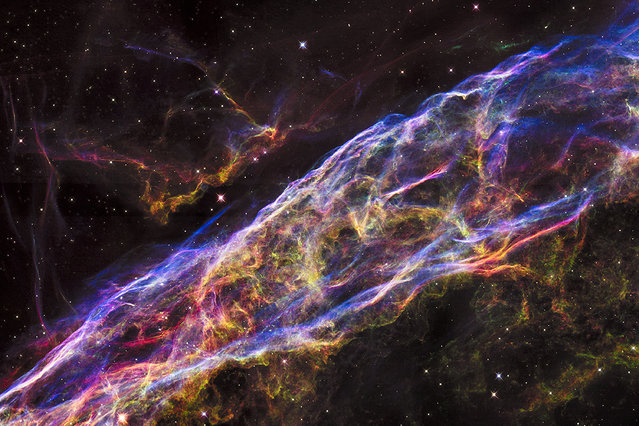
A small section of the expanding remains of the Veil Nebula, a massive star that exploded about 8,000 years ago. The entire nebula is 110 light-years across, covering six full moons on the sky as seen from Earth, and resides about 2,100 light-years away in the constellation Cygnus, the Swan. Image taken by NASA's Hubble Space Telescope. Released September 24, 2015. (Photo by Reuters/NASA/ESA/Hubble Heritage Team)

A small section of the expanding remains of the Veil Nebula, a massive star that exploded about 8,000 years ago. The entire nebula is 110 light-years across, covering six full moons on the sky as seen from Earth, and resides about 2,100 light-years away in the constellation Cygnus, the Swan. Image taken by NASA's Hubble Space Telescope. Released September 24, 2015. (Photo by Reuters/NASA/ESA/Hubble Heritage Team)
Details
10 Dec 2015 08:01:00
Britain's BASE jumper Sam Hardy lives up to his name after throwing himself off the top of the 335m-high Kuala Lumpur Tower during the KL Tower International Jump in Kuala Lumpur, Malaysia, Saturday, September 27, 2014. BASE stands for the places such jumpers usually jump from: buildings, antennas, spans (bridges) and earth (cliffs). (Photo by Lai Seng Sin/AP Photo)

Britain's BASE jumper Sam Hardy lives up to his name after throwing himself off the top of the 335m-high Kuala Lumpur Tower during the KL Tower International Jump in Kuala Lumpur, Malaysia, Saturday, September 27, 2014. BASE stands for the places such jumpers usually jump from: buildings, antennas, spans (bridges) and earth (cliffs). (Photo by Lai Seng Sin/AP Photo)
Details
29 Sep 2014 10:41:00
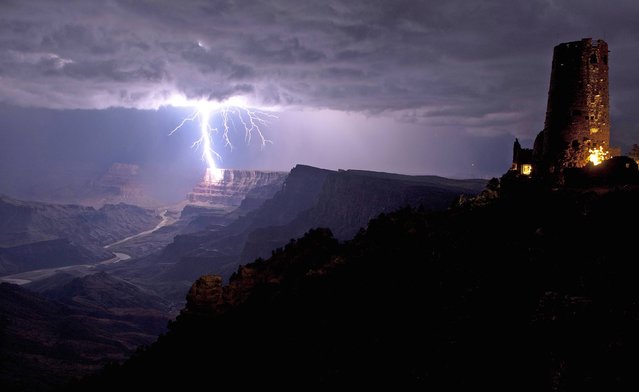
This is the incredible moment a fierce lightning bolt crashed against the Grand Canyon illuminating the steep canyon walls. Shrouded in darkness, the breath-taking landscape was shocked into life as mother nature sent the bolt storming down to Earth. (Photo by Travis Roe/U.S. Dept. of the Interior/Caters News)

This is the incredible moment a fierce lightning bolt crashed against the Grand Canyon illuminating the steep canyon walls. Shrouded in darkness, the breath-taking landscape was shocked into life as mother nature sent the bolt storming down to Earth. As it cracked against the rocks the bright blue bolt illuminated the South Rim of the canyon, considered one of the Seven Natural Wonders of the World. With just the Desert View Watchtower in the foreground, the lightning was perfectly framed by the canyon which is located in Arizona, USA. (Photo by Travis Roe/U.S. Dept. of the Interior/Caters News)
Details
14 May 2013 11:00:00
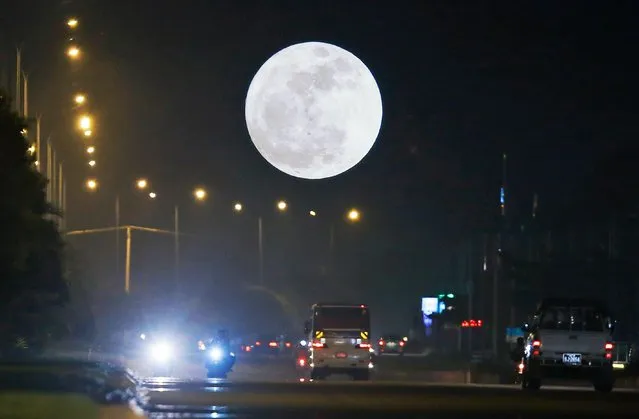
A so-called “Supermoon” dominates the sky while traffic rolls in the streets in Naypyitaw, Myanmar, 03 December 2017. According to the National Aeronautics and Space Administration (NASA) a series of three “Supermoons” – dubbed the “Supermoon trilogy” – will appear in the sky on 03 December 2017, on 01 January 2018 and and 31 January 2018. A 'Supermoon' commonly is a full moon at its closest distance to the earth with the moon appearing larger than usual. (Photo by Hein Htet/EPA/EFE)

A so-called “Supermoon” dominates the sky while traffic rolls in the streets in Naypyitaw, Myanmar, 03 December 2017. According to the National Aeronautics and Space Administration (NASA) a series of three “Supermoons” – dubbed the “Supermoon trilogy” – will appear in the sky on 03 December 2017, on 01 January 2018 and and 31 January 2018. A “Supermoon” commonly is a full moon at its closest distance to the earth with the moon appearing larger than usual. (Photo by Hein Htet/EPA/EFE)
Details
05 Dec 2017 07:45:00
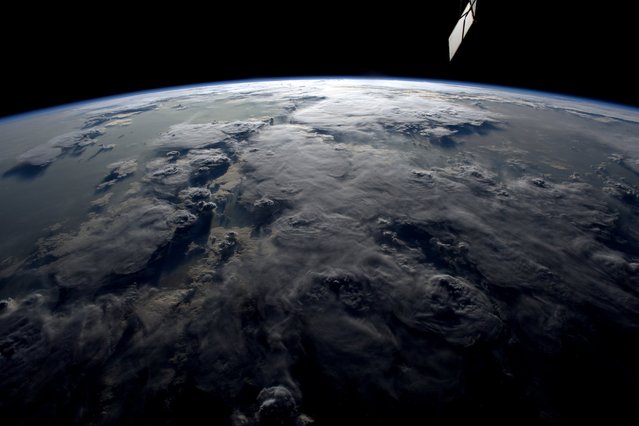
European Space Agency astronaut Tim Peake will return home after a six-month long mission on the International Space Station,on June 18, 2016. Peake was the first British ESA astronaut to visit the ISS and captured hundreds of photographs of the Earth during his mission. Here: “Lots of sun-glint right now during our whole orbit – we haven't seen a sunset for over 3 days”, he wrote. (Photo by Tim Peake/ESA/NASA)

European Space Agency astronaut Tim Peake will return home after a six-month long mission on the International Space Station,on June 18, 2016. Peake was the first British ESA astronaut to visit the ISS and captured hundreds of photographs of the Earth during his mission. Here: “Lots of sun-glint right now during our whole orbit – we haven't seen a sunset for over 3 days”, he wrote. (Photo by Tim Peake/ESA/NASA)
Details
18 Jun 2016 13:08:00
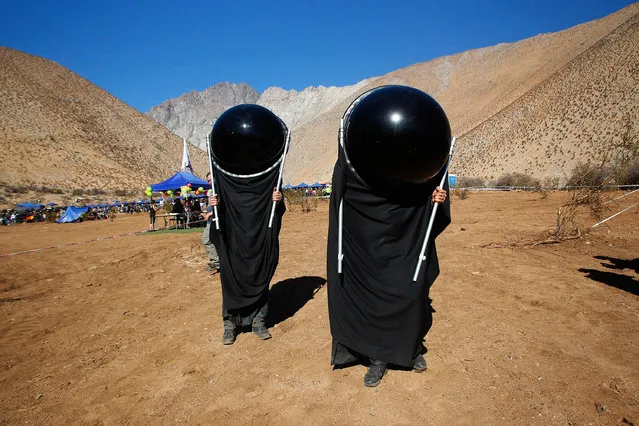
Chileans watch the sky with special suits prior to a total solar eclipse on July 2, 2019 in Paiguano, Chile. Around 25,0000 tourists arrived to Paiguano, a small town of around 1,000 inhabitants in the Elqui Valley, 650 km away Santiago. This is the only Earth's total solar eclipse of 2019 and the first one since 2017. From this point, the sun will fully disappear for around two minutes. It is best visible from a stripe in the South Pacific, Chile and Argentina. (Photo by Marcelo Hernandez/Getty Images)

Chileans watch the sky with special suits prior to a total solar eclipse on July 2, 2019 in Paiguano, Chile. Around 25,0000 tourists arrived to Paiguano, a small town of around 1,000 inhabitants in the Elqui Valley, 650 km away Santiago. This is the only Earth's total solar eclipse of 2019 and the first one since 2017. From this point, the sun will fully disappear for around two minutes. It is best visible from a stripe in the South Pacific, Chile and Argentina. (Photo by Marcelo Hernandez/Getty Images)
Details
04 Jul 2019 00:05:00
An offering of a dried baby llama and fake U.S. burn in honor of Pachamama, or Mother Earth, during a New Year ritual on Turriturrini Mountain on the outskirts of Huarina, Bolivia, Friday, June 21, 2024. Aymara Indigenous communities are celebrating the Andean New Year 5,532 or “Willka Kuti” which translates to “Return of the sun” in Aymara. (Photo by Juan Karita/AP Photo)

An offering of a dried baby llama and fake U.S. burn in honor of Pachamama, or Mother Earth, during a New Year ritual on Turriturrini Mountain on the outskirts of Huarina, Bolivia, Friday, June 21, 2024. Aymara Indigenous communities are celebrating the Andean New Year 5,532 or “Willka Kuti” which translates to “Return of the sun” in Aymara. (Photo by Juan Karita/AP Photo)
Details
31 Jul 2024 06:29:00


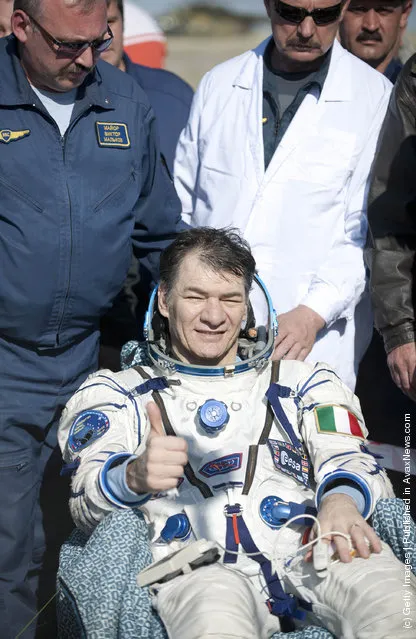
ESA astronaut Paolo Nespoli looks on after landing back on Earth from their Soyuz TMA-20 spacecraft on May 24, 2011 in Zhezkazgan, Kazakhstan. The mission of the Soyuz TMA-20 was launched last December to the International Space Station with the flight engineers Catherine Coleman from the United States, Russian cosmonaut Dmitry Kondratyev and Italian astronaut Paolo Nespoli. The next expedition is expected to launch this June. (Photo by Stephane Corvaja/ESA via Getty Images)
Details
24 May 2011 10:06:00