Loading...
Done
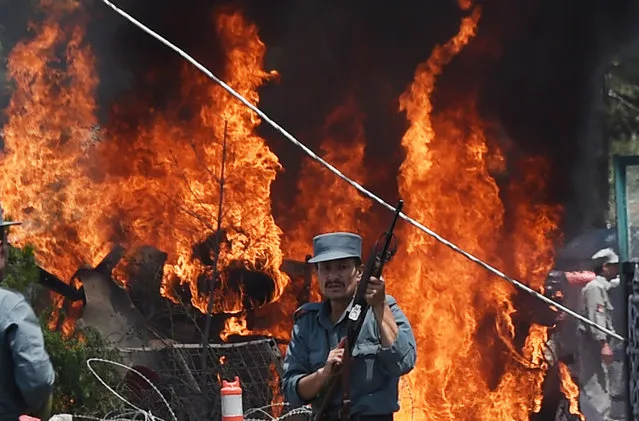
An Afghan policeman stands guard as smoke and flames rise from the site of a huge blast struck near the entrance of Kabul's international airport, in Kabul on August 10, 2015. A huge blast struck near the entrance of Kabul's international airport on August 10 during the peak lunchtime period, officials said, warning that heavy casualties were expected. (Photo by Shah Marai/AFP Photo)

An Afghan policeman stands guard as smoke and flames rise from the site of a huge blast struck near the entrance of Kabul's international airport, in Kabul on August 10, 2015. A huge blast struck near the entrance of Kabul's international airport on August 10 during the peak lunchtime period, officials said, warning that heavy casualties were expected. “The explosion occurred at the first check point of Kabul airport”, said deputy Kabul police chief Sayed Gul Agha Rouhani. (Photo by Shah Marai/AFP Photo)
Details
11 Aug 2015 13:27:00
A man assists two young hostages who managed to escape from the school building after special forces entered the school in Beslan, North Ossetia, Friday 03 September 2004. Streams of hostages fled the besieged school in Beslan in southern Russia Friday amid intensive shooting and a series of powerful explosions that signalled a bloody end to the three-day stand-off with terrorists. (Photo by Yuri Kochetkov/EPA)

On September 1, 2004, Chechen militants stormed an elementary school in the town of Beslan in the Russian republic of North Ossetia. They took 1,100 teachers, children, and their relatives hostage, demanding the withdrawal of federal forces from Chechnya as a condition for their release. On September 3, 2004, Russian security forces stormed the building, resulting in a battle in which more than 330 hostages died, including 186 children. Here: A man assists two young hostages who managed to escape from the school building after special forces entered the school in Beslan, North Ossetia, Friday 03 September 2004. (Photo by Yuri Kochetkov/EPA)
Details
25 Sep 2017 06:41:00
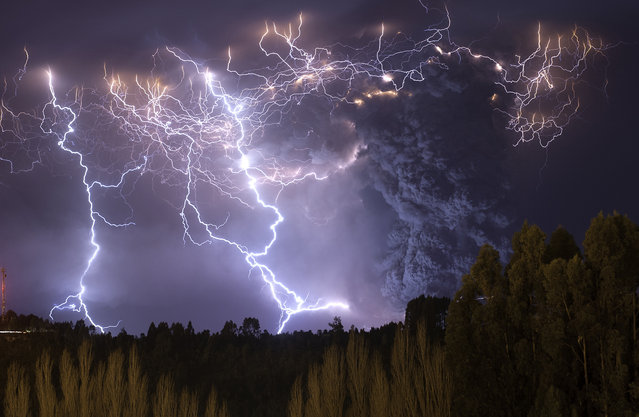
The eruption of Cordon Caulle began on June 4, 2011, located in the Region of Los Rios in Chile. For about 12 months, people and animals became accustomed to living with the daily fall of ash, which also caused problems in the air traffic in South America. The explosions and lightning during first days of the eruption could be seen from hundreds of miles around. This photograph was taken on the second night of eruption from the town of Lago Ranco. (Photo and caption by Francisco Negroni/National Geographic Traveler Photo Contest)

The eruption of Cordon Caulle began on June 4, 2011, located in the Region of Los Rios in Chile. For about 12 months, people and animals became accustomed to living with the daily fall of ash, which also caused problems in the air traffic in South America. The explosions and lightning during first days of the eruption could be seen from hundreds of miles around. This photograph was taken on the second night of eruption from the town of Lago Ranco. (Photo and caption by Francisco Negroni/National Geographic Traveler Photo Contest)

ATTENTION! All pictures are presented in high resolution. To see Hi-Res images – just TWICE click on any picture. In other words, click small picture – opens the BIG picture. Click BIG picture – opens VERY BIG picture.
Details
23 Jun 2013 11:24:00
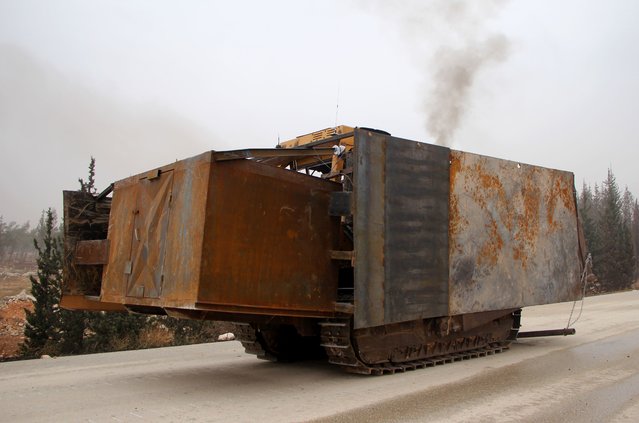
Rebel fighters from the Jaish al- Fatah (or Army of Conquest) brigades manoeuver an alleged explosive- rigged make- shift armoured vehicle during a major assault on Syrian government forces West of Aleppo city on October 28, 2016 Syrian opposition fighters launched a major assault on government forces to break a months- long siege of rebel- held neighbourhoods of the battered city of Aleppo. Rebel groups including the powerful Ahrar al- Sham faction and former Al- Qaeda affiliate Fateh al- Sham Front fired waves of rockets into government- held western Aleppo, killing at least 15 civilians, a monitor said. (Photo by Omar Haj Kadour/AFP Photo)

Rebel fighters from the Jaish al- Fatah (or Army of Conquest) brigades manoeuver an alleged explosive- rigged make- shift armoured vehicle during a major assault on Syrian government forces West of Aleppo city on October 28, 2016 Syrian opposition fighters launched a major assault on government forces to break a months- long siege of rebel- held neighbourhoods of the battered city of Aleppo. Rebel groups including the powerful Ahrar al- Sham faction and former Al- Qaeda affiliate Fateh al- Sham Front fired waves of rockets into government- held western Aleppo, killing at least 15 civilians, a monitor said. (Photo by Omar Haj Kadour/AFP Photo)
Details
29 Oct 2016 11:51:00
Artist Heather Dewey-Hagborg's 'Stranger Visions', comprising of 3D printed faces extracted from DNA taken from discarded cigarette butts and chewing gum, is displayed at the Big Bang Data exhibition at Somerset House on December 2, 2015 in London, England. (Photo by Peter Macdiarmid/Getty Images for Somerset House)

Artist Heather Dewey-Hagborg's 'Stranger Visions', comprising of 3D printed faces extracted from DNA taken from discarded cigarette butts and chewing gum, is displayed at the Big Bang Data exhibition at Somerset House on December 2, 2015 in London, England. The show highlights the data explosion that's radically transforming our lives. It opens on December 3, 2015 and runs until February 28, 2016 at Somerset House. (Photo by Peter Macdiarmid/Getty Images for Somerset House)
Details
04 Dec 2015 08:03:00


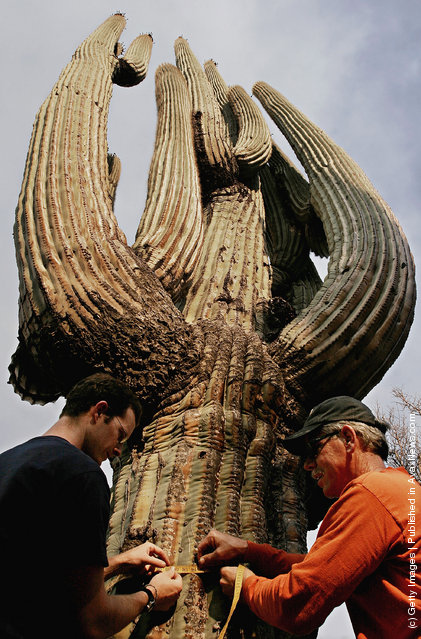
“The saguaro (scientific name Carnegiea gigantea) is a large, tree-sized cactus species in the monotypic genus Carnegiea. It is native to the Sonoran Desert in the U.S. state of Arizona, the Mexican state of Sonora, a small part of Baja California in the San Felipe Desert and an extremely small area of California, U.S. The saguaro blossom is the State Wildflower of Arizona”. – Wikipedia

Photo: Daniel Appel (L), a firefighter with Engine 84 from the Lassen National Forest in California and Mike Hallen, (R), Arizona representative of the National Register of Big Trees, measure the circumference of this Saguaro cactus called the "Grand One," in the Tonto National Forest on July 1, 2005 35 miles north of Phoenix, near Carefree, Arizona. The cactus, estimated to be more than 200 years old, measures a circumference of 7 feet, 10 inches (2.4 meters) and stands 46 feet high (14 meters). The cactus was burned in the Cave Creek Complex fire and may not survive. It was once the largest Saguaro in the world, two others have been found recently that have tied it's measurements. The fire has burned more than 214,000 acres of the Sonoran desert. (Photo by Jeff Topping/Getty Images)

Details
26 Jul 2011 12:27:00
A chained male monkey in a costume and wearing a toy mask performs at a street in Depok, West Java, Indonesia, 30 September 2021. A performing monkey in a street, known as “Topeng Monyet” (lit. Monkey Mask), is a popular form of cheap entertainment in Indonesia, especially on the island of Java. During a street monkey show, a trainer issues orders by pulling the chain tied around the primate's neck, forcing it to perform tricks such as wearing a mask or riding a toy motorcycle. The Indonesian government in 2013 banned the Topeng Monyet in the capital Jakarta to improve public order and ending animal abuse. However, monkey performances are still popular in several other parts of the country, such as West Java, especially after the government lowered the level of Enforcement of Restrictions on Community Activities (PPKM) in a number of areas during the COVID-19 pandemic. (Photo by Adi Weda/EPA/EFE)

A chained male monkey in a costume and wearing a toy mask performs at a street in Depok, West Java, Indonesia, 30 September 2021. A performing monkey in a street, known as “Topeng Monyet” (lit. Monkey Mask), is a popular form of cheap entertainment in Indonesia, especially on the island of Java. (Photo by Adi Weda/EPA/EFE)
Details
16 Oct 2021 09:08:00
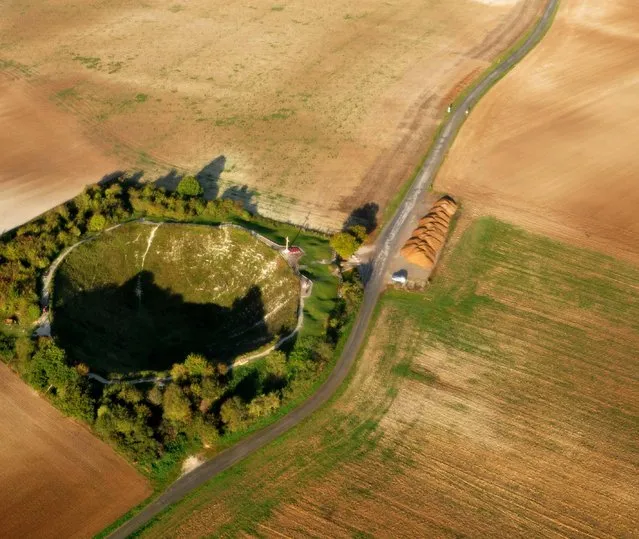
Lochnagar Crater Somme In France

It is amazing how much the humanity can change the face of the earth. Not only can it create huge craters, which look a lot like craters from meteors, they leave a big enough impact that it can be seen from space. Though this crater, caused by a massive explosion on 1 July 1916, looks large, being 90 feet deep and 300 feet across; it is nowhere big enough to be viewed for space. A common misconception is that the Great Wall of China can be seen from space. In reality, however, it is impossible. Not only is it of the same color as the earth near it, it is also not that wide. Deforestation, on the other hand, can be clearly seen from space. Also, at night, all the lights that the large cities produce are also very visible.
Details
17 Nov 2014 12:48:00