Loading...
Done
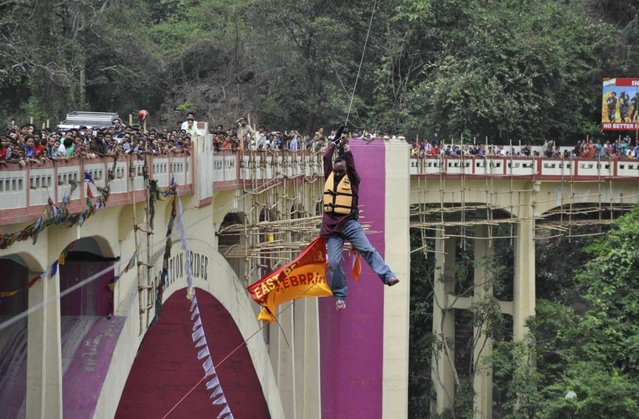
In this Sunday, April 28, 2013 photograph, people watch as Indian Sailendra Nath Roy attempts to cross Teesta river suspended from a zip wire attached to his ponytail moments before his death in Siliguri, West Bengal state, India. Roy who was named a Guinness World Record holder in 2011 for travelling the farthest distance on a zip wire using hair died during the stunt Sunday when he suffered a heart attack. (Photo by AP Photo)

In this Sunday, April 28, 2013 photograph, people watch as Indian Sailendra Nath Roy attempts to cross Teesta river suspended from a zip wire attached to his ponytail moments before his death in Siliguri, West Bengal state, India. Roy who was named a Guinness World Record holder in 2011 for travelling the farthest distance on a zip wire using hair died during the stunt Sunday when he suffered a heart attack. (Photo by AP Photo)
Details
30 Apr 2013 08:21:00
Alien Landscapes Of Dallol Volcano Dionys Moser

Photographer Dionys Moser traveling to Ethiopia stopped at the famous volcano Dallol, where he made a shocking series of photos. Looking at them, it seems that the pictures are taken on a different planet!
Details
04 Aug 2013 19:01:00
HINOI Team (HINOIチーム) - Night of Fire (with Korikki)

Greetings, sickly monkeys! Do you remember about the planet Nibiru?! Confess, parasites! Listen to good music! Love you! Yours truly, Avax


Details
18 May 2012 12:04:00
A radiation monitor indicates 114.00 microsieverts per hour near the building housing the plant's No. 4 reactor, center, and an under construction foundation, right, which will store the reactor's melted fuel rods at Tokyo Electric Power Co.'s tsunami-crippled Fukushima Dai-ichi nuclear power plant in Okuma, Fukushima prefecture, Wednesday, March 6, 2013, ahead of the second anniversary of the March 11, 2011 tsunami and earthquake. (Photo by Issei Kato/AP Photo/Pool)

A radiation monitor indicates 114.00 microsieverts per hour near the building housing the plant's No. 4 reactor, center, and an under construction foundation, right, which will store the reactor's melted fuel rods at Tokyo Electric Power Co.'s tsunami-crippled Fukushima Dai-ichi nuclear power plant in Okuma, Fukushima prefecture, Wednesday, March 6, 2013, ahead of the second anniversary of the March 11, 2011 tsunami and earthquake. Some 110,000 people living around the nuclear plant were evacuated after the massive March 11, 2011, earthquake and tsunami knocked out the plant's power and cooling systems, causing meltdowns in three reactors and spewing radiation into the surrounding air, soil and water. (Photo by Issei Kato/AP Photo/Pool)
Details
06 Mar 2013 13:19:00
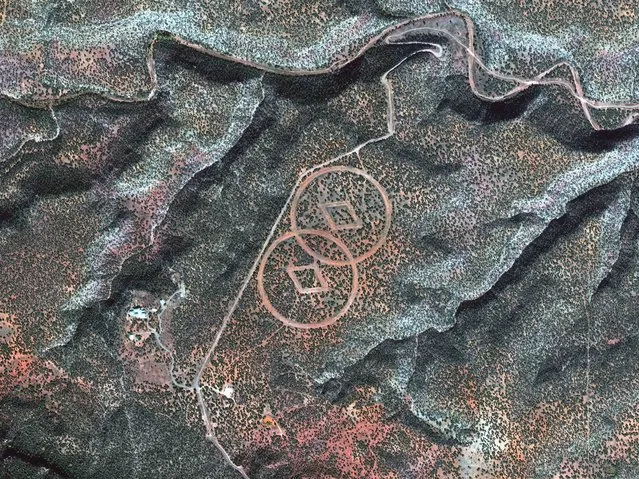
Trementina, New Mexico. (Photo by DigitalGlobe/Caters News)

These stunning photographs may look like alien planets, but they are actually satellite images of planet Earth. Commercial satellite company DigitalGlobe recently released the images as a way of highlighting the incredible detail of their imagery – the highest-resolution commercial satellite imagery in the world. Some of the images – taken above Afghanistan, Algeria, Peru, Russia and the United States – look more like abstract works by Mondrian than segments of the globe. DigitalGlobe, based in Westminster, Colo., launched its first satellite in 1999 and currently has four in operation. Here: Trementina, New Mexico. (Photo by DigitalGlobe/Caters News)
Details
02 Oct 2015 08:01:00
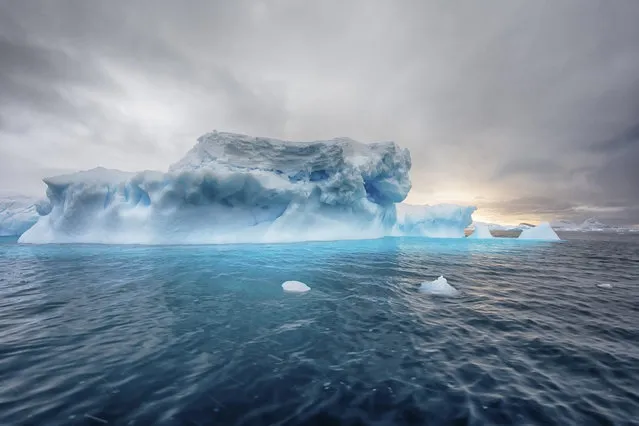
A serene turquoise glow glimmers from underneath these powerful icebergs. Stood in the middle of Antarctica, the giant icebergs appear to be from an unearthly world. These stunning photographs were captured by American photographer Michael Leggero. “My images show pure nature, as that is how I describe Antarctica, simply pure nature”, says the 43 year old, of Carthage, New York. “It is the only place on our planet that humans have not left a presence behind”. (Photo by Michael Leggero/Hotspotmedia/Visual Press Agency)

A serene turquoise glow glimmers from underneath these powerful icebergs. Stood in the middle of Antarctica, the giant icebergs appear to be from an unearthly world. These stunning photographs were captured by American photographer Michael Leggero. “My images show pure nature, as that is how I describe Antarctica, simply pure nature”, says the 43 year old, of Carthage, New York. “It is the only place on our planet that humans have not left a presence behind”. (Photo by Michael Leggero/Hotspotmedia/Visual Press Agency)
Details
07 Aug 2014 10:32:00
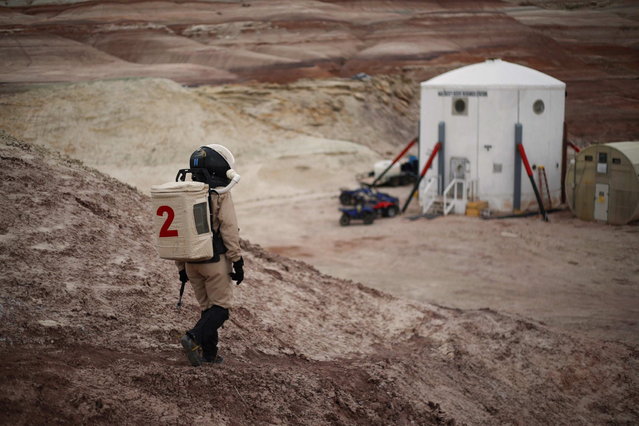
Csilla Orgel, a geologist of Crew 125 EuroMoonMars B mission, makes her way back to the Mars Desert Research Station (MDRS) in the Utah desert March 3, 2013. (Photo by Jim Urquhart/Reuters)

NASA says it could be another 20 years before humans touch down on Mars, but in a sense, the Mars Society has been exploring the red planet for more than a decade – in Utah. Photo: Csilla Orgel, a geologist of Crew 125 EuroMoonMars B mission, makes her way back to the Mars Desert Research Station (MDRS) in the Utah desert March 3, 2013. The MDRS aims to investigate the feasibility of a human exploration of Mars and uses the Utah desert's Mars-like terrain to simulate working conditions on the red planet. Scientists, students and enthusiasts work together developing field tactics and studying the terrain. All outdoor exploration is done wearing simulated spacesuits and carrying air supply packs and crews live together in a small communication base with limited amounts of electricity, food, oxygen and water. Everything needed to survive must be produced, fixed and replaced on site. (Photo by Jim Urquhart/Reuters)
Details
14 Mar 2013 12:11:00
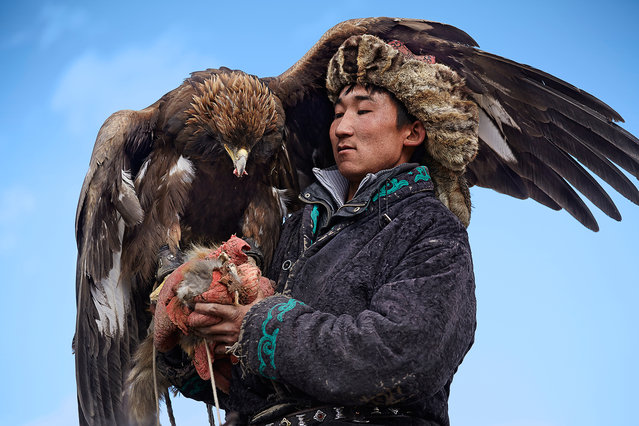
In one of the planet’s most desolate and harsh terrains, the Altai Mountains which run from Siberia in Russia down to Mongolia’s Gobi Desert, hunting with eagles is currently only practiced by a handful of Kyrgyz and Kazakhs. This form of falconry, the practice of hunting with the aid of birds of prey, can be traced back as far as 4,000 years in Central Asia. (Photo by Tariq Zaidi/The Washington Post)

In one of the planet’s most desolate and harsh terrains, the Altai Mountains which run from Siberia in Russia down to Mongolia’s Gobi Desert, hunting with eagles is currently only practiced by a handful of Kyrgyz and Kazakhs. This form of falconry, the practice of hunting with the aid of birds of prey, can be traced back as far as 4,000 years in Central Asia. Here: after a successful hunt, a proud hunter rewards his eagle by feeding it the lungs of the prey, which is considered the most highly prized part of the animal. (Photo by Tariq Zaidi/The Washington Post)
Details
22 Aug 2015 12:46:00