Loading...
Done
Teekhree Silpa-Archa of Thailand competes in the Figure Skating – Women Single Skating Short Program on day 6 of the 9th Asian Winter Games Harbin 2025 at HIC Multifunctional Hall on February 12, 2025 in Harbin, Heilongjiang Province of China. (Photo by Tingshu Wang/Reuters)

Teekhree Silpa-Archa of Thailand competes in the Figure Skating – Women Single Skating Short Program on day 6 of the 9th Asian Winter Games Harbin 2025 at HIC Multifunctional Hall on February 12, 2025 in Harbin, Heilongjiang Province of China. (Photo by Tingshu Wang/Reuters)
Details
22 Feb 2025 04:09:00
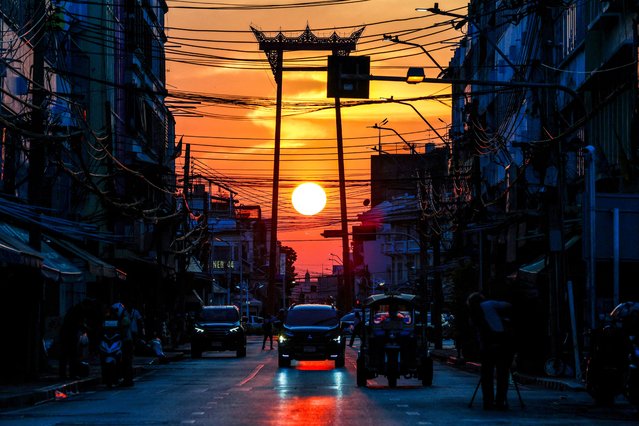
The sun sets behind the Giant Swing, also known as Sao Chingcha, in Bangkok, Thailand, on March 6, 2025. (Photo by Athit Perawongmetha/Reuters)

The sun sets behind the Giant Swing, also known as Sao Chingcha, in Bangkok, Thailand, on March 6, 2025. (Photo by Athit Perawongmetha/Reuters)
Details
12 Mar 2025 03:55:00
A model wears a creation for the L'Oreal Spring-Summer 2022 ready-to-wear fashion show presented in Paris, Sunday, October 3, 2021. (Photo by Vianney Le Caer/Invision/AP Photo)

A model wears a creation for the L'Oreal Spring-Summer 2022 ready-to-wear fashion show presented in Paris, Sunday, October 3, 2021. (Photo by Vianney Le Caer/Invision/AP Photo)
Details
05 Oct 2021 09:09:00
An Iranian man lights a firework during the Wednesday Fire celebration (Chaharshanbeh Suri in Persian) at a park in Tehran, Iran on March 12, 2024. (Photo by Majid Asgaripour/WANA vie Reuters)

An Iranian man lights a firework during the Wednesday Fire celebration (Chaharshanbeh Suri in Persian) at a park in Tehran, Iran on March 12, 2024. (Photo by Majid Asgaripour/WANA vie Reuters)
Details
26 Mar 2024 06:24:00
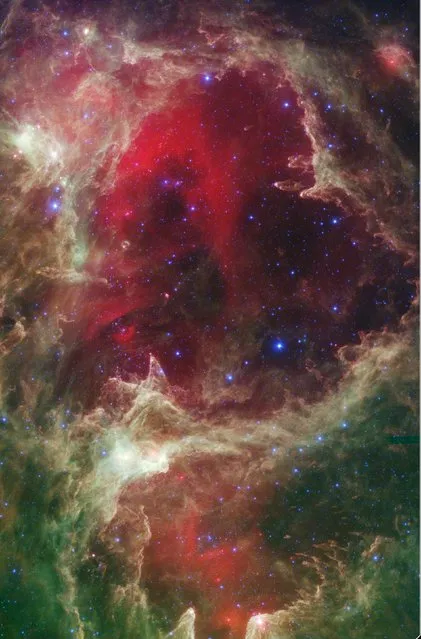
An infrared portrait from NASA's Spitzer Space Telescope which shows generations of stars is seen in this undated NASA handout image released February 14, 2013. In this wispy star-forming region, called W5, the oldest stars can be seen as blue dots in the centers of the two hollow cavities (other blue dots are background and foreground stars not associated with the region). Red shows heated dust that pervades the region's cavities, while green highlights dense clouds. (Photo by NASA/Reuters/JPL-Caltech/Harvard-Smithsonian/Handout)

An infrared portrait from NASA's Spitzer Space Telescope which shows generations of stars is seen in this undated NASA handout image released February 14, 2013. In this wispy star-forming region, called W5, the oldest stars can be seen as blue dots in the centers of the two hollow cavities (other blue dots are background and foreground stars not associated with the region). Red shows heated dust that pervades the region's cavities, while green highlights dense clouds. (Photo by NASA/Reuters/JPL-Caltech/Harvard-Smithsonian/Handout)
Details
03 Mar 2013 08:44:00


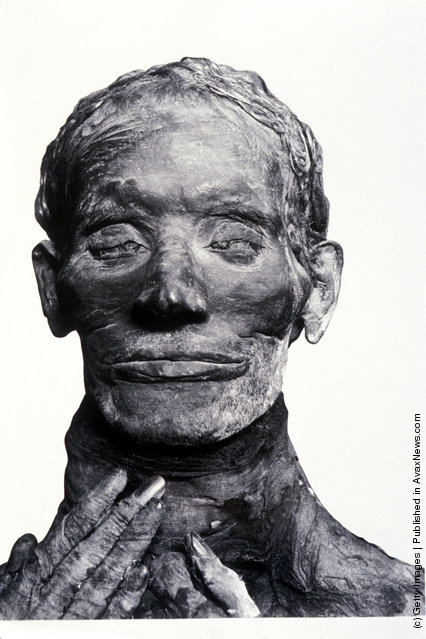
The mummy of Yuya thought by some to be Josua who, after Moses, led the Hebrews into the Promised land and logically would be the father-in-law of Amenophis III, at Cairo Museum, Egypt. (Photo by Patrick Landmann/Cairo Museum/Getty Images)
Details
22 Apr 2011 08:47:00
Fat Jew makes his entrance at the first birthday party for White Girl Rosé hosted by Elite Daily at The Dream Downtown, Sunday, July 17, 2016, in New York. (Photo by Diane Bondareff/Invision for White Girl Rosé/AP Images)

Fat Jew makes his entrance at the first birthday party for White Girl Rosé hosted by Elite Daily at The Dream Downtown, Sunday, July 17, 2016, in New York. (Photo by Diane Bondareff/Invision for White Girl Rosé/AP Images)
Details
24 Jul 2016 10:52:00
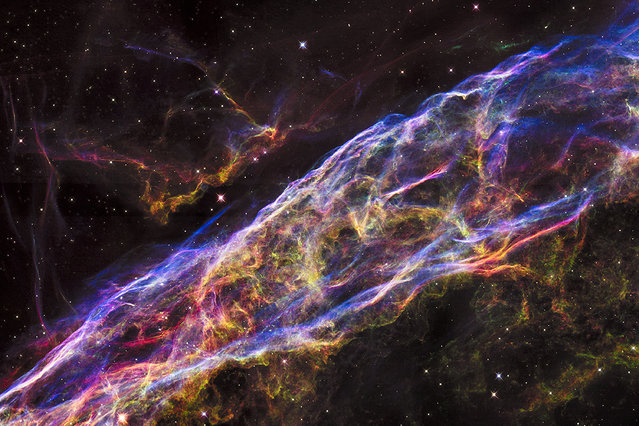
A small section of the expanding remains of the Veil Nebula, a massive star that exploded about 8,000 years ago. The entire nebula is 110 light-years across, covering six full moons on the sky as seen from Earth, and resides about 2,100 light-years away in the constellation Cygnus, the Swan. Image taken by NASA's Hubble Space Telescope. Released September 24, 2015. (Photo by Reuters/NASA/ESA/Hubble Heritage Team)

A small section of the expanding remains of the Veil Nebula, a massive star that exploded about 8,000 years ago. The entire nebula is 110 light-years across, covering six full moons on the sky as seen from Earth, and resides about 2,100 light-years away in the constellation Cygnus, the Swan. Image taken by NASA's Hubble Space Telescope. Released September 24, 2015. (Photo by Reuters/NASA/ESA/Hubble Heritage Team)
Details
10 Dec 2015 08:01:00