Loading...
Done


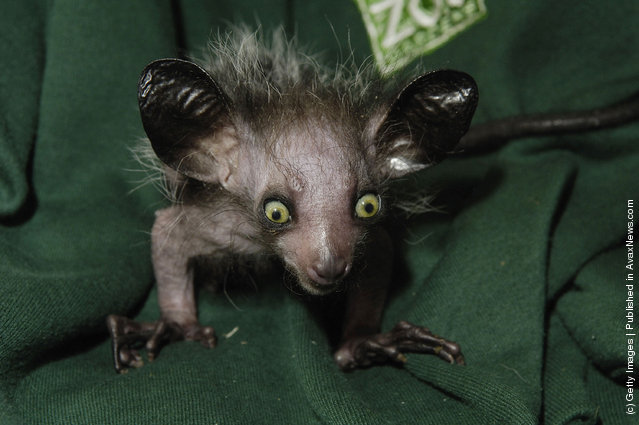
“The aye-aye (Daubentonia madagascariensis) is a lemur, a strepsirrhine primate native to Madagascar that combines rodent-like teeth and a special thin middle finger to fill the same ecological niche as a woodpecker. It is the world's largest nocturnal primate, and is characterized by its unusual method of finding food; it taps on trees to find grubs, then gnaws holes in the wood and inserts its narrow middle finger to pull the grubs out. The only other animal species known to find food in this way is the striped possum. From an ecological point of view the aye-aye fills the niche of a woodpecker as it is capable of penetrating wood to extract the invertebrates within”. – Wikipedia

Photo: In this handout image from Bristol Zoo is seen the first captive bred aye-aye in the UK named “Kintana” (meaning star in Malagasy) April 15, 2005 at Bristol Zoo Gardens, England. The zoo announced today only the second baby aye-aye to be hand-reared in the world (the first was in Jersey Zoo) and has now made his first public appearance since his birth on 11 February 2005. (Photo by Rob Cousins/Bristol Zoo via Getty Images)
Details
13 Apr 2011 13:33:00
Glass Sculpture By Scott Bisson

Scott Bisson of Quantum Creative Glass was first fascinated by the medium in high school chemistry class, at age seventeen. Since then, he has studied with five different masters, as well as at the world renowned Pilchuck School with Robert A. Mickelson, and has met and observed Dante Marioni, William Morris, and Peter Novotney.
Details
06 Apr 2016 15:44:00
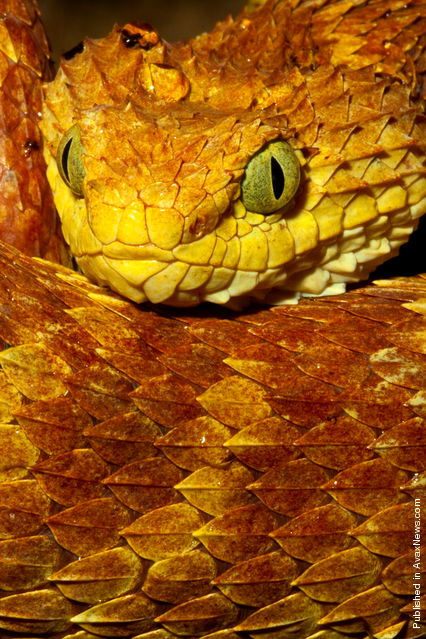
Atheris squamigera

“Atheris is a genus of venomous vipers found only in tropical subsaharan Africa, excluding southern Africa. Confined to rain forest areas, many members have isolated and fragmented distributions. In an interesting example of convergent evolution, they show many similarities to the arboreal pit vipers of Asia and South America”. – Wikipedia

Photo: Atheris squamigera. (Photo by David Williams)
Details
21 Apr 2012 13:14:00


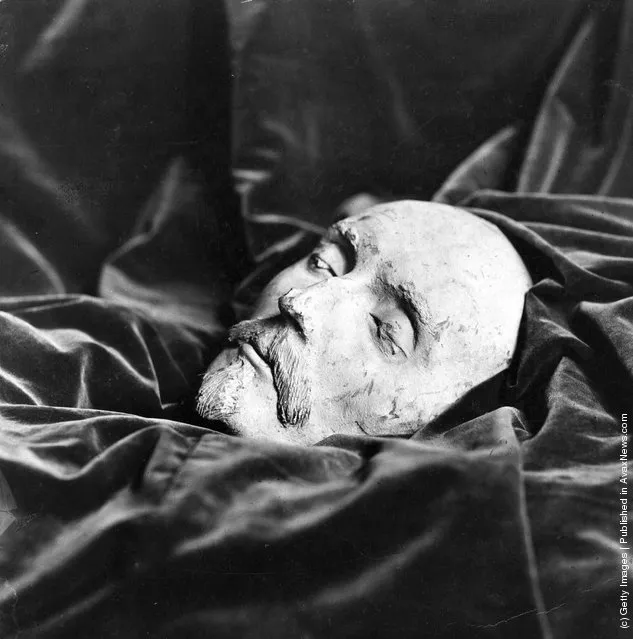
A death mask thought to be that of English dramatist William Shakespeare (1566–1616). Found by Dr. Ludwig Becker in Mainz in 1849, the mask was linked to Shakespeare because of its 1616 date and its supposed facial resemblance to the writer. A rival theory, however, maintains that the mask is more likely to be that of English poet Ben Johnson. (Photo by Hulton Archive/Getty Images). Circa 1900
Details
23 Jun 2011 10:19:00
1936:  Lucie Clayton instructs pupils in the art of correct posture by balancing a glass and book on their heads at her finishing school

Lucie Clayton instructs pupils in the art of correct posture by balancing a glass and book on their heads at her finishing school in Old Cavendish Street, London. (Photo by William Vanderson/Fox Photos/Getty Images). 25th November 1936
Details
06 Sep 2011 12:06:00
October Snowstorm Hits The Northeast

Fall foliage rests on a street after tumbling down after a winter storm October 30, 2011 in Doylestown, Pennsylvania. Thousands in Pennsylvania and Delaware were left without power from the early winter storm that left up to 10 inches of snow in parts of the states. (Photo by William Thomas Cain/Getty Images)
Details
31 Oct 2011 11:22:00
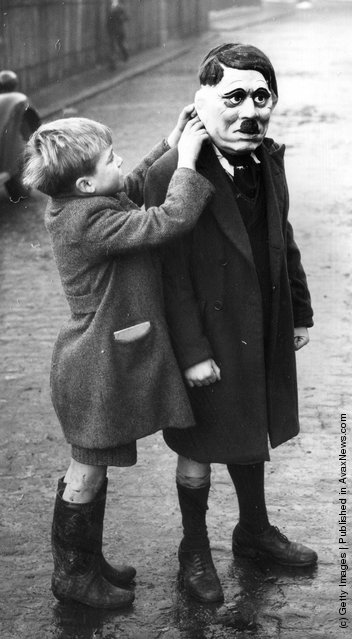
A young boy adjusts his friend's Adolf Hitler mask during a game on a street in King's Cross, London, 1938

A young boy adjusts his friend's Adolf Hitler mask during a game on a street in King's Cross, London. (Photo by William Vanderson/Getty Images). 1938
Details
02 Dec 2011 09:12:00
Scotland fans in Leicester Square in London, Britain before the match against England on June 18, 2021. (Photo by Henry Nicholls/Reuters)

Scotland fans climbed on English playwright William Shakespeare's statue in Leicester Square prior to the Euro 2020 soccer championship group D match between England and Scotland, in London, Friday, June 18, 2021. (Photo by Henry Nicholls/Reuters)
Details
20 Jun 2021 08:25:00