Loading...
Done
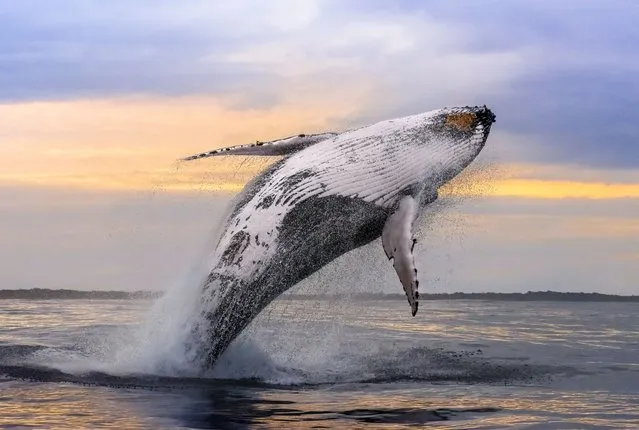
A 40-tonne humpback launching out of the water in an incredible breach in New South Wales, Australia on October 2022 in front of a sunset. The humpback whale can grow up to 56 feet long and typically covers 9,900 miles a year as it travels through the oceans of the world. Humpback whales are a species of Baleen whale, meaning they don't have teeth. Instead, they have baleen which helps them to filter feed. Their main source of food is krill or tiny bait fish. (Photo by Jodie Lowe/Media Drum Images)

A 40-tonne humpback launching out of the water in an incredible breach in New South Wales, Australia on October 2022 in front of a sunset. The humpback whale can grow up to 56 feet long and typically covers 9,900 miles a year as it travels through the oceans of the world. Humpback whales are a species of Baleen whale, meaning they don't have teeth. Instead, they have baleen which helps them to filter feed. Their main source of food is krill or tiny bait fish. (Photo by Jodie Lowe/Media Drum Images)
Details
30 Oct 2022 04:28:00
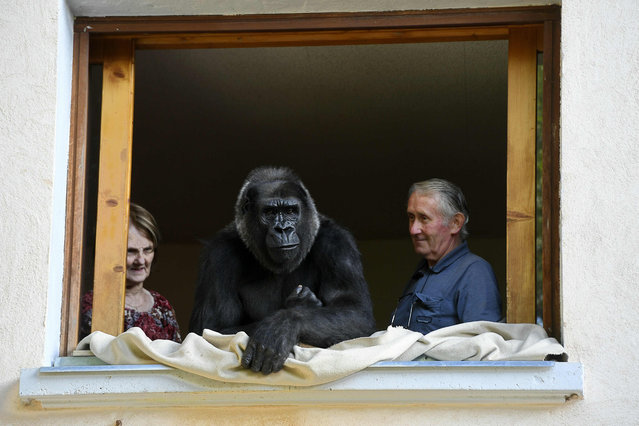
Pierre Thivillon (R), director of the zoological park of Saint-Martin-La-Plaine and his wife Eliane look at Digit, an 18-year-old female gorilla, on August 19, 2016, in Saint-Martin-La-Plaine between Lyon and Saint-Etienne, southeastern France. The zoological park of Saint-Martin-La-Plaine is a shelter for beasts seized by the justice. (Photo by Philippe Desmazes/AFP Photo)

Pierre Thivillon (R), director of the zoological park of Saint-Martin-La-Plaine and his wife Eliane look at Digit, an 18-year-old female gorilla, on August 19, 2016, in Saint-Martin-La-Plaine between Lyon and Saint-Etienne, southeastern France. The zoological park of Saint-Martin-La-Plaine is a shelter for beasts seized by the justice. (Photo by Philippe Desmazes/AFP Photo)
Details
21 Aug 2016 10:57:00
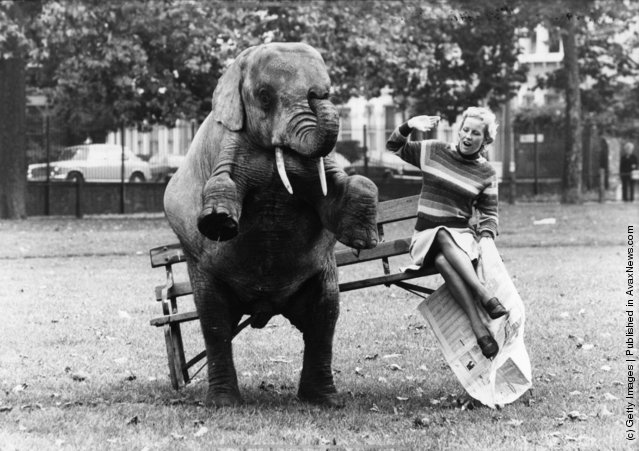
Rosie the elephants proves to be heavier than her companion and tips the park bench when she tries to sit down

Rosie the elephants proves to be heavier than her companion and tips the park bench when she tries to sit down. (Photo by Mike Lloyd/Getty Images). 1977
Details
03 Oct 2011 09:42:00
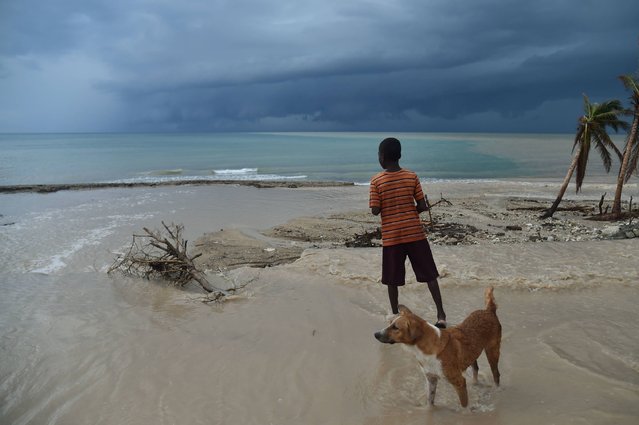
A child watching the sea while residents try to clear the bed of a river that has been blocked by debris left by Hurricane Matthew, in the commune of Roche-a-Bateaux, in the south west of Haiti, on October 21, 2016. At least 546 people were killed and more than 175,000 people lost their homes when Hurricane Matthew roared ashore on October 4, packing winds of 145 miles (230 kilometers) per hour. (Photo by Hector Retamal/AFP Photo)

A child watching the sea while residents try to clear the bed of a river that has been blocked by debris left by Hurricane Matthew, in the commune of Roche-a-Bateaux, in the south west of Haiti, on October 21, 2016. At least 546 people were killed and more than 175,000 people lost their homes when Hurricane Matthew roared ashore on October 4, packing winds of 145 miles (230 kilometers) per hour. (Photo by Hector Retamal/AFP Photo)
Details
27 Oct 2016 11:45:00
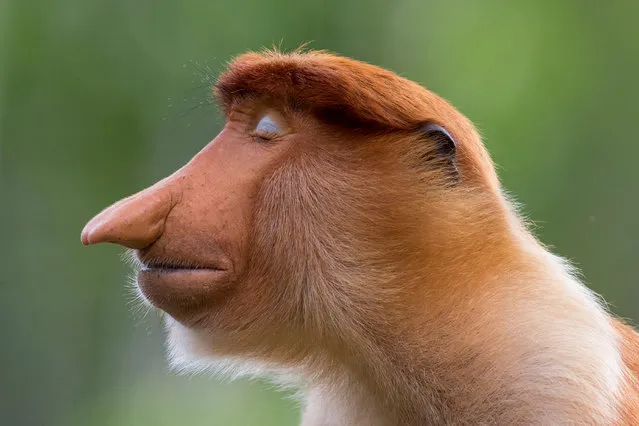
Winner – Animal Portraits: The pose by Mogens Trolle, Denmark. A young male proboscis monkey cocks his head slightly and closes his eyes. Unexpected pale blue eyelids now complement his immaculately groomed auburn hair. He poses for a few seconds as if in meditation. He is a wild visitor to the feeding station at Labuk Bay Proboscis Monkey Sanctuary in Sabah, Borneo – “the most laid-back character”, says Trolle, “quite unlike anything I’ve ever seen on another monkey” – connects us, he hopes, with a fellow primate. (Photo by Mogens Trolle/Wildlife Photographer of the Year 2020)

Winner – Animal Portraits: The pose by Mogens Trolle, Denmark. A young male proboscis monkey cocks his head slightly and closes his eyes. Unexpected pale blue eyelids now complement his immaculately groomed auburn hair. He poses for a few seconds as if in meditation. He is a wild visitor to the feeding station at Labuk Bay Proboscis Monkey Sanctuary in Sabah, Borneo – “the most laid-back character”, says Trolle, “quite unlike anything I’ve ever seen on another monkey” – connects us, he hopes, with a fellow primate. (Photo by Mogens Trolle/Wildlife Photographer of the Year 2020)
Details
16 Oct 2020 00:03:00
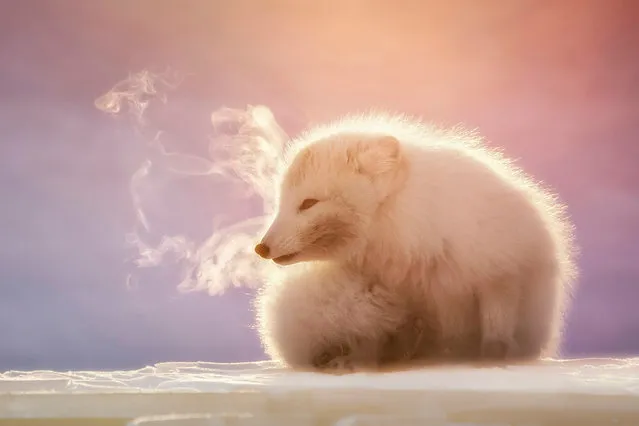
Breath of an Arctic fox by Marco Gaiotti, Italy. Marco was watching this little Arctic fox as it incessantly called another nearby. Gradually he noticed the fox’s wet breath was quickly freezing in the air after each call. It was late winter in Spitsbergen, Svalbard, and the air was -35C (-31F). Photographing Arctic foxes is often frustrating, as they are normally running around fast in search of food, but this one was very relaxed and let Marco get close enough to focus on it, with the light glowing perfectly in the background. (Photo by Marco Gaiotti/Wildlife Photographer of the Year 2021)

Breath of an Arctic fox by Marco Gaiotti, Italy. Marco was watching this little Arctic fox as it incessantly called another nearby. Gradually he noticed the fox’s wet breath was quickly freezing in the air after each call. It was late winter in Spitsbergen, Svalbard, and the air was -35C (-31F). Photographing Arctic foxes is often frustrating, as they are normally running around fast in search of food, but this one was very relaxed and let Marco get close enough to focus on it, with the light glowing perfectly in the background. (Photo by Marco Gaiotti/Wildlife Photographer of the Year 2021)
Details
05 Dec 2021 06:36:00
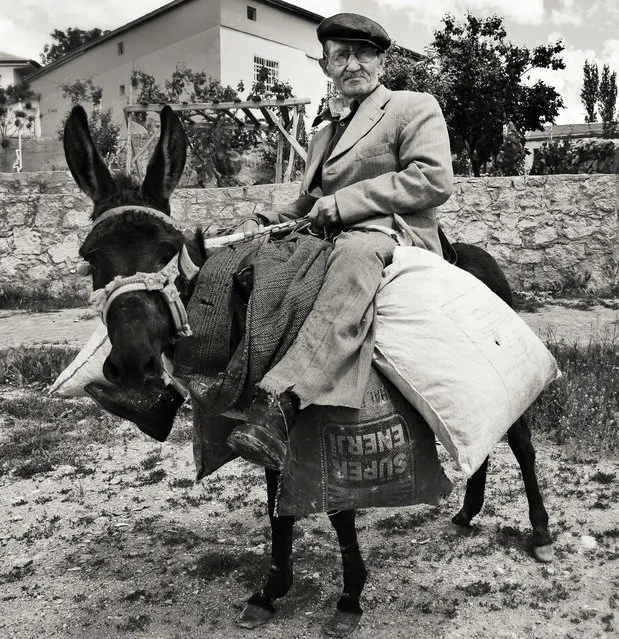
“Super Enerji”. Taken on my road trip through Turkey. (Photo and caption by Michelle Brandemuehl/National Geographic Traveler Photo Contest)

“Super Enerji”. Taken on my road trip through Turkey. (Photo and caption by Michelle Brandemuehl/National Geographic Traveler Photo Contest)

ATTENTION! All pictures are presented in high resolution. To see Hi-Res images – just TWICE click on any picture. In other words, click small picture – opens the BIG picture. Click BIG picture – opens VERY BIG picture.
Details
05 Jul 2013 11:17:00
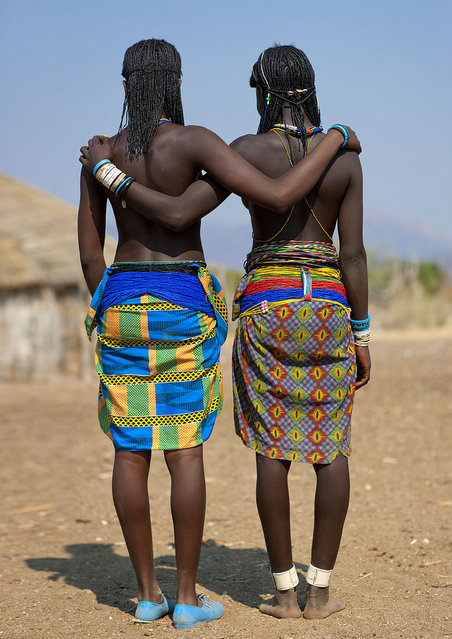
“Show us our butts! Mucawana tribe – Angola. In Soba village, the Muhacaona (Mucawana) tribe, perhaps the best place i have visited. They use cow dung and fat to make this so nice haircut, and love the beads. They asked me to make pictures of their backs... and butts to see on the camera screen if everything was perfect!”. (Eric Lafforgue)

“Show us our butts! Mucawana tribe – Angola. In Soba village, the Muhacaona (Mucawana) tribe, perhaps the best place i have visited. They use cow dung and fat to make this so nice haircut, and love the beads. They asked me to make pictures of their backs... and butts to see on the camera screen if everything was perfect!”. (Photo and comments by Eric Lafforgue)
Details
09 Nov 2012 15:04:00