Loading...
Done
Switzerland's lead Nicole Schwaegli (L) and second Marisa Winkelhausen sweep during their curling round robin game against Japan at the World Women's Curling Championships in Sapporo March 14, 2015. (Photo by Thomas Peter/Reuters)

Switzerland's lead Nicole Schwaegli (L) and second Marisa Winkelhausen sweep during their curling round robin game against Japan at the World Women's Curling Championships in Sapporo March 14, 2015. (Photo by Thomas Peter/Reuters)
Details
17 Mar 2015 12:15:00
An aerial view of open pits of CODELCO's Andina (L) and Anglo American's Los Bronces copper mines with Olivares glaciers in the background (top L) at Los Andes Mountain range, near Santiago city, November 17, 2014. The rock glaciers of the Chilean central zone, a huge source of water for the basins of the capital, are said to be threatened by the environmental impacts of hydroelectric and mining projects, according to environmental activists Greenpeace. (Photo by Ivan Alvarado/Reuters)

An aerial view of open pits of CODELCO's Andina (L) and Anglo American's Los Bronces copper mines with Olivares glaciers in the background (top L) at Los Andes Mountain range, near Santiago city, November 17, 2014. The rock glaciers of the Chilean central zone, a huge source of water for the basins of the capital, are said to be threatened by the environmental impacts of hydroelectric and mining projects, according to environmental activists Greenpeace. (Photo by Ivan Alvarado/Reuters)
Details
19 Nov 2014 14:06:00
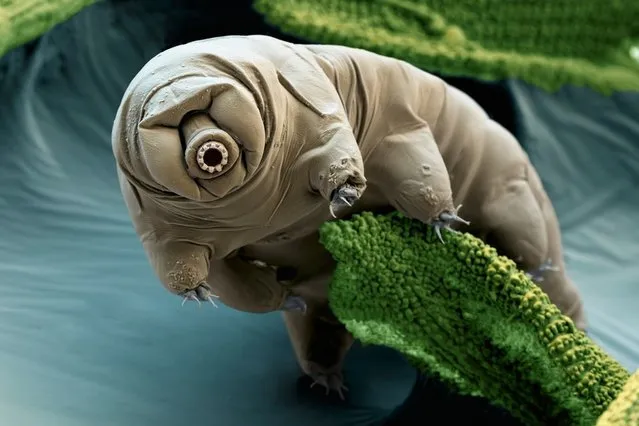
Tardigrades (commonly known as waterbears or moss piglets). (Photo by SPL/East News)

“Tardigrades (commonly known as waterbears or moss piglets) are small, water-dwelling, segmented animals with eight legs. Tardigrades were first discovered in 1773 by Johann August Ephraim Goeze, who called them kleiner Wasserbär, meaning “little water bear” in German. The name Tardigrada means “slow walker” and was given by Lazzaro Spallanzani in 1777. The name water bear comes from the way they walk, reminiscent of a bear's gait. The biggest adults may reach a body length of 1.5 millimetres (0.059 in), the smallest below 0.1 mm. Freshly hatched tardigrades may be smaller than 0.05 mm”. – Wikipedia. Photo: Tardigrades. (Photo by SPL/East News)
Details
26 Sep 2012 09:55:00
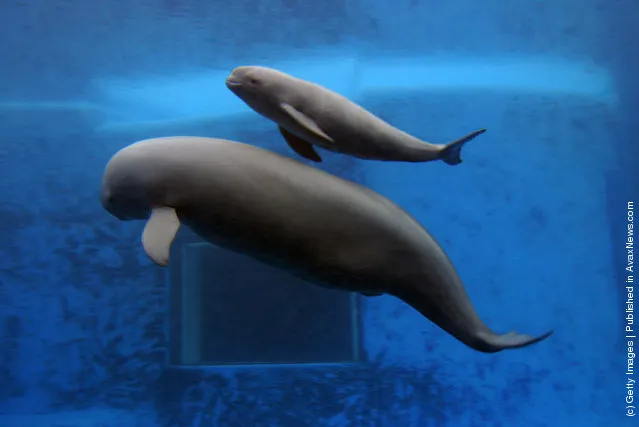
A newly born Yangtze finless porpoise (top) swims with his mother at the Hydrobiology Institute of the Chinese Academy of Sciences

“The finless porpoise (Neophocaena phocaenoides) is one of six porpoise species. In the waters around Japan, at the northern end of its range, it is known as the sunameri. A freshwater population found in the Yangtze River in China is known locally as the jiangzhu or «river pig»”. – Wikipedia

Photo: A newly born Yangtze finless porpoise (top) swims with his mother at the Hydrobiology Institute of the Chinese Academy of Sciences on June 3, 2007 in Wuhan of Hubei Province, China. (Photo by China Photos/Getty Images)
Details
20 Feb 2012 12:23:00
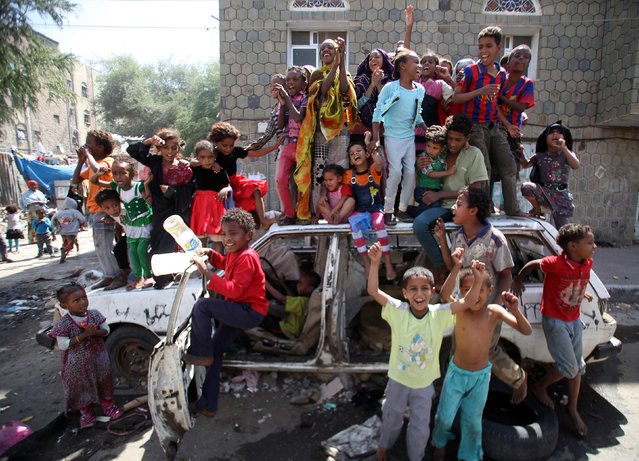
Children play on an abandoned car near a protest, which is against the dissolution of Yemen's parliament and the Shi'ite Muslim Houthi militia's tightening grip on power, in the southwestern city of Taiz, February 13, 2015. (Photo by Mohamed al-Sayaghi/Reuters)

Children play on an abandoned car near a protest, which is against the dissolution of Yemen's parliament and the Shi'ite Muslim Houthi militia's tightening grip on power, in the southwestern city of Taiz, February 13, 2015. (Photo by Mohamed al-Sayaghi/Reuters)
Details
19 Feb 2015 14:08:00
Members of indigenous Gurung community wearing traditional attire takes part with others in a New Year celebration ceremony known as “Tamu Lhosar” in Kathmandu on December 30, 2022. (Photo by Prakash Mathema/AFP Photo)

Members of indigenous Gurung community wearing traditional attire takes part with others in a New Year celebration ceremony known as “Tamu Lhosar” in Kathmandu on December 30, 2022. (Photo by Prakash Mathema/AFP Photo)
Details
18 Jan 2023 00:13:00
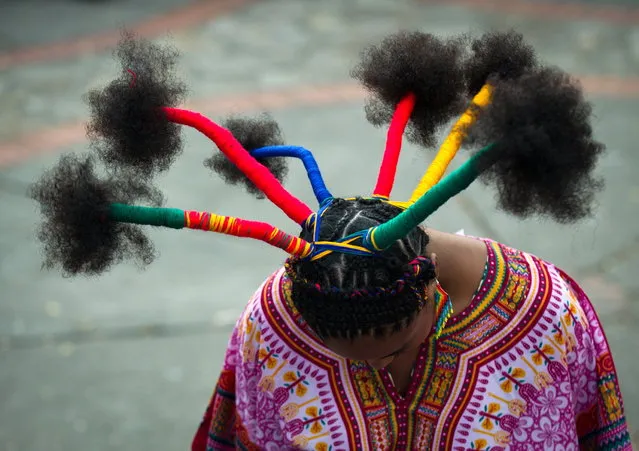
A woman presents an Afro-Colombian hairstyle during the 9th contest of Afro-hairdressers, in Cali, Valle del Cauca departament, Colombia, on May 12, 2013. The Afro hairstyles have their origins in the time of slavery, when women sat to comb their children hair after work. (Photo by Luis Robayo/AFP Photo)

A woman presents an Afro-Colombian hairstyle during the 9th contest of Afro-hairdressers, in Cali, Valle del Cauca departament, Colombia, on May 12, 2013. The Afro hairstyles have their origins in the time of slavery, when women sat to comb their children hair after work. (Photo by Luis Robayo/AFP Photo)
Details
13 May 2013 11:01:00
A family poses for a picture in front of the carcasses of sacrificed buffalos a day after the sacrificial ceremony of the “Gadhimai Mela” festival held in Bariyapur November 29, 2014. Sword-wielding Hindu devotees in Nepal began slaughtering thousands of animals and birds in a ritual sacrifice on Friday, ignoring calls by animal rights activists to halt what they described as the world's largest such exercise. (Photo by Navesh Chitrakar/Reuters)

A family poses for a picture in front of the carcasses of sacrificed buffalos a day after the sacrificial ceremony of the “Gadhimai Mela” festival held in Bariyapur November 29, 2014. Sword-wielding Hindu devotees in Nepal began slaughtering thousands of animals and birds in a ritual sacrifice on Friday, ignoring calls by animal rights activists to halt what they described as the world's largest such exercise. (Photo by Navesh Chitrakar/Reuters)
Details
30 Nov 2014 12:35:00