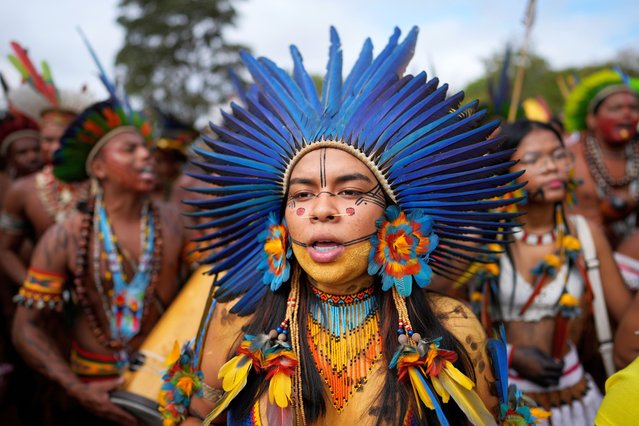
Indigenous people march during the annual Free Earth camp, where they discuss rights, territorial protection and their role in COP30, which will take place for the first time in the Amazon, in Brasilia, Brazil, Tuesday, April 8, 2025. (Photo by Eraldo Peres/AP Photo)
A tourist cools off in front of a misting fan near a venue of the Hozuki-Ichi (Japanese lantern plant fair), at Sensoji temple, in Tokyo, Japan, on July 10, 2025. (Photo by Kim Kyung-Hoon/Reuters)
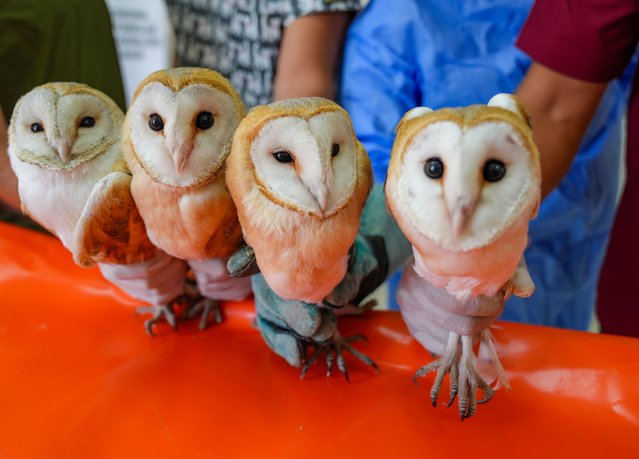
Four orphan barn owl chicks were found weak from hunger and thirst after their mother's death, are under treatment at the Dicle Wildlife Rescue and Rehabilitation Center before being released back into their natural habitat on September 23, 2025, in Diyarbakir, Turkiye. (Photo by Bestami Bodruk/Anadolu via Getty Images)
A veterinarian kisses an 8-month-old cat, wearing a prosthetic two-wheel device, at a veterinary hospital in Chongqing municipality, March 16, 2015. The cat's rear legs lost the abilty to walk after falling from the ninth to fifth floor of a building last November, its since undergone four major surgeries which included removing parts of its organs, local media reported. (Photo by Reuters/China Daily)
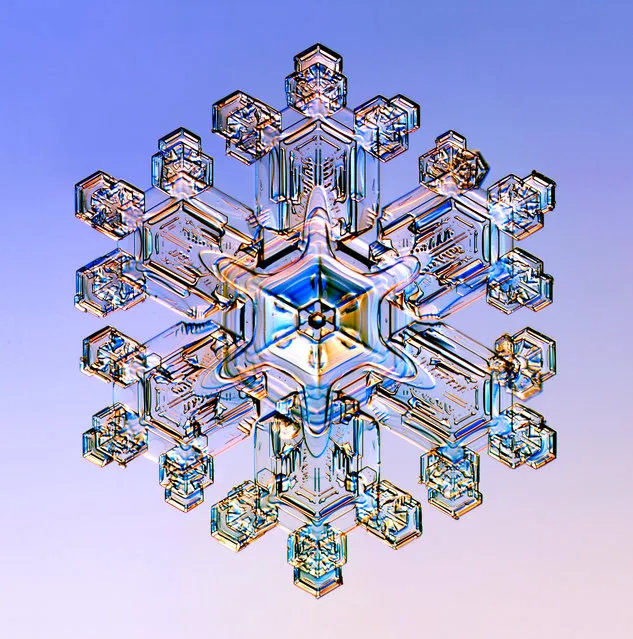
Most people know Nikon as a purveyor of pro and consumer-grade digital cameras. But the company's expertise with optics bleeds over into related markets – it's one of the science community's major suppliers of microscopes. And each year the company asks the community to send it some of their favorite images of tiny objects. A panel of scientists and journalists have chosen the best of this past year's submissions, which Nikon has placed on its Small World site.
Photo: Honorable Mention. “Snow crystal, illuminated with colored lights (5x)”. (Photo by Dr. Kenneth Libbrecht, California Institute of Technology (Caltech), Department of Physics, Pasadena, California, USA)
Cheerleaders let their hair fly as they perform prior to a German first division Bundesliga soccer match between 1. FC Cologne and Bayern Munich in Cologne, Germany, March 4, 2017. (Photo by Michael Probst/AP Photo)
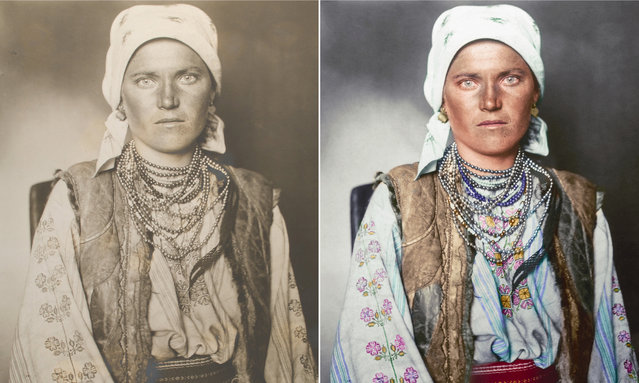
Many of the 12 million people who entered the US through New York’s Ellis Island wore traditional dress from their homelands. Here: A Ruthenian woman circa 1906 from the region historically inhabiting the kingdom of the Rus, incorporating parts of modern-day Slavic speaking countries. Her outfit consists of a shirt and underskirt made from linen embroidered with traditional floral-based patterns. (Photo by Augustus Francis Sherman/New York Public Library/The Guardian)