Loading...
Done
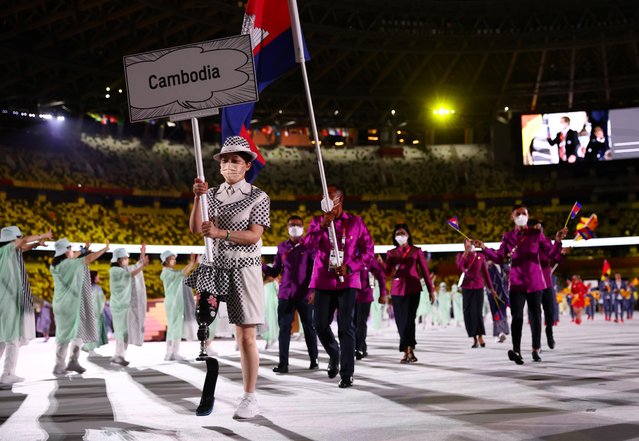
Flag bearers Bunpichmorakat Kheun and Sokong Pen of Team Cambodia during the Opening Ceremony of the Tokyo 2020 Olympic Games at Olympic Stadium on July 23, 2021 in Tokyo, Japan. (Photo by Kai Pfaffenbach/Reuters)

Flag bearers Bunpichmorakat Kheun and Sokong Pen of Team Cambodia during the Opening Ceremony of the Tokyo 2020 Olympic Games at Olympic Stadium on July 23, 2021 in Tokyo, Japan. (Photo by Kai Pfaffenbach/Reuters)
Details
24 Jul 2021 08:31:00
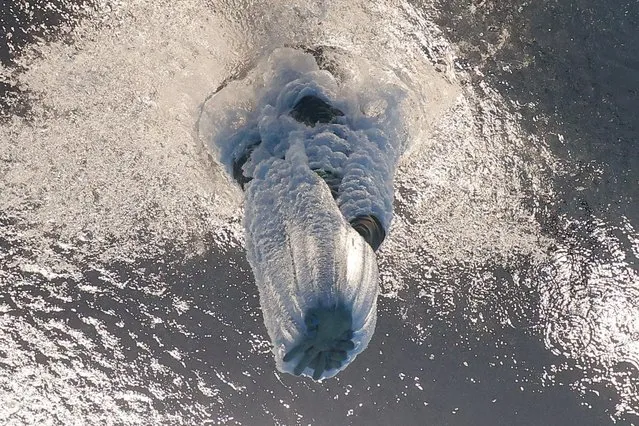
A diving competitor during a practice session at Tokyo Aquatics Centre ahead of the Tokyo 2020 Olympic Games in Japan on Wednesday, July 21, 2021. (Photo by Stefan Wermuth/Reuters)

A diving competitor during a practice session at Tokyo Aquatics Centre ahead of the Tokyo 2020 Olympic Games in Japan on Wednesday, July 21, 2021. (Photo by Stefan Wermuth/Reuters)
Details
26 Jul 2021 08:29:00
A baby orangutan called Barney shows off his dancing at Ragunan Zoo in Jakarta, Indonesia in the first decade of November 2023. (Photo by Syahrul Ramadan/Media Drum Images)

A baby orangutan called Barney shows off his dancing at Ragunan Zoo in Jakarta, Indonesia in the first decade of November 2023. (Photo by Syahrul Ramadan/Media Drum Images)
Details
19 Nov 2023 04:36:00
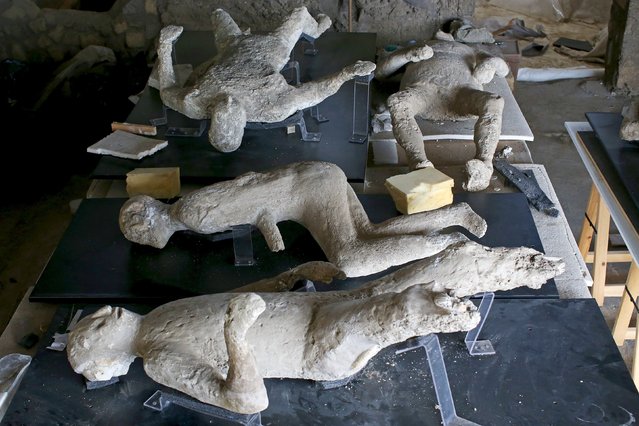
Plaster cast moulds of victims of the Mount Vesuvius eruption lie on a display table in a laboratory at Pompeii October 13, 2015. An expert team made up of archaeologists, radiologists, orthodontists and anthropologists began on September 2015 to use CAT scan technology (computerised axial tomography) to peer inside the plaster cast moulds of Pompeii's victims, in a study that has added more detail to previous findings. (Photo by Alessandro Bianchi/Reuters)

Plaster cast moulds of victims of the Mount Vesuvius eruption lie on a display table in a laboratory at Pompeii October 13, 2015. An expert team made up of archaeologists, radiologists, orthodontists and anthropologists began on September 2015 to use CAT scan technology (computerised axial tomography) to peer inside the plaster cast moulds of Pompeii's victims, in a study that has added more detail to previous findings. A 16-layer scan had to be used in order to penetrate the hardened plaster but the results showed up impressive skeletal remains and near perfect teeth. (Photo by Alessandro Bianchi/Reuters)
Details
22 Oct 2015 08:02:00
WWW

OMG! Cantonese Advertising UEFA Euro 2012 (Music Video)
Details
22 May 2012 12:36:00
A Geisha girl pouring a drink for a visitor, circa 1955. (Photo by Fox Photos)

A Geisha girl pouring a drink for a visitor, circa 1955. (Photo by Fox Photos). P.S. All pictures are presented in high resolution.
Details
07 Sep 2012 11:24:00
This picture taken on January 3, 2019 shows a Vietnamese woman collecting incense sticks in a courtyard in the village of Quang Phu Cau on the outskirts of Hanoi. In Vietnam's “incense village”, hundreds of workers are hard at work dying, drying and whittling down bamboo bark to make the fragrant sticks ahead of the busy lunar new year holiday. (Photo by Manan Vatsyayana/AFP Photo)

This picture taken on January 3, 2019 shows a Vietnamese woman collecting incense sticks in a courtyard in the village of Quang Phu Cau on the outskirts of Hanoi. In Vietnam's “incense village”, hundreds of workers are hard at work dying, drying and whittling down bamboo bark to make the fragrant sticks ahead of the busy lunar new year holiday. (Photo by Manan Vatsyayana/AFP Photo)
Details
01 Mar 2019 00:05:00
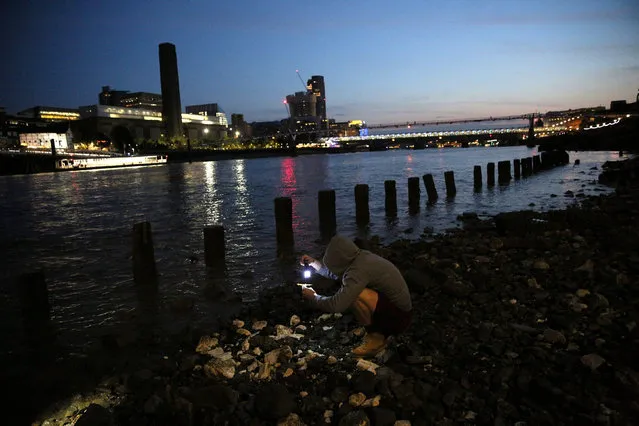
A mudlark uses a torch to look for items on the bank of the River Thames in London, Britain June 06, 2016. Mudlarking is believed to trace its origins to the 18th and 19th century, when scavengers searched the Thames' shores for items to sell. These days, history and archaeology fans are the ones hoping to find old relics such as coins, ceramics, artifacts or everyday items from across centuries. They wait for the low tide and then scour specific areas of exposed shores. "If you're in a field you could be out all day long, with the river you're restricted to about two or three hours," mudlark Nick Stevens said. While many just use the naked eye for their searches, others rely on metal detectors for which a permit from the Port of London Authority is needed. Digging also requires consent. (Photo by Neil Hall/Reuters)

A mudlark uses a torch to look for items on the bank of the River Thames in London, Britain June 06, 2016. Mudlarking is believed to trace its origins to the 18th and 19th century, when scavengers searched the Thames' shores for items to sell. These days, history and archaeology fans are the ones hoping to find old relics such as coins, ceramics, artifacts or everyday items from across centuries. their finds with the Portable Antiquities Scheme. Any item over 300 years old must be recorded. (Photo by Neil Hall/Reuters)

Details
27 Aug 2016 10:43:00