Loading...
Done
Tercio Galdino, 66, and his wife Aliceia, 65, wear their protective “space suits” as they walk on the sidewalk of Copacabana Beach amid the coronavirus outbreak in Rio de Janeiro, Brazil, July 11, 2020. (Photo by Ricardo Moraes/Reuters)

Tercio Galdino, 66, and his wife Aliceia, 65, wear their protective “space suits” as they walk on the sidewalk of Copacabana Beach amid the coronavirus outbreak in Rio de Janeiro, Brazil, July 11, 2020. (Photo by Ricardo Moraes/Reuters)
Details
25 Nov 2020 00:03:00
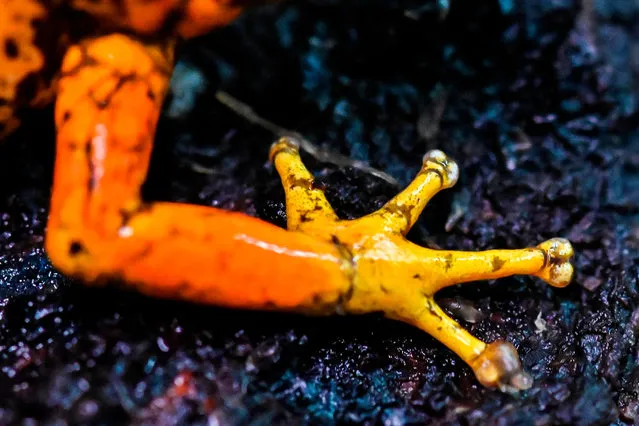
A leg of a “diablito” frog (Oophaga sylvatica) is photographed in a laboratory at a laboratory in the zoo of Cali, Colombia, on July 19, 2019. Colombia is the second country with the largest number of amphibians in the world after Brazil. More than 40% of amphibian species worldwide are in danger of extinction. (Photo by Luis Robayo/AFP Photo)

A leg of a “diablito” frog (Oophaga sylvatica) is photographed in a laboratory at a laboratory in the zoo of Cali, Colombia, on July 19, 2019. Colombia is the second country with the largest number of amphibians in the world after Brazil. More than 40% of amphibian species worldwide are in danger of extinction. (Photo by Luis Robayo/AFP Photo)
Details
28 Nov 2020 00:03:00
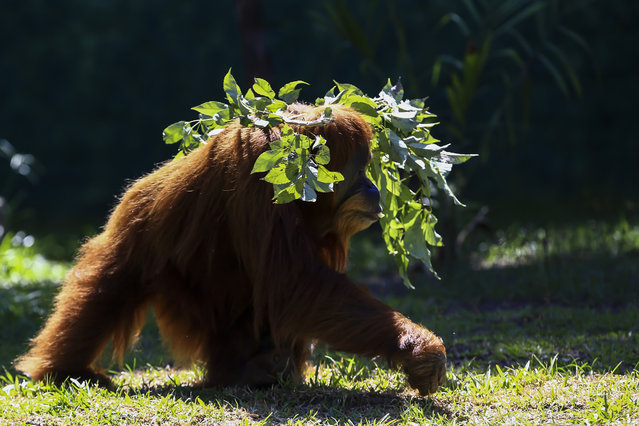
An Orangutan named Elze walks in the Biopark of Rio during a media tour in Rio de Janeiro, Brazil, Thursday, March 18, 2021. The park was closed to the public for renovations to convert the city zoo into a center for biodiversity conservation and will reopen to the general public at the end of March. (Photo by Bruna Prado/AP Photo)

An Orangutan named Elze walks in the Biopark of Rio during a media tour in Rio de Janeiro, Brazil, Thursday, March 18, 2021. The park was closed to the public for renovations to convert the city zoo into a center for biodiversity conservation and will reopen to the general public at the end of March. (Photo by Bruna Prado/AP Photo)
Details
28 Mar 2021 09:55:00
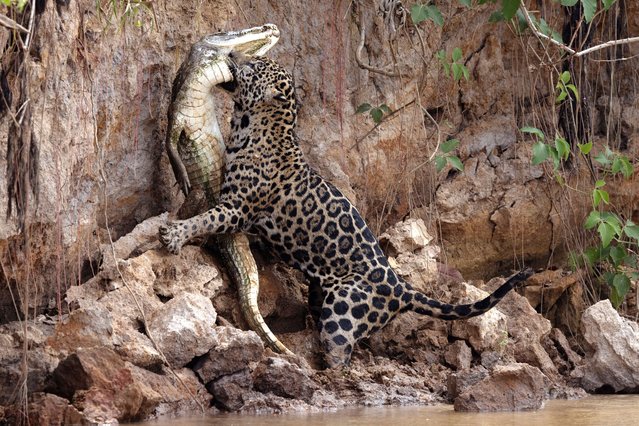
A female jaguar named Ti, by the NGO Jaguar ID, bites an alligator at Encontro das Aguas State Park, in the Pantanal, the largest wetland in the world, in Pocone, Mato Grosso, Brazil, on October 10, 2024. (Photo by Sergio Moraes/Reuters)

A female jaguar named Ti, by the NGO Jaguar ID, bites an alligator at Encontro das Aguas State Park, in the Pantanal, the largest wetland in the world, in Pocone, Mato Grosso, Brazil, on October 10, 2024. (Photo by Sergio Moraes/Reuters)
Details
10 Nov 2024 04:10:00
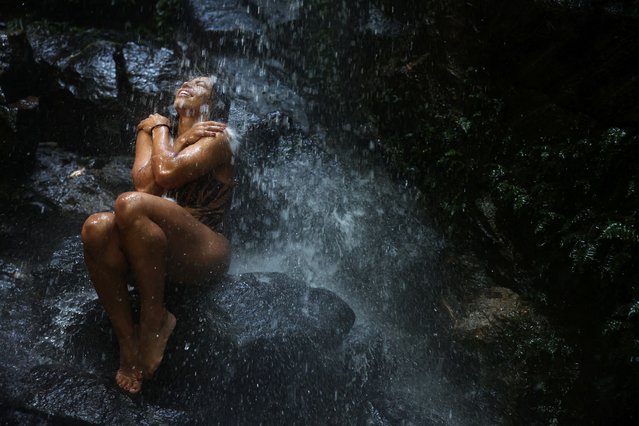
Anda Oliveira, 34, enjoys a waterfall in the Tijuca National Park, one of the world's biggest urban forests, marking the World Water Day in Rio de Janeiro, Brazil on March 15, 2024. (Photo by Pilar Olivares/Reuters)

Anda Oliveira, 34, enjoys a waterfall in the Tijuca National Park, one of the world's biggest urban forests, marking the World Water Day in Rio de Janeiro, Brazil on March 15, 2024. (Photo by Pilar Olivares/Reuters)
Details
01 Jul 2025 02:56:00
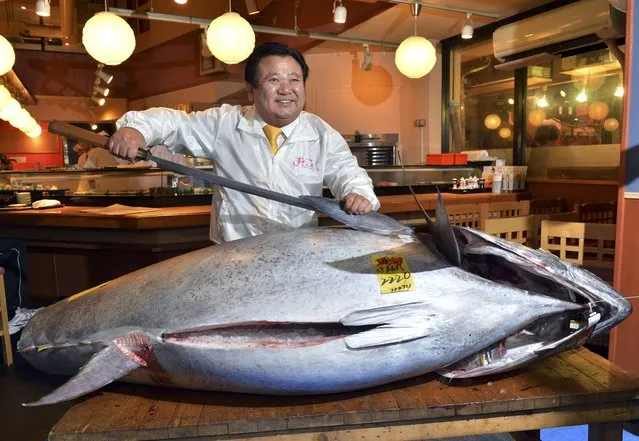
President of sushi restaurant chain Sushi-Zanmai, Kiyoshi Kimura, displays a 222kg bluefin tuna at his main restaurant near Tokyo's Tsukiji fish market on January 5, 2013. The bluefin tuna was traded at 155.4 million yen (1.77 million USD) at the wholesale market, smashing a previous record. (Photo by Yoshikazu Tsuno/AFP Photo)

Japanese businessman Kiyoshi Kimura has paid 1.38 million euros ($1.76 million, or 155.4 million yen) for a blue fin tuna – more than three times the previous high – which he also set one year ago. The 222-kilogram fish will be served to Kimura’s customers. Blue fin tuna is annually sold in a traditional New Year’s auction. Japan consumes 80 percent blue fin tuna caught worldwide.

Photo: President of sushi restaurant chain Sushi-Zanmai, Kiyoshi Kimura, displays a 222kg bluefin tuna at his main restaurant near Tokyo's Tsukiji fish market on January 5, 2013. The bluefin tuna was traded at 155.4 million yen (1.77 million USD) at the wholesale market, smashing a previous record. (Photo by Yoshikazu Tsuno/AFP Photo)
Details
06 Jan 2013 13:26:00
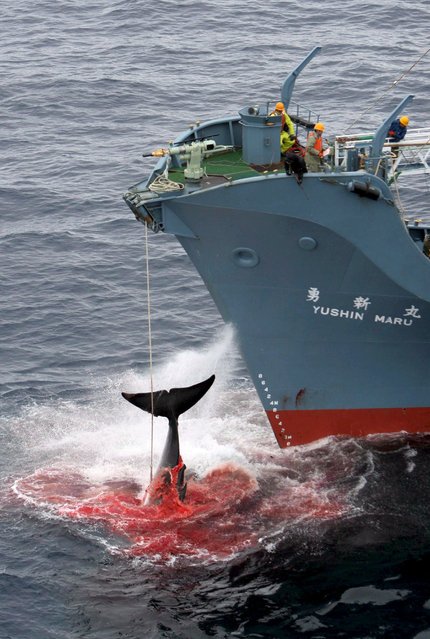
A file photograph dated 07 January 2006 and released by Greenpeace, showing the Yushin Maru, a factory ship in a Japanese whaling fleet, injuring a whale with it's first harpoon attempt. A UN court in The Hague on 31 March 2014 halted Japan's much-criticized whaling programme, ruling that it contravenes a 1986 moratorium on whale hunting. Japan must end its 'research whaling' programme, the International Court of Justice (ICJ) said. (Photo by Kate Davison/EPA)

A file photograph dated 07 January 2006 and released by Greenpeace, showing the Yushin Maru, a factory ship in a Japanese whaling fleet, injuring a whale with it's first harpoon attempt. A UN court in The Hague on 31 March 2014 halted Japan's much-criticized whaling programme, ruling that it contravenes a 1986 moratorium on whale hunting. Japan must end its 'research whaling' programme, the International Court of Justice (ICJ) said. Japan said the programme was for scientific research and permitted under international conventions. Australia had brought the case to the ICJ in 2010, charging that Japan was breaching international law by killing hundreds of whales every year for commercial purposes. Japan was “deeply disappointed” by the ruling, an unnamed government official was quoted by the Kyodo News agency as saying. But the official said Japan would stand by the ruling. (Photo by Kate Davison/EPA)
Details
01 Apr 2014 08:38:00
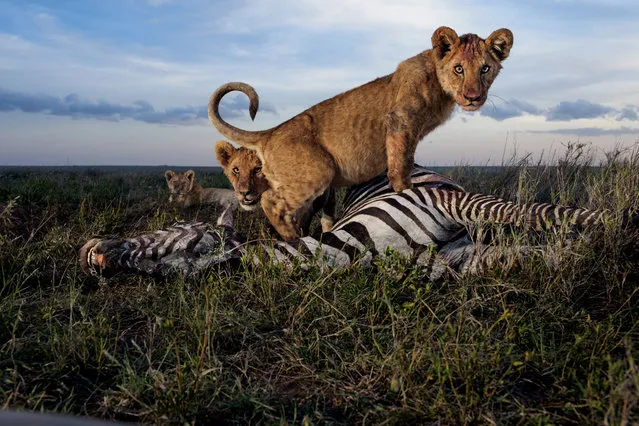
Cubs of the Simba East pride: too young to kill but old enough to crave meat. Adult females, and sometimes males, do the hunting. Zebras and wildebeests rank high as chosen prey in the rainy season. (Photo by Michael Nichols/National Geographic via The Atlantic)

“Serengeti National Park encompasses 5,700 square miles of grassy plains and woodlands near the northern border of Tanzania, and is home to more than 3,500 lions grouped into a couple dozen prides. Photographer Nick Nichols and videographer Nathan Williamson made several extended trips to the Serengeti between July 2011 and January 2013, determined to break new visual ground in their coverage of the Serengeti Lions”. Photo: Cubs of the Simba East pride: too young to kill but old enough to crave meat. Adult females, and sometimes males, do the hunting. Zebras and wildebeests rank high as chosen prey in the rainy season. (Photo by Michael Nichols/National Geographic via The Atlantic)
Details
09 Aug 2013 08:15:00