Loading...
Done
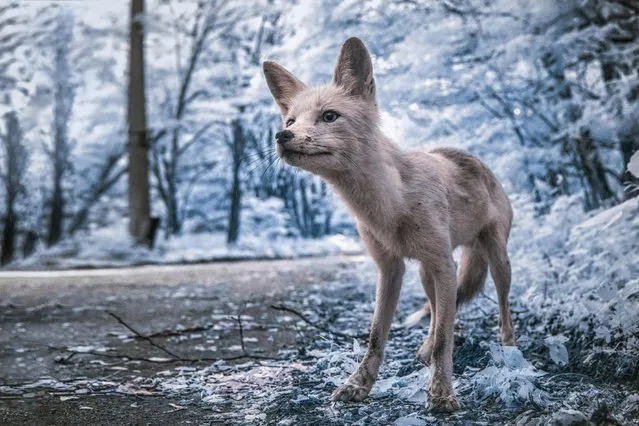
Simon – a friendly fox, who often approaches tourists in the exclusion zone, asking for food. (Photo by Vladimir Mitgutin/Caters News Agency)

This fascinating photo series looks at the bleak isolation of Chernobyl as never before. Employing infrared filters, photographer Vladimir Mitgutin is able to bring out details of decay – an abandoned bus, a radar system, an amusement park, a doll, a sports hall, a piano – frozen in time. Here: Simon – a friendly fox, who often approaches tourists in the exclusion zone, asking for food. (Photo by Vladimir Mitgutin/Caters News Agency)
Details
12 Feb 2018 00:02:00
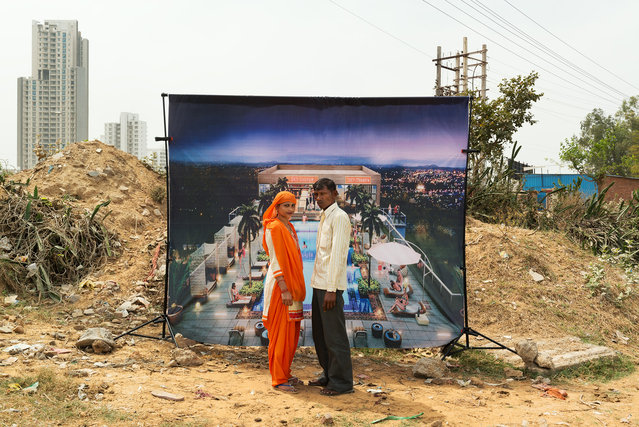
Luxury Living Bhiwadi: “Sky Club on 18th Floor”. Passersby, workers and villagers pose in front of the idealised representations of modern homes. (Photo by Arthur Crestani/The Guardian)

Inspired by traditional Indian travelling photography studios, Arthur Crestani photographed the inhabitants of Gurgaon, a city built almost entirely by private companies. Arthur Crestani’s “Bad City Dreams” contrasts the glossy ideal sold by developers with urban reality. Here: Luxury Living Bhiwadi: “Sky Club on 18th Floor”. (Photo by Arthur Crestani/The Guardian)
Details
16 Mar 2018 00:01:00
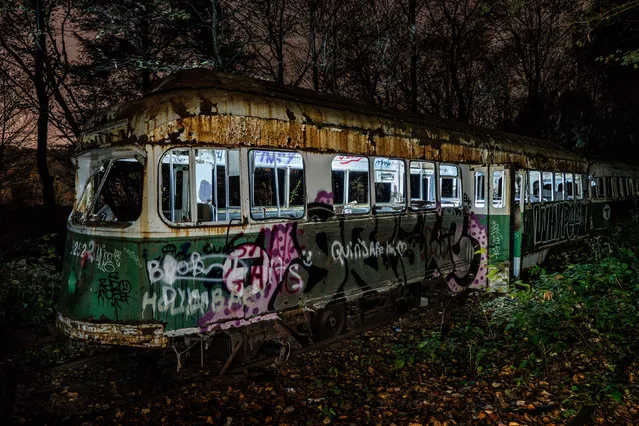
Abandoned trolley graveyard in Pennsylvania. (Photo by Matthew Christopher/Abandoned America/Caters News Agency)

Tucked away in these spooky woodlands, one man has amassed a huge collection of decaying trolley cars. Once a novel mode of public transport in the likes early 20th Century New York, the hauntingly beautiful trolleys are now at one with nature – a scene that abandoned location photographer Matthew Christopher was able to discover in a location not disclosed to the public. Here: Abandoned trolley graveyard in Pennsylvania. (Photo by Matthew Christopher/Abandoned America/Caters News Agency)
Details
27 Mar 2018 00:05:00
Of all the species affected by river regulation in Australia, the ibis is one of the few that has changed its behaviour and moved to coastal cities. (Photo by Rick Stevens/The Guardian)

Tip turkey, dumpster chook, rubbish raptor – the Australian white ibis goes by many unflattering names. But it is a true urban success story, scavenging to survive in cities across Australia as wetlands have been lost. Wildlife photographer Rick Stevens captured them in Sydney. Here: Of all the species affected by river regulation in Australia, the ibis is one of the few that has changed its behaviour and moved to coastal cities. (Photo by Rick Stevens/The Guardian)
Details
11 Apr 2018 00:03:00
American media personality Draya Michele attends #REVOLVEawards at DREAM Hollywood on November 2, 2017 in Hollywood, California. (Photo by Barry King/Getty Images)

American media personality Draya Michele attends #REVOLVEawards at DREAM Hollywood on November 2, 2017 in Hollywood, California. (Photo by Barry King/Getty Images)
Details
05 Nov 2017 08:18:00
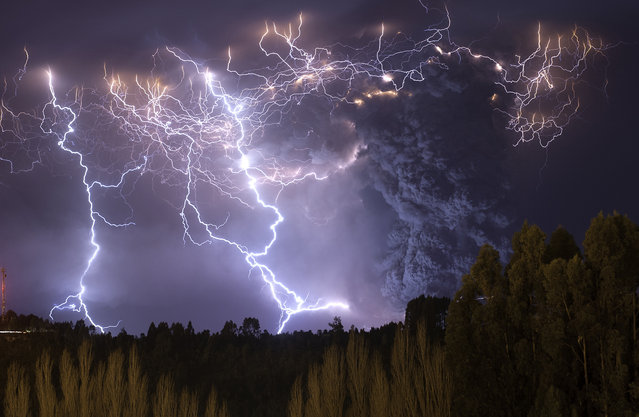
The eruption of Cordon Caulle began on June 4, 2011, located in the Region of Los Rios in Chile. For about 12 months, people and animals became accustomed to living with the daily fall of ash, which also caused problems in the air traffic in South America. The explosions and lightning during first days of the eruption could be seen from hundreds of miles around. This photograph was taken on the second night of eruption from the town of Lago Ranco. (Photo and caption by Francisco Negroni/National Geographic Traveler Photo Contest)

The eruption of Cordon Caulle began on June 4, 2011, located in the Region of Los Rios in Chile. For about 12 months, people and animals became accustomed to living with the daily fall of ash, which also caused problems in the air traffic in South America. The explosions and lightning during first days of the eruption could be seen from hundreds of miles around. This photograph was taken on the second night of eruption from the town of Lago Ranco. (Photo and caption by Francisco Negroni/National Geographic Traveler Photo Contest)

ATTENTION! All pictures are presented in high resolution. To see Hi-Res images – just TWICE click on any picture. In other words, click small picture – opens the BIG picture. Click BIG picture – opens VERY BIG picture.
Details
23 Jun 2013 11:24:00
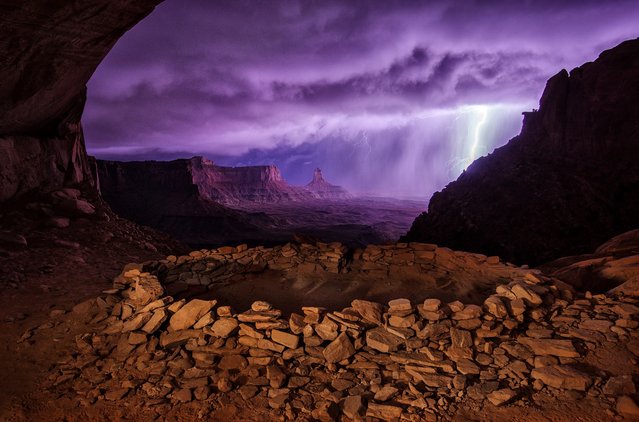
Second Place Winner: “Thunderstorm at False Kiva”. I hiked out to these ruins at night hoping to photograph them with the Milky Way, but instead a thunderstorm rolled through, creating this dramatic image. – Max Seigal. (Photo and caption by Max Seigal/National Geographic Traveler Photo Contest)

Second Place Winner: “Thunderstorm at False Kiva”. I hiked out to these ruins at night hoping to photograph them with the Milky Way, but instead a thunderstorm rolled through, creating this dramatic image. – Max Seigal. National Geographic Traveler Director of Photography Dan Westergren, one of this year's judges, shares his thoughts on the second place winner: “This photo combines two different scenes into one: the small kiva in a cliff dwelling and the grand vista of Canyonlands National Park across the valley. I really like the two different color palettes – warm inside and purple outside. This two-for-one scene was caused by the lightning storm outside the dwelling, which lit up the landscape like it was a huge electronic flash. Looking at this picture I can imagine what a wonderful sight it must have been for the ancient people who lived here. It doesn't seem too amazing now in our modern world, but might have been mind-blowing for the prehistoric residents”. Location: Utah. (Photo and caption by Max Seigal/National Geographic Traveler Photo Contest)
Details
02 Aug 2013 06:16:00
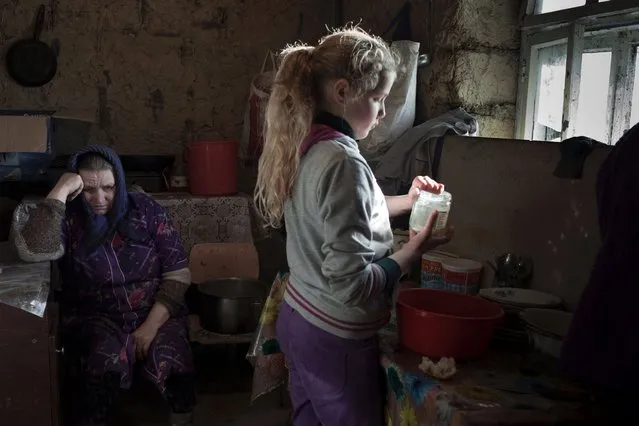
According to the U.S. government, Moldova, one of the poorest countries in Europe, depends on about $1.6 billion annually sent back from the roughly one million Moldovans who left for work in in Europe, Russia, and other former Soviet Bloc countries. Photographer Myriam Meloni went to Moldova to document what she refers to as “social orphans” – children whose parents have emigrated to another country in search of a job and a better future for their families. Here: Lulia is seen washing dishes in her grandmother's house, where she lives. (Photo by Myriam Meloni)

According to the U.S. government, Moldova, one of the poorest countries in Europe, depends on about $1.6 billion annually sent back from the roughly one million Moldovans who left for work in in Europe, Russia, and other former Soviet Bloc countries. Photographer Myriam Meloni went to Moldova to document what she refers to as “social orphans” – children whose parents have emigrated to another country in search of a job and a better future for their families. Here: Lulia is seen washing dishes in her grandmother's house, where she lives. (Photo by Myriam Meloni)
Details
12 Mar 2016 14:57:00