Loading...
Done
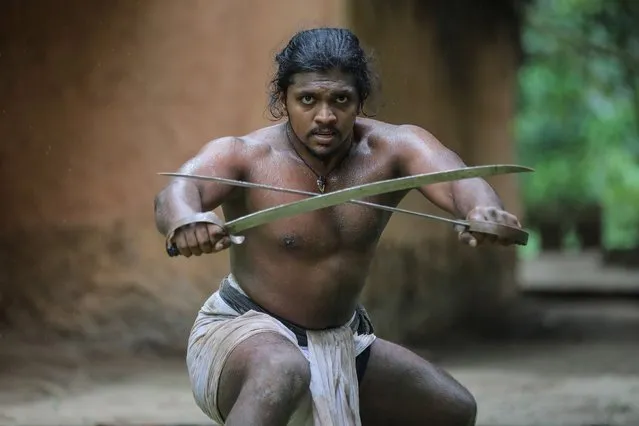
A student of the Sri Lankan ancient martial art “Angampora” performs during a practice session at the angam maduwa or fighting field, in Korathota, a suburb of Colombo, Sri Lanka, 07 September 2022. Sri Lanka's ancient martial art, Angampora, is thought to be thousands of years old. Anga translates to “body parts” and Angampora is a fighting art that uses body parts. Martial arts practitioners in Angampora were mostly in the king's service, and they were tasked with protecting the king and his kingdom. Angampora was practiced in secret for most centuries because the British, who colonized Sri Lanka, banned it in 1818 after seeing it as a threat. (Photo by Chamila Karunarathne/EPA/EFE)

A student of the Sri Lankan ancient martial art “Angampora” performs during a practice session at the angam maduwa or fighting field, in Korathota, a suburb of Colombo, Sri Lanka, 07 September 2022. Sri Lanka's ancient martial art, Angampora, is thought to be thousands of years old. Anga translates to “body parts” and Angampora is a fighting art that uses body parts. Martial arts practitioners in Angampora were mostly in the king's service, and they were tasked with protecting the king and his kingdom. Angampora was practiced in secret for most centuries because the British, who colonized Sri Lanka, banned it in 1818 after seeing it as a threat. (Photo by Chamila Karunarathne/EPA/EFE)
Details
14 Oct 2022 04:47:00
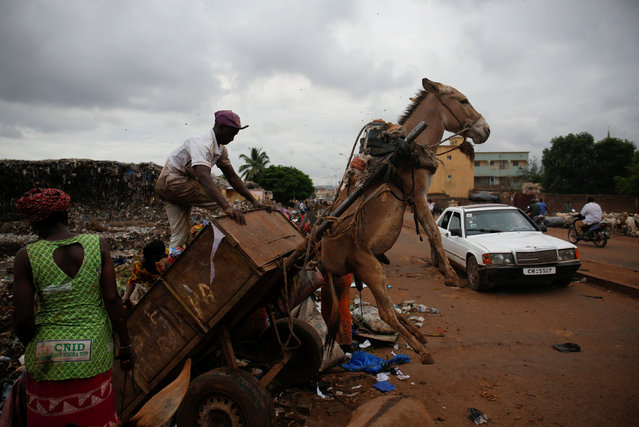
A waste picker unloads garbage at a waste transfer station in Bamako, Mali, August 19, 2018. In the Malian capital of Bamako, donkey carts driven by young men like 19-year-old Arouna Diabate play a vital role battling the fast-growing city's waste problem. Every morning before dawn, Diabate hitches his donkey to a cart and sets off on his rounds, going door-to-door to collect household garbage which he delivers to a local waste transfer station for a monthly salary of around $35. “I won't be picking up trash with a donkey cart for the rest of my life, but for now people appreciate us because we help clean up the homes of Bamako”, Diabate said. (Photo by Luc Gnago/Reuters)

A waste picker unloads garbage at a waste transfer station in Bamako, Mali, August 19, 2018. In the Malian capital of Bamako, donkey carts driven by young men like 19-year-old Arouna Diabate play a vital role battling the fast-growing city's waste problem. Every morning before dawn, Diabate hitches his donkey to a cart and sets off on his rounds, going door-to-door to collect household garbage which he delivers to a local waste transfer station for a monthly salary of around $35. “I won't be picking up trash with a donkey cart for the rest of my life, but for now people appreciate us because we help clean up the homes of Bamako”, Diabate said. (Photo by Luc Gnago/Reuters)
Details
18 Sep 2018 00:01:00
Montegut fire chief Toby Henry walks back to his fire truck in the rain as firefighters cut through trees on the road in Bourg, Louisiana as Hurricane Ida passes on August 29, 2021. Hurricane Ida struck the coast of Louisiana on August 29 as a powerful Category 4 storm, 16 years to the day after deadly Hurricane Katrina devastated the southern US city of New Orleans. “Extremely dangerous Category 4 Hurricane Ida makes landfall near Port Fourchon, Louisiana”, the National Hurricane Center wrote in an advisory. (Photo by Mark Felix/AFP Photo)

Montegut fire chief Toby Henry walks back to his fire truck in the rain as firefighters cut through trees on the road in Bourg, Louisiana as Hurricane Ida passes on August 29, 2021. Hurricane Ida struck the coast of Louisiana on August 29 as a powerful Category 4 storm, 16 years to the day after deadly Hurricane Katrina devastated the southern US city of New Orleans. “Extremely dangerous Category 4 Hurricane Ida makes landfall near Port Fourchon, Louisiana”, the National Hurricane Center wrote in an advisory. (Photo by Mark Felix/AFP Photo)
Details
28 Sep 2021 08:03:00
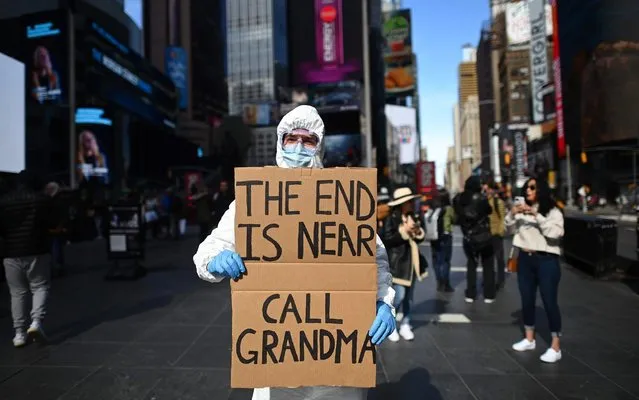
A man wearing a hazmat suit and a mask holds a sign reading “The end is near – call grandma” at Times Square on March 14, 2020 in New York City. The World Health Organization said March 13, 2020 it was not yet possible to say when the COVID-19 pandemic, which has killed more than 5,000 people worldwide, will peak. “It's impossible for us to say when this will peak globally”, Maria Van Kerkhove, who heads the WHO's emerging diseases unit, told a virtual press conference, adding that “we hope that it is sooner rather than later”. (Photo by Johannes Eisele/AFP Photo)

A man wearing a hazmat suit and a mask holds a sign reading “The end is near – call grandma” at Times Square on March 14, 2020 in New York City. The World Health Organization said March 13, 2020 it was not yet possible to say when the COVID-19 pandemic, which has killed more than 5,000 people worldwide, will peak. “It's impossible for us to say when this will peak globally”, Maria Van Kerkhove, who heads the WHO's emerging diseases unit, told a virtual press conference, adding that “we hope that it is sooner rather than later”. (Photo by Johannes Eisele/AFP Photo)
Details
16 Mar 2020 00:07:00
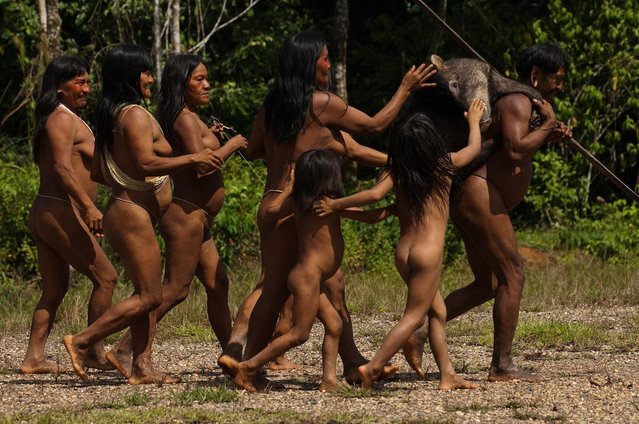
Spectacular images offering insight into the lives of the Huaorani people in the Ecuadorian Amazon have been revealed showing how they use traditional methods to hunt monkeys for food. The stunning pictures were taken by conservation photographer Pete Oxford from Torquay, Devon in the Ecuadorian Amazon. “The Huaorani Indians are a forest people highly in tune with their environment. Many are now totally acculturated since the 1950s by missionaries”, said Pete. “Today they face radical change to their culture to the proximity of oil exploration within their territory and the Yasuni National Park and Biosphere Reserve, they are vastly changed. Some still live very traditionally and for this shoot, through my Huaorani friend, a direct relative of those photographed he wanted to depict them as close to their original culture as possible. They still largely hunt with blow pipes and spears eating a lot of monkeys and peccaries”. The Huaorani are also known as the Waorani, Waodani or the Waos and are native Amerindians. Their lands are located between the Curaray and Napo rivers and speak the Huaorani language. Pete says that during his visit he was welcomed into the group and hopes that ancient cultures can be saved. Here: The tribe were seen celebrating after a hunter returned to camp with a wild pig. (Photo by Pete Oxford/Mediadrumworld.com)

Spectacular images offering insight into the lives of the Huaorani people in the Ecuadorian Amazon have been revealed showing how they use traditional methods to hunt monkeys for food. The stunning pictures were taken by conservation photographer Pete Oxford from Torquay, Devon in the Ecuadorian Amazon. Here: The tribe were seen celebrating after a hunter returned to camp with a wild pig. (Photo by Pete Oxford/Mediadrumworld.com)
Details
20 Jan 2017 07:58:00
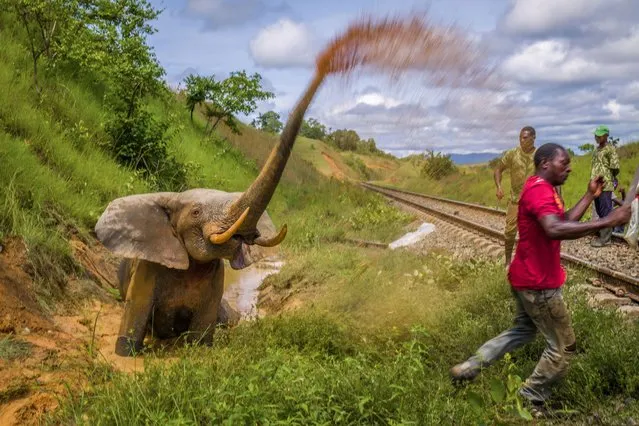
Grand prize winner: environmental photographer of the year 2023; also 1st place in the humanity v nature category; and winner of the 2023 public award. Lopé national park, Gabon, 2021. An angry elephant tries to defend itself after it was hit by a train that crosses paths the animals use within Lopé national park. Park officials decided the elephant was too severely injured to be saved. After it was killed, the park director distributed the meat to local people. As the forest loses its carrying capacity to sustain its megafauna, this kind of human-wildlife conflict is increasing. (Photo by Jasper Doest/Environmental Photography Award)

Grand prize winner: environmental photographer of the year 2023; also 1st place in the humanity v nature category; and winner of the 2023 public award. Lopé national park, Gabon, 2021. An angry elephant tries to defend itself after it was hit by a train that crosses paths the animals use within Lopé national park. Park officials decided the elephant was too severely injured to be saved. After it was killed, the park director distributed the meat to local people. As the forest loses its carrying capacity to sustain its megafauna, this kind of human-wildlife conflict is increasing. (Photo by Jasper Doest/Environmental Photography Award)
Details
09 Jul 2023 03:06:00
Pedra da Gavea highline, 850 meters above the city, 100 meters direct exposure, March 24, 2013. Brian Mosbaugh on the line. Carefully tiptoeing almost 3000 metres above Rio de Janeiro on a thin wire got a bit too much for this adrenaline junkie – so he decided to have a LIE DOWN. Fearless Brian Mosbaugh is so used to the perilous heights he decided he deserved a short break and proceeded to kick back and relax over the famous Brazilian city. (Photo by Scott Rogers/Caters)

Pedra da Gavea highline, 850 meters above the city, 100 meters direct exposure, March 24, 2013. Brian Mosbaugh on the line. Carefully tiptoeing almost 3000 metres above Rio de Janeiro on a thin wire got a bit too much for this adrenaline junkie – so he decided to have a LIE DOWN. Fearless Brian Mosbaugh is so used to the perilous heights he decided he deserved a short break and proceeded to kick back and relax over the famous Brazilian city. (Photo by Scott Rogers/Caters)

P.S. All pictures are presented in high resolution. To see Hi-Res images – just TWICE click on any picture. In other words, click small picture – opens the BIG picture. Click BIG picture – opens VERY BIG picture (if available; this principle works anywhere on the site AvaxNews).
Details
30 Mar 2013 12:00:00
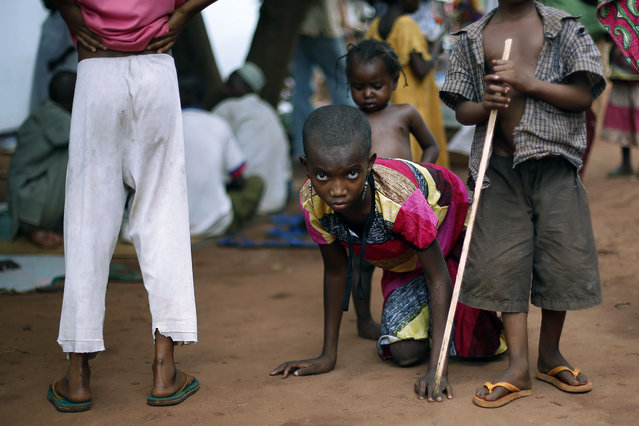
In this April 14, 2014 file photo, Hamamatou Harouna, 10, who lost the use of her legs to polio, crawls to the restroom on the grounds of the Catholic Church where she and hundreds of others found refuge after fleeing violence in her village, in Carnot, Central African Republic. Health authorities on Tuesday, August 25, 2020 are expected to declare the African continent free of the wild poliovirus after decades of effort, though cases of vaccine-derived polio are still sparking outbreaks of the paralyzing disease in more than a dozen countries. (Photo by Jerome Delay/AP Photo/File)

In this April 14, 2014 file photo, Hamamatou Harouna, 10, who lost the use of her legs to polio, crawls to the restroom on the grounds of the Catholic Church where she and hundreds of others found refuge after fleeing violence in her village, in Carnot, Central African Republic. Health authorities on Tuesday, August 25, 2020 are expected to declare the African continent free of the wild poliovirus after decades of effort, though cases of vaccine-derived polio are still sparking outbreaks of the paralyzing disease in more than a dozen countries. (Photo by Jerome Delay/AP Photo/File)
Details
15 Sep 2020 00:03:00