Loading...
Done
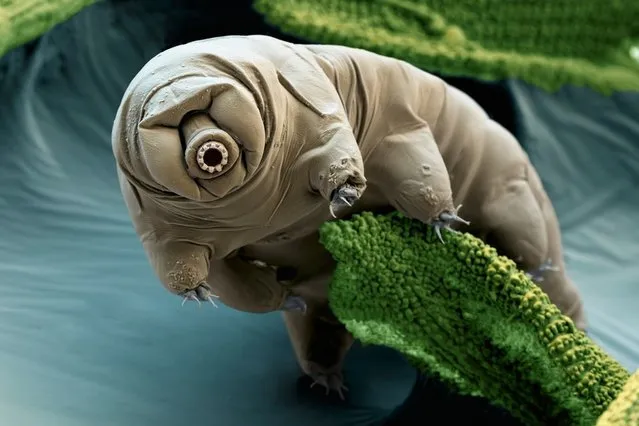
Tardigrades (commonly known as waterbears or moss piglets). (Photo by SPL/East News)

“Tardigrades (commonly known as waterbears or moss piglets) are small, water-dwelling, segmented animals with eight legs. Tardigrades were first discovered in 1773 by Johann August Ephraim Goeze, who called them kleiner Wasserbär, meaning “little water bear” in German. The name Tardigrada means “slow walker” and was given by Lazzaro Spallanzani in 1777. The name water bear comes from the way they walk, reminiscent of a bear's gait. The biggest adults may reach a body length of 1.5 millimetres (0.059 in), the smallest below 0.1 mm. Freshly hatched tardigrades may be smaller than 0.05 mm”. – Wikipedia. Photo: Tardigrades. (Photo by SPL/East News)
Details
26 Sep 2012 09:55:00
Models present creations from Vislumbre during Fashion Weekend Plus Size in Sao Paulo, Brazil, March 19, 2017. (Photo by Paulo Whitaker/Reuters)

Models present creations from Vislumbre during Fashion Weekend Plus Size in Sao Paulo, Brazil, March 19, 2017. (Photo by Paulo Whitaker/Reuters)
Details
26 Mar 2017 08:51:00
A boy bursts a soap-bubble at Gorky Park in Moscow on July 19, 2017. (Photo by Mladen Antonov/AFP Photo)

A boy bursts a soap-bubble at Gorky Park in Moscow on July 19, 2017. (Photo by Mladen Antonov/AFP Photo)
Details
13 Dec 2017 07:30:00
“F U 2”. (Photo and comment by EvoLNoMiS)

“F U 2”. (Photo and comment by EvoLNoMiS)

Details
20 Feb 2013 14:04:00
A man steers with his legs while riding a motorcycle on a road in Vietnam's northern Hoa Binh province, outside Hanoi, October 15, 2015. (Photo by Reuters/Kham)

A man steers with his legs while riding a motorcycle on a road in Vietnam's northern Hoa Binh province, outside Hanoi, October 15, 2015. (Photo by Reuters/Kham)
Details
23 Nov 2015 08:01:00
Participants prepare kimchi, a traditional Korean dish of spicy fermented cabbage and radish, during a kimchi making festival at the Jogyesa Buddhist temple in Seoul on December 2, 2021, before it is distributed among the less privileged from the local neighbourhood. (Photo by Anthony Wallace/AFP Photo)

Participants prepare kimchi, a traditional Korean dish of spicy fermented cabbage and radish, during a kimchi making festival at the Jogyesa Buddhist temple in Seoul on December 2, 2021, before it is distributed among the less privileged from the local neighbourhood. (Photo by Anthony Wallace/AFP Photo)
Details
24 Dec 2021 07:50:00
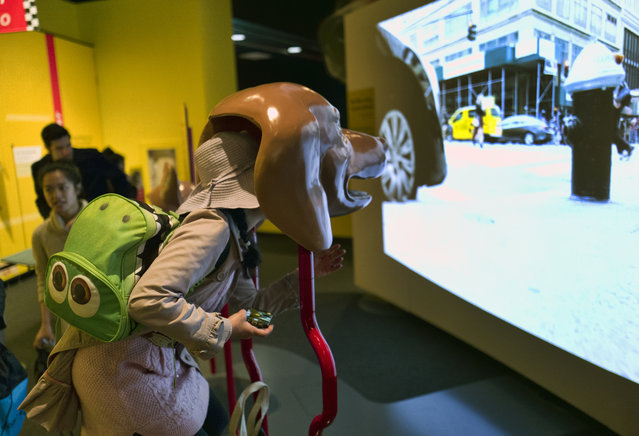
In this Tuesday, March 12, 2019 photo, a visitor takes part in an immersive experience showing visitors how dogs see from inside the head of a dog at the California Science Center in Los Angeles. A new exhibit at a Los Angeles museum examines the relationship between dogs and humans and explores why the two species seem to think so much alike and get along so well. “Dogs! A Science Tail” opens Saturday, March 16, 2019, at the California Science Center. (Photo by Richard Vogel/AP Photo)

In this Tuesday, March 12, 2019 photo, a visitor takes part in an immersive experience showing visitors how dogs see from inside the head of a dog at the California Science Center in Los Angeles. A new exhibit at a Los Angeles museum examines the relationship between dogs and humans and explores why the two species seem to think so much alike and get along so well. “Dogs! A Science Tail” opens Saturday, March 16, 2019, at the California Science Center. (Photo by Richard Vogel/AP Photo)
Details
15 Mar 2019 08:49:00
Members of Siam Classic Dance Studio perform for onlookers at Haymarket on January 21, 2023 in Sydney, Australia. The Lunar New Year or Spring Festival marks the transition of the Chinese zodiac sign from one animal to the next. 2023 sees in the Year of the Rabbit, which begins on January 22. In Chinese culture, the Rabbit is a symbol of longevity, peace and prosperity. The festival is celebrated in Australia by the country's significant Chinese-origin minority, who follow much of the same traditions as the Chinese diaspora in the rest of the world. (Photo by Lisa Maree Williams/Getty Images)

Members of Siam Classic Dance Studio perform for onlookers at Haymarket on January 21, 2023 in Sydney, Australia. The Lunar New Year or Spring Festival marks the transition of the Chinese zodiac sign from one animal to the next. 2023 sees in the Year of the Rabbit, which begins on January 22. In Chinese culture, the Rabbit is a symbol of longevity, peace and prosperity. The festival is celebrated in Australia by the country's significant Chinese-origin minority, who follow much of the same traditions as the Chinese diaspora in the rest of the world. (Photo by Lisa Maree Williams/Getty Images)
Details
13 Apr 2024 05:28:00