Loading...
Done


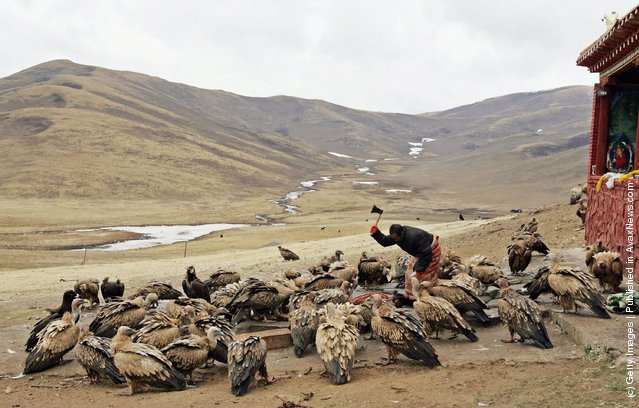
“Sky burial or ritual dissection was once a common funerary practice in Tibet wherein a human corpse is cut in specific locations and placed on a mountaintop, exposing it to the elements or the mahabhuta and animals – especially to birds of prey. The location of the sky burial preparation and place of execution are understood in the Vajrayana traditions as charnel grounds. In Tibet the practice is known as jhator, which literally means, «giving alms to the birds»”. – Wikipedia

Photo: A burial master chops bones of a body to feed vultures during a celestial burial ceremony on April 19, 2006 in Dari County of Guoluo Prefecture, Qinghai Province, northwest China. Celestial burial is a traditional funeral of Tibetan people, which began in the 7th century. (Photo by China Photos/Getty Images)
Details
18 Jun 2011 12:12:00
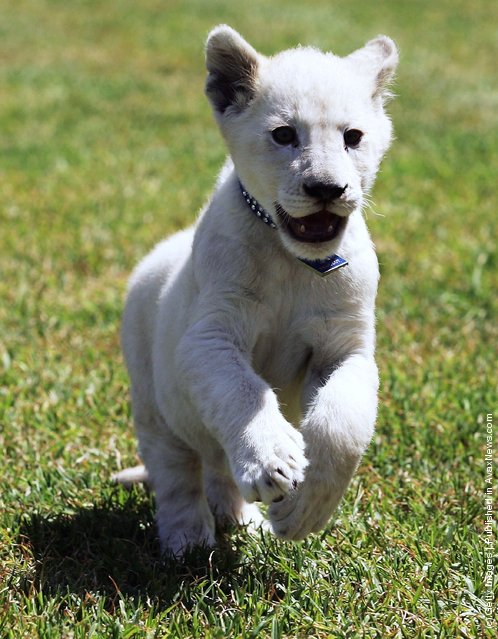
White Lion Cubs

“The white lion is not a distinct subspecies, but a special morph with a genetic condition, leucism, that causes paler colouration akin to that of the white tiger; the condition is similar to melanism, which causes black panthers”. – Wikipedia

Photo: One of two rare white lion cubs from Mogo Zoo on New South Wales South Coast is seen at a photo call at Lavender Green, Luna Park on November 23, 2006 in Sydney, Australia. (Photo by Matt King/Getty Images)
Details
26 Sep 2011 12:01:00
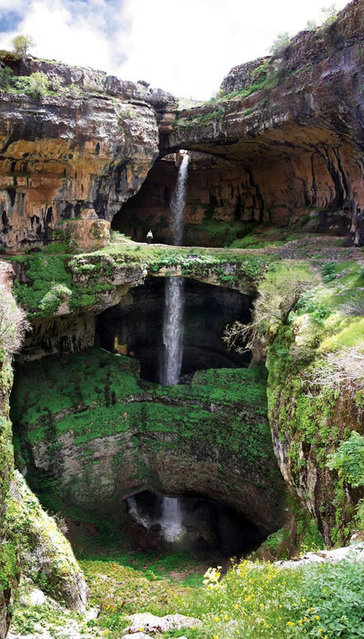
Baatara Gorge Waterfall

Discovered in 1952 by French bio-speleologist Henri Coiffait, the waterfall and accompanying sinkhole were fully mapped in the 1980s by the Spéléo club du Liban. The cave is also known as the "Cave of the Three Bridges." Traveling from Laklouk to Tannourine one passes the village of Balaa, and the "Three Bridges Chasm" (in French "Gouffre des Trois Ponts") is a five-minute journey into the valley below where one sees three natural bridges, rising one above the other and overhanging a chasm descending into Mount Lebanon. During the spring melt, a 90–100-metre (300–330 ft) cascade falls behind the three bridges and then down into the 250-metre (820 ft) chasm. A 1988 fluorescent dye test demonstrated that the water emerged at the spring of Dalleh in Mgharet al-Ghaouaghir.
Details
31 Aug 2013 11:27:00
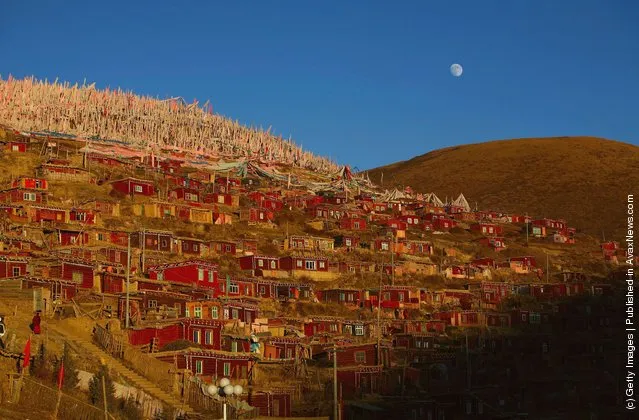
Monastic dormitories stand on the hillside at the Serthar Wuming Buddhist Study Institute in Serthar County of Garze Tibetan Autonomous Prefecture, Sichuan Province, China

Monastic dormitories stand on the hillside at the Serthar Wuming Buddhist Study Institute on November 4, 2006 in Serthar County of Garze Tibetan Autonomous Prefecture, Sichuan Province, China. The Wuming Buddhist Study Institute is located in Larung Gar Monastery on an altitude of 3,700 meters (about 12,136 feet). The institute has the largest conglomeration of monks and nuns in Tibetan Areas, with over 40,000 monastics from the Tibet Buddhism Nyingma School, Gelug School, Sakya School and Kagyu School, including more than 10,000 nuns. (Photo by China Photos/Getty Images)
Details
10 Feb 2012 11:39:00
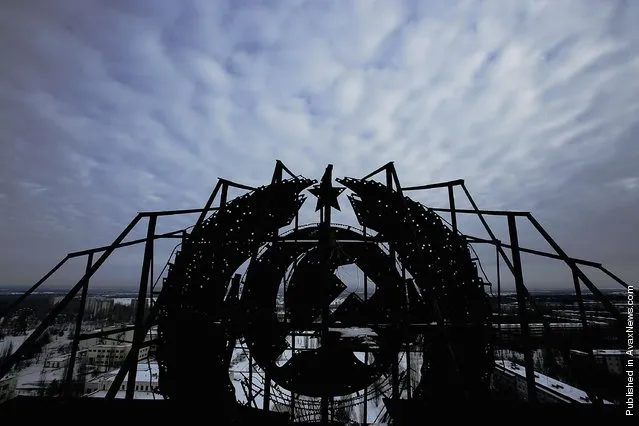
Chernobyl

Scaffolding holding a remnant of the Soviet Union, the hammer and sickle, is seen on a rooftop of an abandoned building in the town of Pripyat on January 25, 2006 near Chernobyl, Ukraine. The town of Pripyat, deserted since the 1986 catastrophe, once housed 30,000 people, the majority of being workers from the Chernobyl Nuclear Power Plant. Days after the catastrophe the inhabitants were relocated to other locations in the Soviet Union. The town of Pripyat has remained uninhabited since. Prypyat and the surrounding area will not be safe for human habitation for several centuries. Scientists estimate that the most dangerous radioactive elements will take up to 900 years to decay sufficiently to render the area safe.
Details
14 Mar 2011 10:20:00


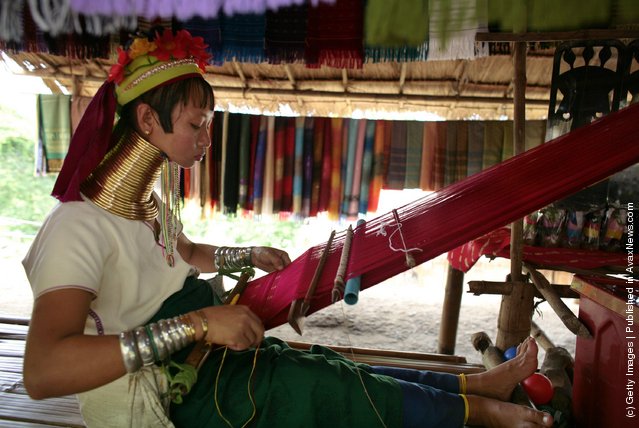
Mah Chan, a Long Neck Padaung hill tribe woman weaves a scraf for sale to tourists in a small village where 30 familes live July 13, 2006 in Chiang Dao, Thailand. All the Long Neck villages are set up for tourists and just over a year ago the hill tribe members were hand picked to move closer to Chiang Mai from more remote communities so that they could be more accessible. The Padaung women famously wear brass rings around their necks, beginning at five-years-old, to distort the growth of their collarbones and making them look like they have long necks. They are originally from eastern Burma near the Thailand border. (Photo by Paula Bronstein/Getty Images)
Details
19 Apr 2011 11:56:00


South Korean bee farmer Ahn Sang-Kyu protests Japan's claim of sovereignty over disputed islets May 2, 2006 in Seoul, South Korea. Ahn, a local bee farmer, released over 140,000 bees and attracted them to his body to protest Japan's sovereignty claims over a tiny group of islands located off the east coast of South Korea, called the Dokdo islets by the Koreans and Takeshima by the Japanese. The volcanic islets located about 90 kilometres east of South Korea's Ullung Island, have been a source of diplomatic friction between South Korea and Japan for years. (Photo by Chung Sung-Jun/Getty Images)
Details
05 May 2011 10:32:00
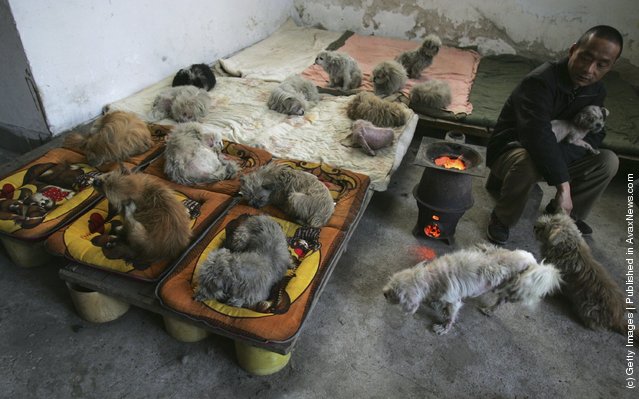
The animal shelter, established by animal lover Dai Shuqing, is located at an abandoned warehouse which houses some 100 dogs

Dai Shuqing's husband sits among adopted stray dogs at an animal shelter on December 15, 2006 in the outskirts of Xian of Shaanxi Province, China. The animal shelter, established by animal lover Dai Shuqing, is located at an abandoned warehouse which houses some 100 dogs and costs over 2,000 yuan (about US $255) per month. (Photo by China Photos/Getty Images)
Details
20 Jan 2012 14:40:00