Loading...
Done
Mummies

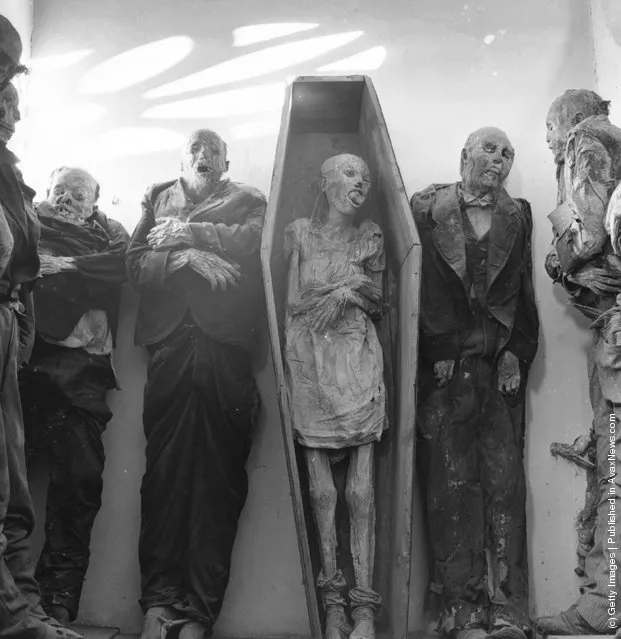
Dried and shrivelled corpses, some fully clothed and some in coffins, line the wall of a vault of the Pantheon Cemetery on the summit of Cerro del Trozado in Mexico. They were removed from the crypts because of non-payment of cemetery fees. The hot dry air stopped the bodies from rotting. Most of them were placed here between the turn of the century and WW I. (Photo by Three Lions/Getty Images). Circa 1955
Details
29 Aug 2011 13:46:00
Flossis By Rosalie

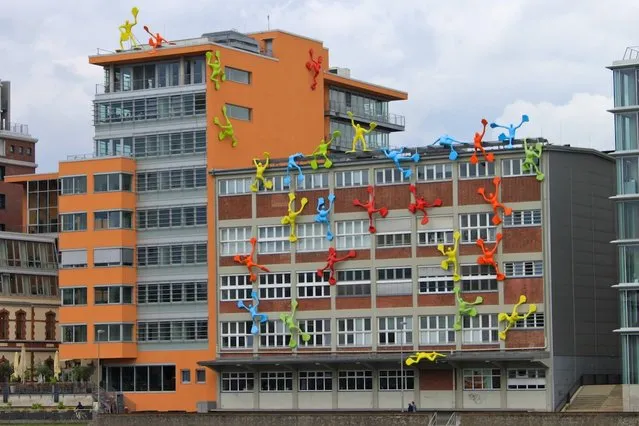
Flossis by the artist Rosalie are known far beyond the boundaries of Dьsseldorf, Germany. In this city on the Rhine, the Flossis became famous. Many buildings’ outer walls are decorated with these figures. Flossis by Rosalie come in different variants of small to large and they are popular among young and old. Flossis are made of resin and resist temperatures under -15 degrees. Below that, they should be brought to the warm inside of the building. The currently most sold Flossi, is the “type I” in red, like shown in the following illustration.
Details
12 Jun 2013 12:30:00
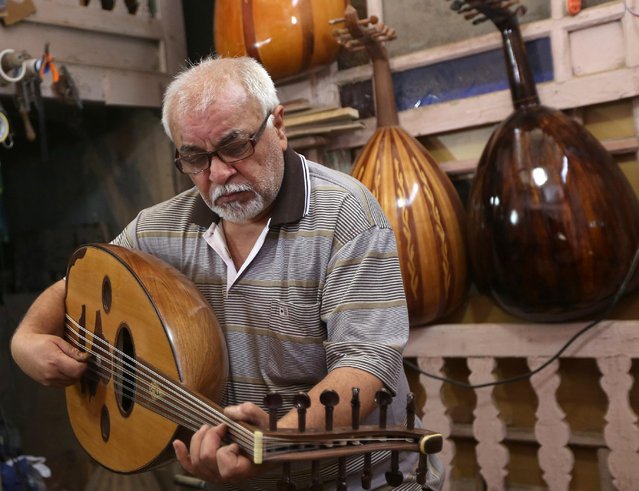
In this photo taken Saturday, June 20, 2015, Mahmoud Abdulnabi tries out an oud, an Arabic instrument related to the lute, at his workshop in Baghdad, Iraq. “The oud is different than other musical instruments”, said Abdulnabi, who has crafted ouds played by some of Iraq's best known musicians, many of whom look down from headshots on the walls. “If you feel joyful, it can play your joy. If the circumstances are sad it can play your sorrow and... help to empty whatever is in your chest”. (Photo by Hadi Mizban/AP Photo)

In this photo taken Saturday, June 20, 2015, Mahmoud Abdulnabi tries out an oud, an Arabic instrument related to the lute, at his workshop in Baghdad, Iraq. “The oud is different than other musical instruments”, said Abdulnabi, who has crafted ouds played by some of Iraq's best known musicians, many of whom look down from headshots on the walls. “If you feel joyful, it can play your joy. If the circumstances are sad it can play your sorrow and... help to empty whatever is in your chest”. (Photo by Hadi Mizban/AP Photo)
Details
05 Jul 2015 10:32:00
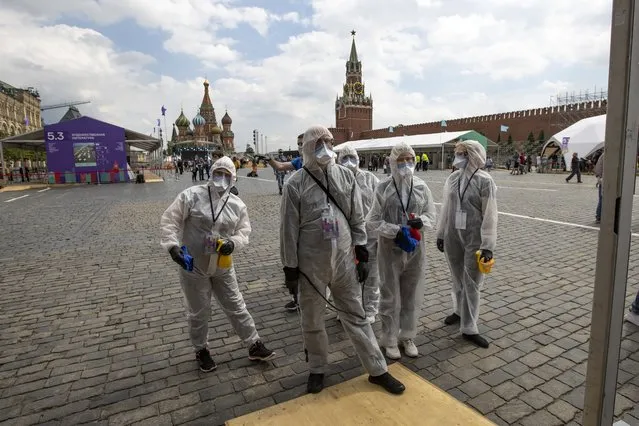
Volunteers wearing face masks, gloves and protective gear to protect against coronavirus, gather to clean an area of an outdoor book market set up at Red Square with GUM, State Department store, left, St. Basil's Cathedral, center, Spasskaya Tower, second with, and the Kremlin Wall, right, in Moscow, Russia, Saturday, June 6, 2020. Muscovites clad in face masks and gloves ventured into Red Square for an outdoor book market, a small sign of the Russian capital's gradual efforts to open up amid coronavirus concerns. (Photo by Alexander Zemlianichenko/AP Photo)

Volunteers wearing face masks, gloves and protective gear to protect against coronavirus, gather to clean an area of an outdoor book market set up at Red Square with GUM, State Department store, left, St. Basil's Cathedral, center, Spasskaya Tower, second with, and the Kremlin Wall, right, in Moscow, Russia, Saturday, June 6, 2020. Muscovites clad in face masks and gloves ventured into Red Square for an outdoor book market, a small sign of the Russian capital's gradual efforts to open up amid coronavirus concerns. (Photo by Alexander Zemlianichenko/AP Photo)
Details
08 Jun 2020 00:01:00
Swimming Pool Art Installation by Leandro Erlich

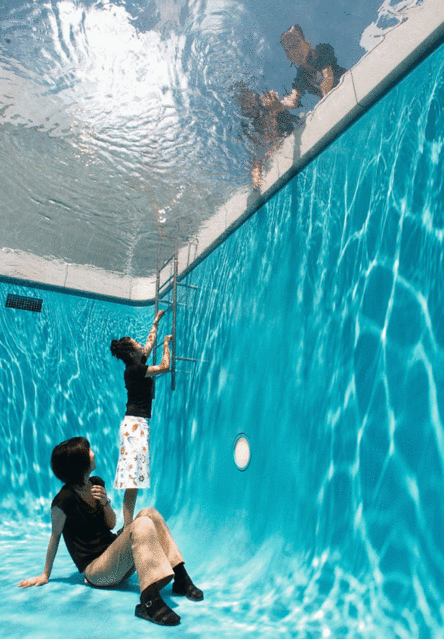
In one of the Museum’s courtyards is a swimming pool framed by a limestone deck. When seen from the deck, the pool appears to be filled with deep, shimmering water. In fact, however, a layer of water only some 10 centimeters deep is suspended over transparent glass. Below the glass is an empty space with aquamarine walls that viewers can enter. The work sets up an unfolding sequence of experiences—we view the pool through the glass wall enclosing the courtyard; from the deck, looking down into the pool; and from the interior of the pool, looking up. The Swimming Pool might hence be considered a place where, slowly, with time, different perspectives and perceptions of self and others all come to intersect.
Details
25 Aug 2012 07:31:00
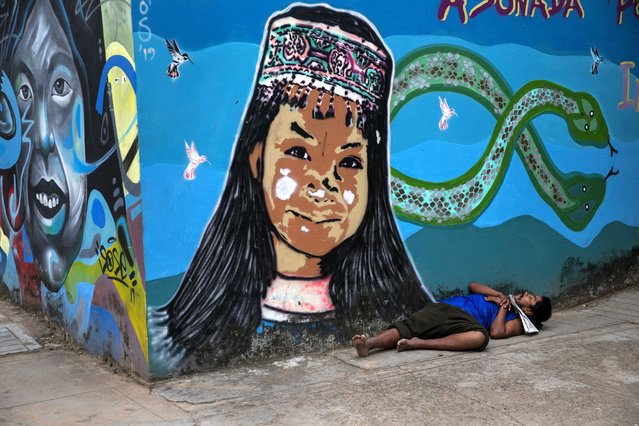
A homeless man sleeps against a wall adorned with a mural featuring a Shipibo Indigenous girl and Amazon rainforest animals, in Pucallpa, in Peru's Ucayali region, Wednesday, September 2, 2020. Peru is home to one of Latin America's largest Indigenous populations, whose ancestors lived in the Andean country before the arrival of Spanish colonists. (Photo by Rodrigo Abd/AP Photo)

A homeless man sleeps against a wall adorned with a mural featuring a Shipibo Indigenous girl and Amazon rainforest animals, in Pucallpa, in Peru's Ucayali region, Wednesday, September 2, 2020. Peru is home to one of Latin America's largest Indigenous populations, whose ancestors lived in the Andean country before the arrival of Spanish colonists. (Photo by Rodrigo Abd/AP Photo)
Details
23 Oct 2020 00:03:00
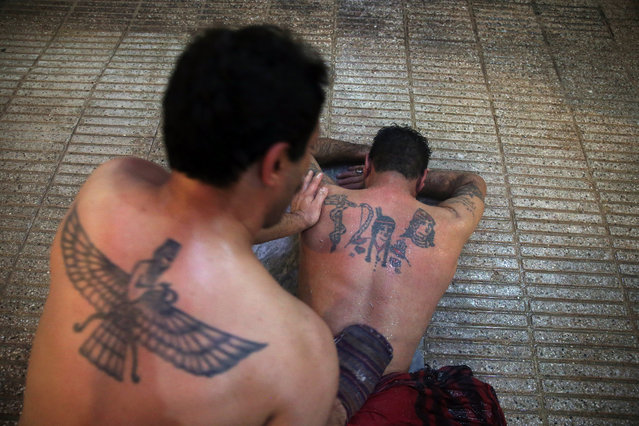
In this Friday, January 9, 2015 photo, bathhouse worker Omid Riahi, 39, scrubs a man to remove dead skin, at the Ghebleh public bathhouse, in Tehran, Iran. The steamy air and curved tiled walls of Iran's famed public bathhouses, some rinsing and massaging patrons for hundreds of years, slowly may wash away as interest in them wanes. (Photo by Ebrahim Noroozi/AP Photo)

In this Friday, January 9, 2015 photo, bathhouse worker Omid Riahi, 39, scrubs a man to remove dead skin, at the Ghebleh public bathhouse, in Tehran, Iran. The steamy air and curved tiled walls of Iran's famed public bathhouses, some rinsing and massaging patrons for hundreds of years, slowly may wash away as interest in them wanes. The bathhouses, known as “hammams” in Persian, find themselves in rough financial times as modern conveniences now allow showers and baths in most homes across the Islamic Republic. (Photo by Ebrahim Noroozi/AP Photo)
Details
03 Apr 2015 12:40:00
A woman poses for a picture as bunches of paprika hang on the walls of her house to dry in the village of Donja Lakosnica, Serbia October 6, 2016. Donja Lokosnica is the Serbian “capital of paprika”, since almost all of the 1300 inhabitants are involved in growing paprika. As autumn approaches, the whole village turns red, because of many threads of dried peppers, that hang around Lokosnica, waiting for their winter use. Each of these paprika threads is handmade, still dried according to traditional techniques, assisted solely by the sun and fresh air. (Photo by Marko Djurica/Reuters)

A woman poses for a picture as bunches of paprika hang on the walls of her house to dry in the village of Donja Lakosnica, Serbia October 6, 2016. Donja Lokosnica is the Serbian “capital of paprika”, since almost all of the 1300 inhabitants are involved in growing paprika. As autumn approaches, the whole village turns red, because of many threads of dried peppers, that hang around Lokosnica, waiting for their winter use. Each of these paprika threads is handmade, still dried according to traditional techniques, assisted solely by the sun and fresh air. (Photo by Marko Djurica/Reuters)
Details
08 Oct 2016 12:04:00