Loading...
Done
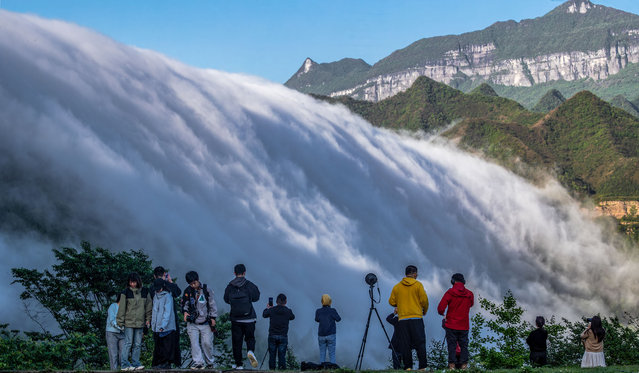
Water vapour cascades down the Gold Buddha Mountain after a rainfall, drawing large crowds of visitors, on May 13, 2024 in Chongqing, China. (Photo by Qu Mingbin/VCG via Getty Images)

Water vapour cascades down the Gold Buddha Mountain after a rainfall, drawing large crowds of visitors, on May 13, 2024 in Chongqing, China. (Photo by Qu Mingbin/VCG via Getty Images)
Details
25 May 2024 01:59:00
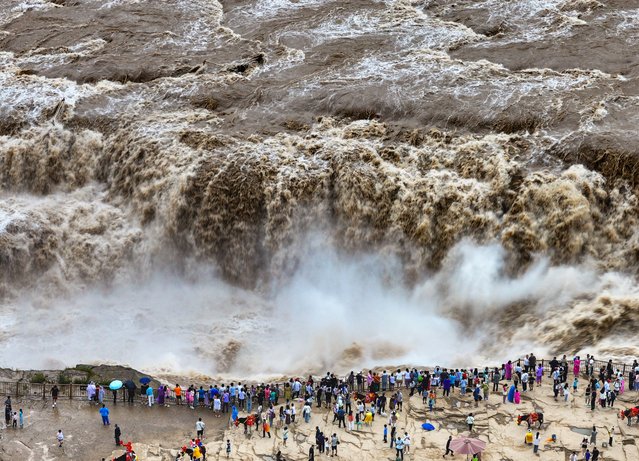
Tourists watch roaring torrent carrying a large amount of yellow sediment at the Hukou Waterfall on the Yellow River on August 15, 2024 in Yan'an, Shaanxi Province of China. (Photo by VCG/VCG via Getty Images)

Tourists watch roaring torrent carrying a large amount of yellow sediment at the Hukou Waterfall on the Yellow River on August 15, 2024 in Yan'an, Shaanxi Province of China. (Photo by VCG/VCG via Getty Images)
Details
28 Aug 2024 03:26:00
CANADA: Stanley Ferdinand filets large trout he caught in Great Bear Lake in Deline, Northwest Territories, Canada September 8, 2016. (Photo by Pat Kane/Reuters)

CANADA: Stanley Ferdinand filets large trout he caught in Great Bear Lake in Deline, Northwest Territories, Canada September 8, 2016. (Photo by Pat Kane/Reuters)
Details
26 Dec 2016 06:36:00
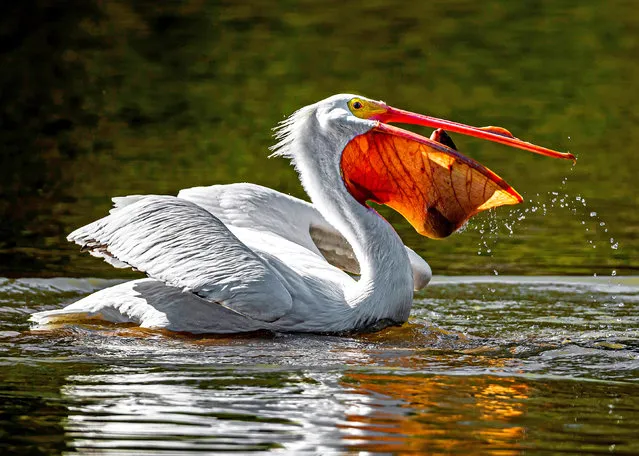
A pelican on a lake in California in the first decade of January 2024 deftly snares a large trout after scooping it up, tossing it into the air and catching it in its bill. (Photo by Jiahong Zeng/Solent news)

A pelican on a lake in California in the first decade of January 2024 deftly snares a large trout after scooping it up, tossing it into the air and catching it in its bill. (Photo by Jiahong Zeng/Solent news)
Details
21 Jan 2024 09:06:00
Children play on an uprooted tree along a beach in Mele, Vanuatu that was once lined with vegetation, now largely lost to storms, erosion and other environmental pressures on Saturday, July 19, 2025. (Photo by Annika Hammerschlag/AP Photo)

Children play on an uprooted tree along a beach in Mele, Vanuatu that was once lined with vegetation, now largely lost to storms, erosion and other environmental pressures on Saturday, July 19, 2025. (Photo by Annika Hammerschlag/AP Photo)
Details
22 Aug 2025 04:02:00
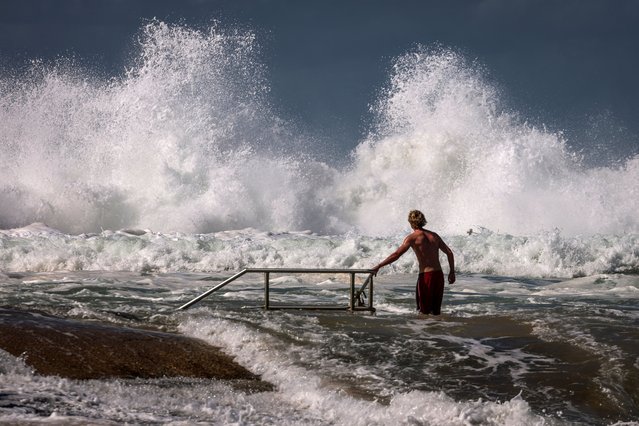
A man walks towards a wave breaking on a rock pool at North Narrabeen Beach in Sydney on April 18, 2025, as large swells hit the east coast of Australia. (Photo by David Gray/AFP Photo)

A man walks towards a wave breaking on a rock pool at North Narrabeen Beach in Sydney on April 18, 2025, as large swells hit the east coast of Australia. (Photo by David Gray/AFP Photo)
Details
28 Oct 2025 04:55:00
An Iraqi woman and foreigners use  pair of compact discs as a filter to watch the partial solar eclipse in war-torn Baghdad, 29 March 2006. Without access to proper equipment to protect their eyes from the sun's rays, eclipse watchers in Iraq used makeshift filters.  The moon blotted out the sun over northwest Africa early Wednesday, turning day into night in a total solar eclipse as it swept a shadowy path from the outer tip of Brazil to the steppes of Mongolia. (Photo by Hassan Ammar/AFP Photo)

An Iraqi woman and foreigners use pair of compact discs as a filter to watch the partial solar eclipse in war-torn Baghdad, 29 March 2006. Without access to proper equipment to protect their eyes from the sun's rays, eclipse watchers in Iraq used makeshift filters. The moon blotted out the sun over northwest Africa early Wednesday, turning day into night in a total solar eclipse as it swept a shadowy path from the outer tip of Brazil to the steppes of Mongolia. (Photo by Hassan Ammar/AFP Photo)
Details
25 Jul 2017 09:31:00
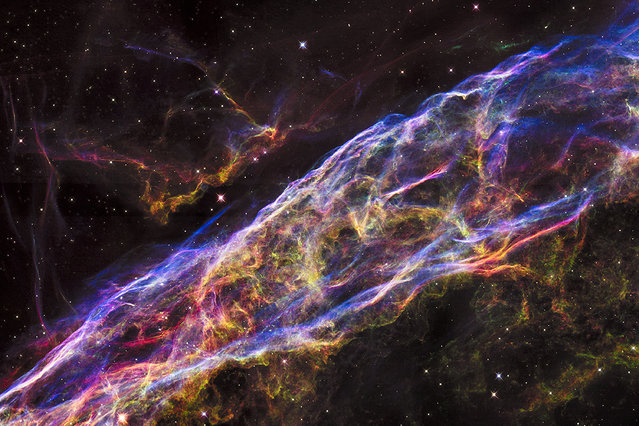
A small section of the expanding remains of the Veil Nebula, a massive star that exploded about 8,000 years ago. The entire nebula is 110 light-years across, covering six full moons on the sky as seen from Earth, and resides about 2,100 light-years away in the constellation Cygnus, the Swan. Image taken by NASA's Hubble Space Telescope. Released September 24, 2015. (Photo by Reuters/NASA/ESA/Hubble Heritage Team)

A small section of the expanding remains of the Veil Nebula, a massive star that exploded about 8,000 years ago. The entire nebula is 110 light-years across, covering six full moons on the sky as seen from Earth, and resides about 2,100 light-years away in the constellation Cygnus, the Swan. Image taken by NASA's Hubble Space Telescope. Released September 24, 2015. (Photo by Reuters/NASA/ESA/Hubble Heritage Team)
Details
10 Dec 2015 08:01:00