Loading...
Done
Viewing The Earth From Space

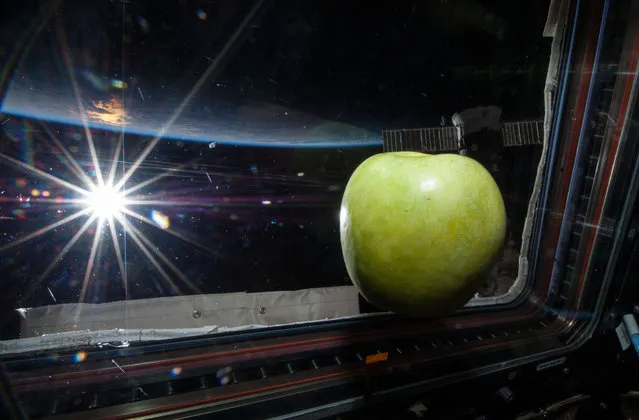
Despite any political differences between the United States and Russia, the space agencies of the two countries continue their cooperative work in Earth's orbit, aboard the International Space Station. Apart from the research being done in microgravity, ISS crew members continue to send back amazing images of our home world, photographed from low Earth orbit. Gathered here are recent images of Earth from aboard the ISS, and from a handful of other NASA satellites.
Details
01 Jun 2014 12:36:00
An attendee dances at the start of the “Big Goth Dance Party” during the Porcupine Freedom Festival, or PorcFest, the Free State Project's annual summer gathering in Lancaster, NH on Wednesday, June 25, 2014. (Photo by Matthew Cavanaugh/The Washington Post)

An attendee dances at the start of the “Big Goth Dance Party” during the Porcupine Freedom Festival, or PorcFest, the Free State Project's annual summer gathering in Lancaster, NH on Wednesday, June 25, 2014. (Photo by Matthew Cavanaugh/The Washington Post)
Details
07 Jul 2014 13:05:00
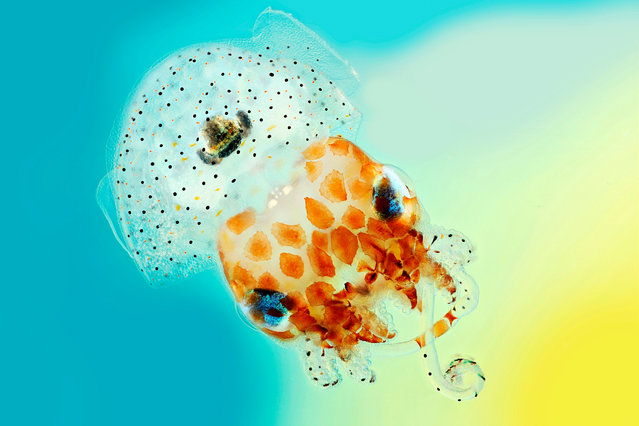
With its huge eyes, comical name and diminutive size, Mark R. Smith’s image of a baby Hawaiian bobtail squid can’t help but raise a smile. A curiously endearing creature, the cephalopod is just 1.5cm across, its mantle cavity bearing more than a passing resemblance to a rather natty shower cap. But it is also a beautiful example of symbiosis – nature’s version of “I’ll scratch your back if you scratch mine” – for on the underside of the squid is a light organ which houses bioluminescent bacteria. The squid offers the bacteria protection and food, while the bacteria emit a glow – a handy trait that the squid uses to offset its silhouette, helping it to evade predators in the depths below. Mark R. Smith’s entry combines several images of a Hawaiian bobtail squid with different focus lengths to create a final picture with greater depth of field than normal. (Photo by Mark R. Smith/Wellcome Images/Macroscopic Solutions)

With its huge eyes, comical name and diminutive size, Mark R. Smith’s image of a baby Hawaiian bobtail squid can’t help but raise a smile. A curiously endearing creature, the cephalopod is just 1.5cm across, its mantle cavity bearing more than a passing resemblance to a rather natty shower cap. But it is also a beautiful example of symbiosis – nature’s version of “I’ll scratch your back if you scratch mine” – for on the underside of the squid is a light organ which houses bioluminescent bacteria. The squid offers the bacteria protection and food, while the bacteria emit a glow – a handy trait that the squid uses to offset its silhouette, helping it to evade predators in the depths below. Mark R. Smith’s entry combines several images of a Hawaiian bobtail squid with different focus lengths to create a final picture with greater depth of field than normal. (Photo by Mark R. Smith/Wellcome Images/Macroscopic Solutions)
Details
08 Mar 2017 00:05:00
A Palestinian woman argues with an Israeli border policewoman over the Israeli demolition of a building housing an apartment and a restaurant as the building owners said they were informed by the forces that they did not obtain a construction permit, in Beit Jala in the Israeli-occupied West Bank on August 26, 2019. (Photo by Mussa Qawasma/Reuters)

A Palestinian woman argues with an Israeli border policewoman over the Israeli demolition of a building housing an apartment and a restaurant as the building owners said they were informed by the forces that they did not obtain a construction permit, in Beit Jala in the Israeli-occupied West Bank on August 26, 2019. (Photo by Mussa Qawasma/Reuters)
Details
28 Aug 2019 00:05:00
In this picture taken on December 13, 2017, a woman commutes on a street on a cold day in Baoding. As temperatures dipped below freezing in a northern Chinese village, a group of parka-clad women tried to stay warm as they played mahjong around a small gas stove in a grocery store. (Photo by Fred Dufour/AFP Photo)

In this picture taken on December 13, 2017, a woman commutes on a street on a cold day in Baoding. As temperatures dipped below freezing in a northern Chinese village, a group of parka-clad women tried to stay warm as they played mahjong around a small gas stove in a grocery store. (Photo by Fred Dufour/AFP Photo)
Details
22 Dec 2017 07:52:00
Forensic investigators look at the body of a man infected with the new coronavirus who collapsed on the street and died, according to Police Captain Diego Lopez, in Quito, Ecuador, Tuesday, May 5, 2020. (Photo by Dolores Ochoa/AP Photo)

Forensic investigators look at the body of a man infected with the new coronavirus who collapsed on the street and died, according to Police Captain Diego Lopez, in Quito, Ecuador, Tuesday, May 5, 2020. (Photo by Dolores Ochoa/AP Photo)
Details
07 May 2020 00:03:00
An Embraer E-190 E2 aircraft featuring a spray painted tiger's face on the nose of the aircraft is displayed during a media preview of the Singapore Airshow February 4, 2018. (Photo by Edgar Su/Reuters)

An Embraer E-190 E2 aircraft featuring a spray painted tiger's face on the nose of the aircraft is displayed during a media preview of the Singapore Airshow February 4, 2018. (Photo by Edgar Su/Reuters)
Details
22 Jun 2018 00:03:00
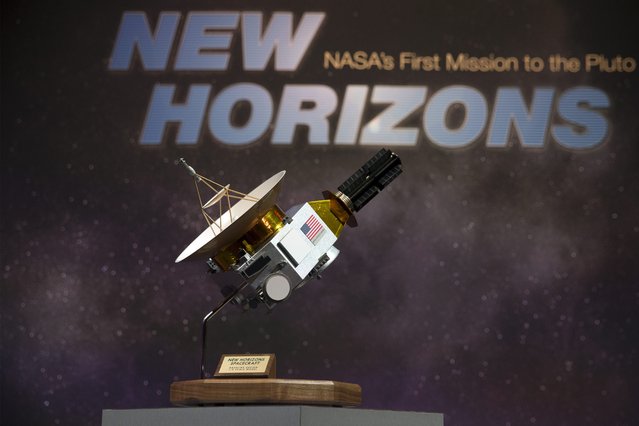
A model of the New Horizons spacecraft is seen at a live television program on NASA television celebrating the spacecraft's closest proximity to Pluto, at Johns Hopkins University Applied Physics Laboratory, site of the mission operations center, in Laurel, Maryland, USA, 14 July 2015. (Photo by Michael Reynolds/EPA)

A model of the New Horizons spacecraft is seen at a live television program on NASA television celebrating the spacecraft's closest proximity to Pluto, at Johns Hopkins University Applied Physics Laboratory, site of the mission operations center, in Laurel, Maryland, USA, 14 July 2015. At approximately 7:49 am ET (11:49 am GMT), 14 July, New Horizons was scheduled to be as close to Pluto as the spacecraft will get; about 7,800 miles (12,500 kilometers) above the surface, following a journey of more than nine years and three billion miles. This is the first mission to the Pluto System and the Kuiper Belt. (Photo by Michael Reynolds/EPA)
Details
15 Jul 2015 10:08:00