Loading...
Done
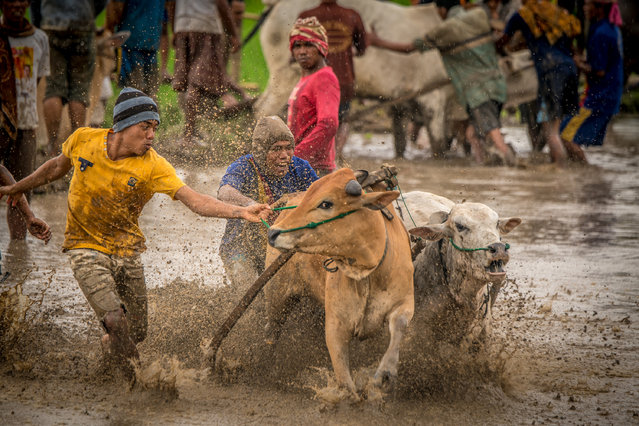
Cows rush through mud and water while jockey holds onto their tails, on March 12, 2016 in Padang, West Sumatra, Indonesia. (Photo by Teh Han Lin/Barcroft Images)

Cows rush through mud and water while jockey holds onto their tails, on March 12, 2016 in Padang, West Sumatra, Indonesia. For hundreds of years these farmers have competed in one of the worldís most oddest races in the hopes of showing off their cattle. Known as Pacu Jawi the traditional cow race takes place in Padang, West Sumatra, and has become the highlight of the year for locals. (Photo by Teh Han Lin/Barcroft Images)
Details
20 Jan 2017 08:07:00
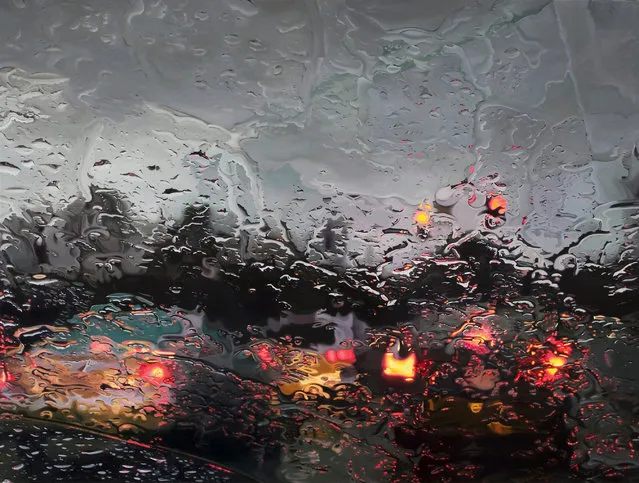
“Complete Stop”. (Painting by Gregory Thielker)

When he's driving, New York-based painter Gregory Thielker takes in the views that change from moment to moment: the road, the sky, other cars. “Inside the car it's easy to forget the outside temperature, humidity, the noise of the road”, he says. “But something happens when rain interrupts the view: the lens through which we are seeing is revealed. Water both obscures and highlights the landscape”. Gregory Thielker's exhibition “Between here and now” will be at Castor Gallery in lower Manhattan from early March. Here: “Complete Stop”. (Painting by Gregory Thielker)
Details
18 Jan 2016 08:02:00
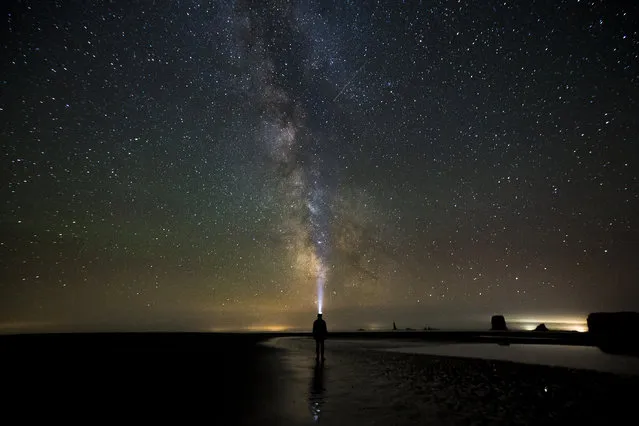
Second Beach, La Push, Washington, March, 2015. (Photo by Andrew Ling/Caters News)

Andrew Ling's inspiring photographs showcase the splendor of the natural world, using people to highlight the beauty and scale of these epic landscapes. Each image features a person photographed from hundreds of feet away, seemingly insignificant in comparison to the breathtaking landscape that surrounds them – whether beneath gushing waterfalls, under millions of glittering stars or atop of gigantic cliffs. Andrew, 22, said, “I hope these images will help remind people how beautiful the world we live in is”. Here: Second Beach, La Push, Washington, March, 2015. (Photo by Andrew Ling/Caters News)
Details
31 Mar 2016 11:12:00
A woman dressed as a cleaning lady laughs during “Weiberfastnacht” (Women's Carnival) in Cologne February 12, 2015. (Photo by Ina Fassbender/Reuters)

A woman dressed as a cleaning lady laughs during “Weiberfastnacht” (Women's Carnival) in Cologne February 12, 2015. Women's Carnival marks the start of a week of street festivals, the highlight of the event being “Rosenmontag” (Rose Monday), the final day of the carnival where mass processions are held. (Photo by Ina Fassbender/Reuters)
Details
13 Feb 2015 13:22:00
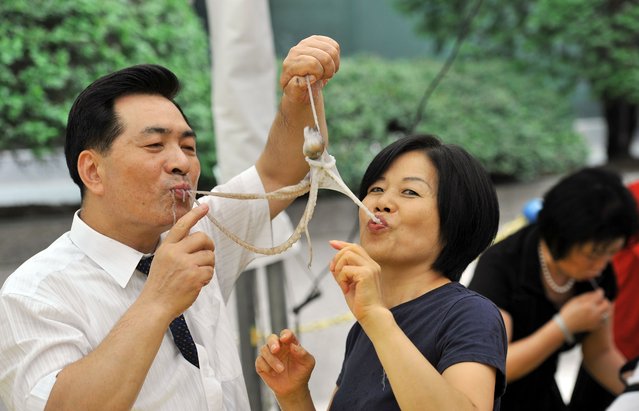
A South Korean man and a woman eat a live octopus during an event to promote a local food festival in Seoul on September 12, 2013. (Photo by Jung Yeon-Je/AFP Photo)

Live octopus is a delicacy in South Korea but is a known choking hazard, since the still-moving suction cups can cause tentacle pieces to stick in a person's throat. A baby octopus is often consumed whole, while larger varieties are cut up and the still-wriggling tentacles eaten with a splash of sesame oil. Photo: A South Korean man and a woman eat a live octopus during an event to promote a local food festival in Seoul on September 12, 2013. (Photo by Jung Yeon-Je/AFP Photo)
Details
13 Sep 2013 09:40:00
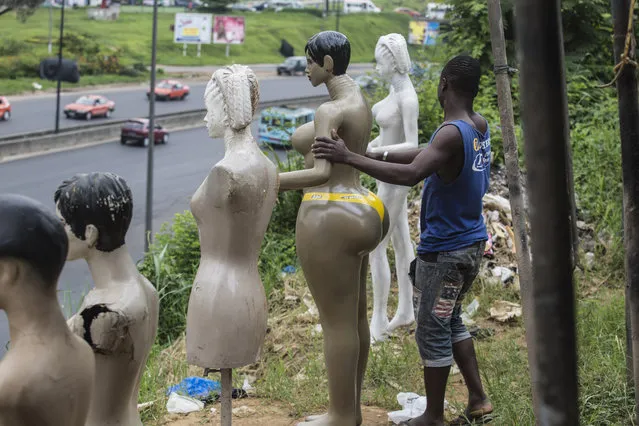
A curvy woman is considered prosperous, healthy and s*xy in Ivory Coast, photographer Joana Choumali explains. Here: An apprentice lines up his work on a roadside. (Photo by Joana Choumali)

Photographer Joana Choumali’s latest project explores body image and beauty by documenting the men building Abidjan’s clothing models. The “Awoulaba” mannequin is a customised model designed with the African ideal of beauty in mind, curvier than the stick-thin examples usually seen in the west. They first appeared in 2011, and have since become a familiar sight outside the numerous clothing shops dotted throughout Ivory Coast’s capital, Abidjan. Here: An apprentice lines up his work on a roadside. (Photo by Joana Choumali)
Details
06 Jun 2016 11:05:00
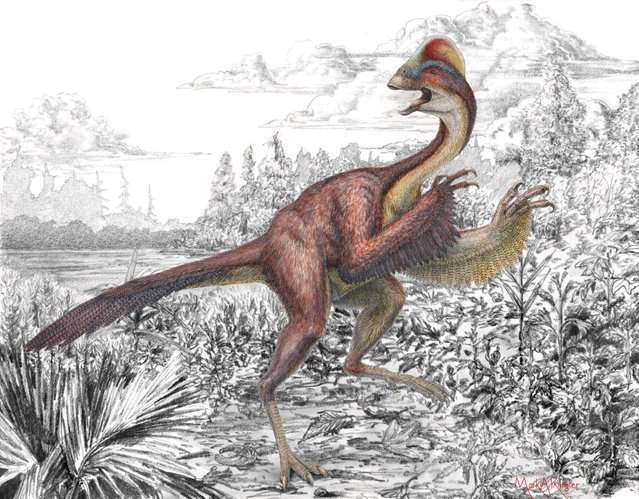
Life reconstruction of the new oviraptorosaurian dinosaur species Anzu wyliei in its 66 million-year-old environment in western North America as seen in an undated handout illustration by Mark A. Klinger, Carnegie Museum of Natural History. Some 18,000 species, great and small, were discovered in 2014, adding to the 2 million already known, scientists said on May 21, 2015 as they released a “Top 10” list that highlights the diversity of life. (Photo by Mark A. Klingler/Reuters/Carnegie Museum of Natural History)

Life reconstruction of the new oviraptorosaurian dinosaur species Anzu wyliei in its 66 million-year-old environment in western North America as seen in an undated handout illustration by Mark A. Klinger, Carnegie Museum of Natural History. Some 18,000 species, great and small, were discovered in 2014, adding to the 2 million already known, scientists said on May 21, 2015 as they released a “Top 10” list that highlights the diversity of life. Anzu wyliei, one of the top 10, dubbed “the chicken from hell”, is extinct. The feathered dinosaur whose partial skeletons were unearthed in the Dakotas was a contemporary of T. rex and Triceratops. (Photo by Mark A. Klingler/Reuters/Carnegie Museum of Natural History)
Details
22 May 2015 12:31:00
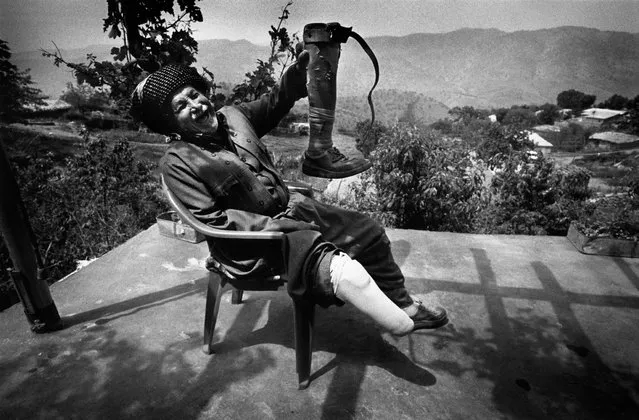
Ismail Mustafa, seen in 2007. “I was collecting mushrooms on the hill near here. I didn’t see the mine. There was a huge explosion. When I woke up I saw that both my legs were gone; I thought my life was over. My brother and another guy were with me. They made a stretcher from sticks and tied it together with clothing. It took two hours to get off the mountain. ‘My daughter has also been injured. She found a shell and brought it into the house and put it on the fire. She didn’t know what she was doing at the time – she was only three. She is blind and has lost an arm”. (Photo by Sean Sutton for the Mines Advisory Group/The Guardian)

Ismail Mustafa, seen in 2007. “I was collecting mushrooms on the hill near here. I didn’t see the mine. There was a huge explosion. When I woke up I saw that both my legs were gone; I thought my life was over. My brother and another guy were with me. They made a stretcher from sticks and tied it together with clothing. It took two hours to get off the mountain. ‘My daughter has also been injured. She found a shell and brought it into the house and put it on the fire. She didn’t know what she was doing at the time – she was only three. She is blind and has lost an arm”. (Photo by Sean Sutton for the Mines Advisory Group/The Guardian)
Details
08 Sep 2017 09:33:00