Loading...
Done


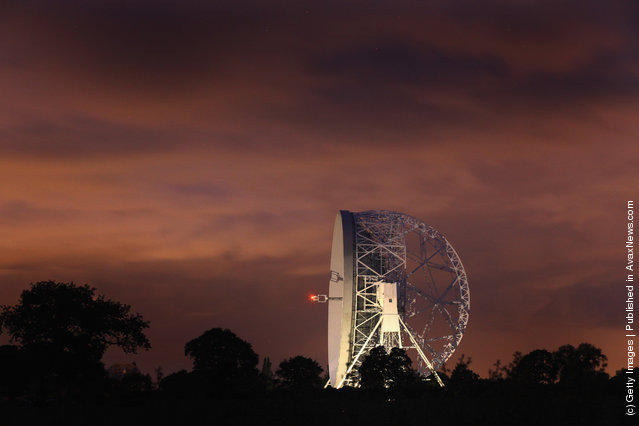
“The Lovell Telescope is a radio telescope at Jodrell Bank Observatory, near Goostrey, Cheshire in the north-west of England. When it was constructed in 1955, the telescope was the largest steerable dish radio telescope in the world at 76.2 m (250 ft) in diameter; it is now the third largest, after the Green Bank telescope in West Virginia, USA, and the Effelsberg telescope in Germany. It was originally known as the 250 ft (76 m) telescope or the Radio Telescope at Jodrell Bank, before becoming the Mark I telescope around 1961 when future telescopes (the Mark II, III, and IV) were being discussed. It was renamed to the Lovell Telescope in 1987 after Bernard Lovell, and became a Grade I listed building in 1988. The telescope forms part of the MERLIN and European VLBI Network arrays of radio telescopes”. – Wikipedia

Photo: The Lovell Telescope listens to the night sky for radio signals from space at Jodrell Bank on June 22, 2011 in Holmes Chapel, England. Jodrell Bank Centre for Astrophysics and it's world famous Lovell Telescope is on the shortlist of Britain's submission for Unesco World Heritage Site status. (Photo by Christopher Furlong/Getty Images)
Details
24 Jun 2011 09:34:00
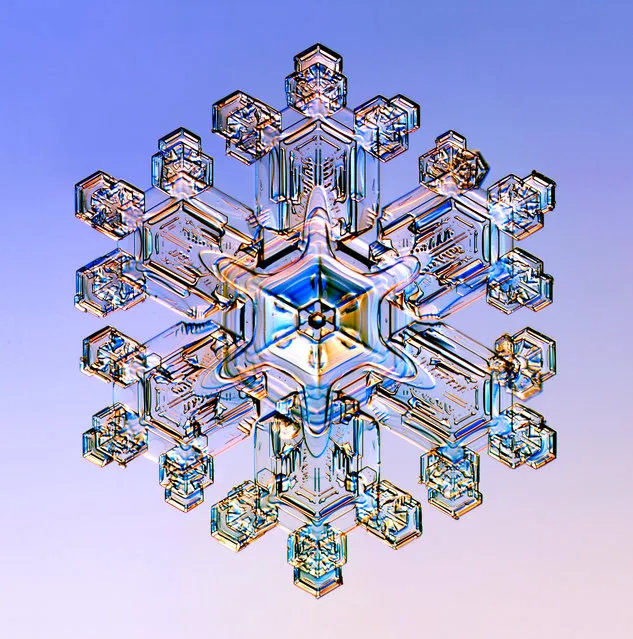
Nikon Small World Photomicrography Competition 2012. Honorable Mention. “Snow crystal, illuminated with colored lights (5x)”. (Photo by Dr. Kenneth Libbrecht, California Institute of Technology (Caltech), Department of Physics, Pasadena, California, USA)

Most people know Nikon as a purveyor of pro and consumer-grade digital cameras. But the company's expertise with optics bleeds over into related markets – it's one of the science community's major suppliers of microscopes. And each year the company asks the community to send it some of their favorite images of tiny objects. A panel of scientists and journalists have chosen the best of this past year's submissions, which Nikon has placed on its Small World site.

Photo: Honorable Mention. “Snow crystal, illuminated with colored lights (5x)”. (Photo by Dr. Kenneth Libbrecht, California Institute of Technology (Caltech), Department of Physics, Pasadena, California, USA)
Details
25 Oct 2012 13:49:00
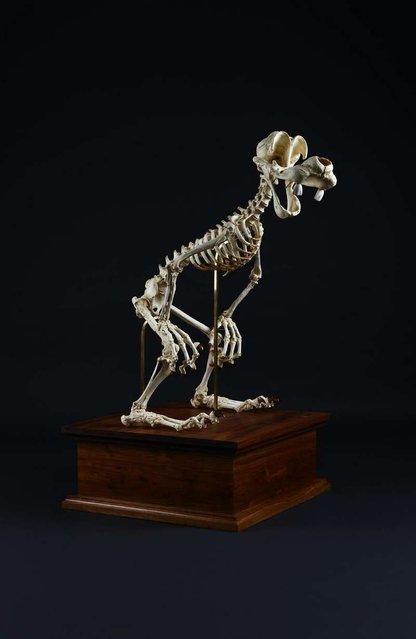
Cartoon Skeletons By Hyungkoo Lee

Korean artist Hyungkoo Lee has created a series (Homo Animatus) of works featuring skeletal representations of familiar cartoon characters. He uses resin, aluminum sticks, stainless steel wires, springs, and oil paint. If you look closely, you will see the bones of our favorite childhood friends like Canis Latrans Animatus (Wile E. Coyote), Geococcyx Animatus (Roadrunner), Lepus Animatus (Bugs Bunny), Felis Catus Animatus (Tom), Mus Animatus (Jerry), Anas Animatus (Donald Duck) and his three nephews, Animatus H, D and L ( Huey, Dewey and Louie)
Details
06 May 2013 12:42:00
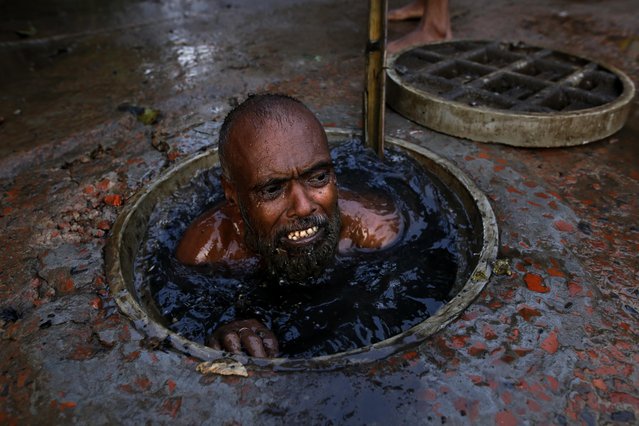
Men are sent down into the sludge to clear the sewers in the Bangladeshi capital Dhaka on May 23, 2018. One man holds his nose as he goes under to scoop blockages out for no more than $10a day. (Photo by Rehman Asad/Barcroft Media)

Men are sent down into the sludge to clear the sewers in the Bangladeshi capital Dhaka on May 23, 2018. The people who do the work aren’t even given any protective clothing or goggles and have to dig out the clogged-up muck with a stick or their bare hands. (Photo by Rehman Asad/Barcroft Media)
Details
26 May 2018 00:05:00
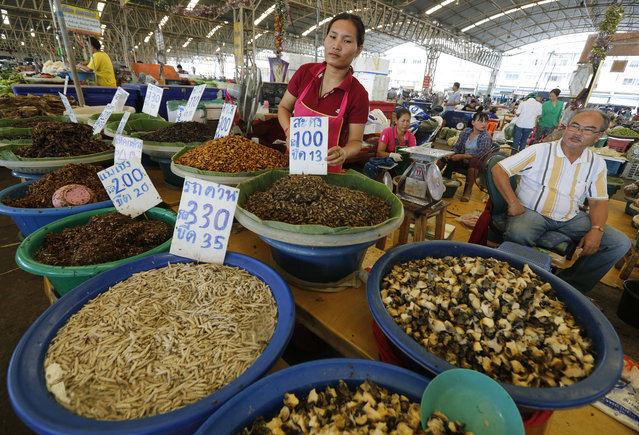
Thai vendors stand next to edible insects for sale at Talad Thai market in Pathum Thani province on the outskirts of Bangkok, Thailand, 15 July 2013. Insects have long been on the menu in Thailand, but academics and the United Nation's Food and Agriculture Organization (FAO) officials are hoping they will become a more common global source of protein and nutrients to meet the need for growing world food requirements in the future. (Photo by Narong Sangnak/EPA)

Thai vendors stand next to edible insects for sale at Talad Thai market in Pathum Thani province on the outskirts of Bangkok, Thailand, 15 July 2013. Insects have long been on the menu in Thailand, but academics and the United Nation's Food and Agriculture Organization (FAO) officials are hoping they will become a more common global source of protein and nutrients to meet the need for growing world food requirements in the future. (Photo by Narong Sangnak/EPA)
Details
22 May 2014 08:51:00
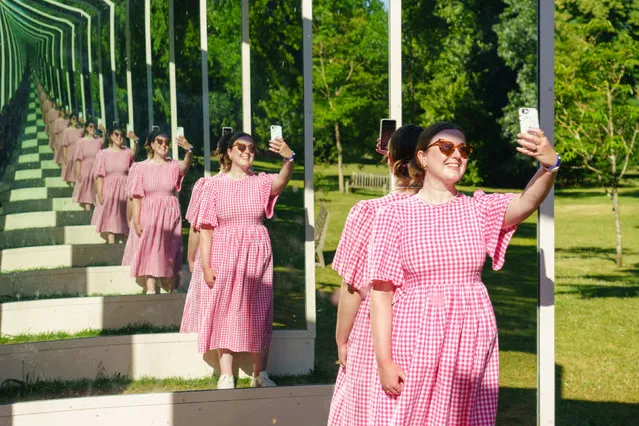
A visitor takes a selfie with “The Breach” by Leandro Erlich, during a photo call for Kew Gardens' forthcoming “Food Forever” exhibition, examining the fragile future of food and the impact of our day-to-day eating habits on the planet, at the Royal Botanic Gardens, in Kew, Richmond, Surrey on Thursday, June 16, 2022. (Photo by Dominic Lipinski/PA Images via Getty Images)

A visitor takes a selfie with “The Breach” by Leandro Erlich, during a photo call for Kew Gardens' forthcoming “Food Forever” exhibition, examining the fragile future of food and the impact of our day-to-day eating habits on the planet, at the Royal Botanic Gardens, in Kew, Richmond, Surrey on Thursday, June 16, 2022. (Photo by Dominic Lipinski/PA Images via Getty Images)
Details
19 Aug 2022 04:53:00
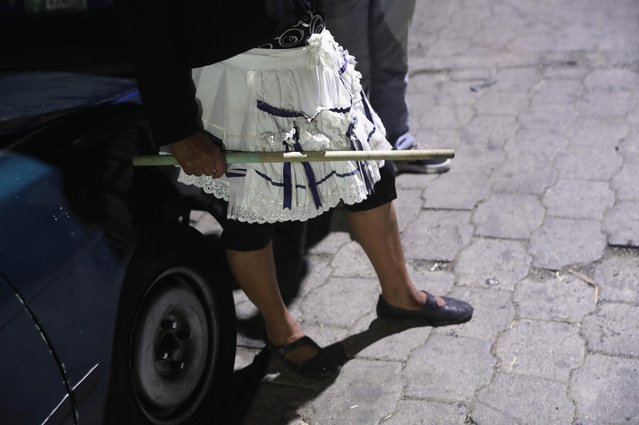
A neighborhood watch volunteer stands guard on her street on February 9, 2017 in Peronia, Guatemala. (Photo by John Moore/Getty Images)

A neighborhood watch volunteer stands guard on her street on February 9, 2017 in Peronia, Guatemala. Residents of Peronia, south of Guatemala City organized block by block to secure their community after ten of their neighbors in January were killed, they say, for refusing to pay extortion money to gangs. Armed with machetes and sticks, residents take turns each night, baring strangers' entry into their neighborhoods. Violence and poverty continue to drive emigration from Central America to the United States, even as the Trump administration moves to tighten border security. (Photo by John Moore/Getty Images)
Details
11 Feb 2017 00:00:00
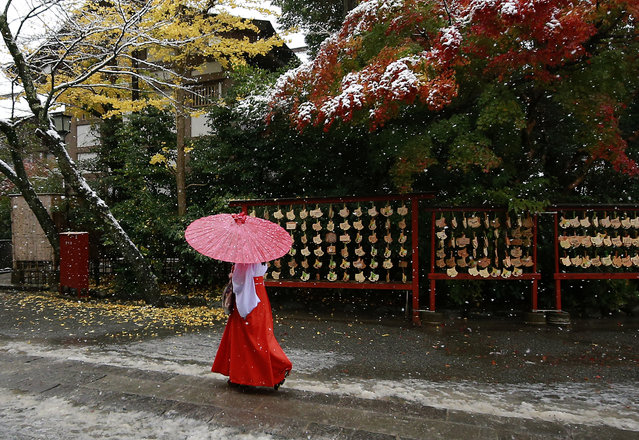
A shrine maiden walks in the snow at the Tsurugaoka Hachimangu Shrine in Kamakura, near Tokyo, Thursday, November 24, 2016. (Photo by Shizuo Kambayashi/AP Photo)

A shrine maiden walks in the snow at the Tsurugaoka Hachimangu Shrine in Kamakura, near Tokyo, Thursday, November 24, 2016. Tokyo residents have woken up to the first November snowfall in more than 50 years. An unusually cold air mass brought wet snow to Japan's capital on Thursday. Above-freezing temperatures kept the snow from sticking, but forecasters said there could be an accumulation of up to 2 centimeters (1 inch). The last time it snowed in central Tokyo in November was in 1962. (Photo by Shizuo Kambayashi/AP Photo)
Details
25 Nov 2016 11:33:00