Loading...
Done


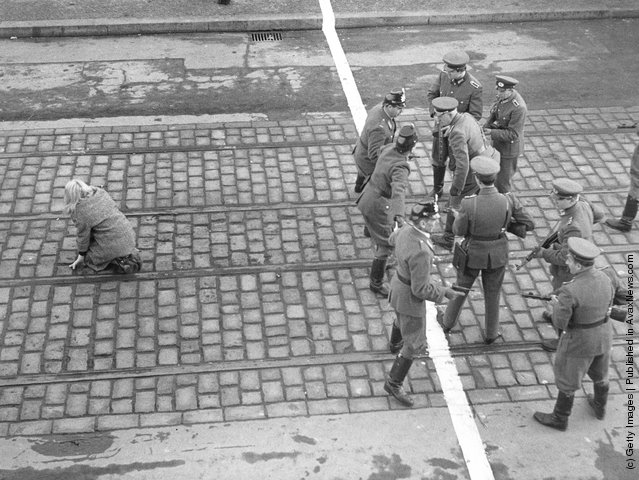
“The Berlin Wall (German: Berliner Mauer) was a barrier constructed by the German Democratic Republic (GDR, East Germany) starting on 13 August 1961, that completely cut off West Berlin from surrounding East Germany and from East Berlin. The barrier included guard towers placed along large concrete walls, which circumscribed a wide area (later known as the “death strip”) that contained anti-vehicle trenches, “fakir beds” and other defenses. The Soviet-dominated Eastern Bloc officially claimed that the wall was erected to protect its population from fascist elements conspiring to prevent the “will of the people” in building a socialist state in East Germany. However, in practice, the Wall served to prevent the massive emigration and defection that marked Germany and the communist Eastern Bloc during the post-World War II period”. – Wikipedia

Photo: West Berlin policemen and East German Volkspolizei face each other across the border in Berlin, circa 1955. (Photo by Three Lions/Hulton Archive/Getty Images)
Details
22 May 2011 10:49:00
Dirndl Flying

A woman dressed in a dirndl, a kind of traditional Bavarian clothing, jumps into Lake Schlier on July 30, 2006 in Schliersee, Germany. The event called "Dirndlfliegen" ("Dirndl Flying") was sponsored by a local fashion store and a big Austrian Dirndl manufacturer. While these kind of events had been held in Austria before, this was the first of its kind in Germany. 29 women and one man wearing a wig participated in the event that held a new Dirndl as the grand prize. (Photo by Andreas Leder/Getty Images)
Details
08 Sep 2011 14:13:00


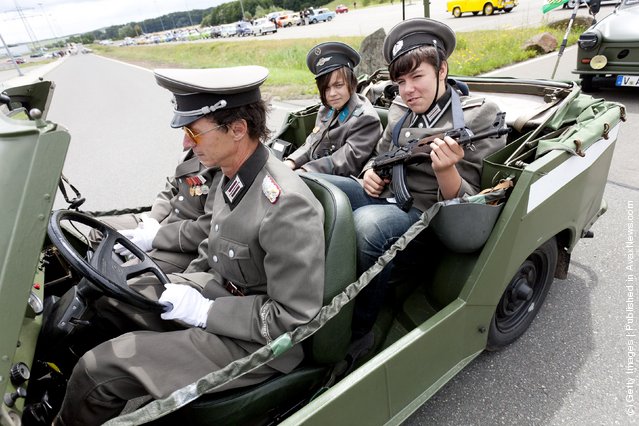
“The Trabant is a car that was produced by former East German auto maker VEB Sachsenring Automobilwerke Zwickau in Zwickau, Sachsen. It was the most common vehicle in East Germany, and was also exported to countries both inside and outside the communist bloc. The main selling points was that it had room for four adults and luggage in a compact, light and durable shell and that it was fast (when introduced) and durable. With its mediocre performance, smoky two-stroke engine, and production shortages, the Trabant is often cited as an example of the disadvantages of centralized planning; on the other hand, it is regarded with derisive affection as a symbol of the failed former East Germany and of the fall of communism (in former West Germany, as many East Germans streamed into West Berlin and West Germany in their Trabants after the opening of the Berlin Wall in 1989). It was in production without any significant changes for nearly 30 years with 3,096,099 Trabants produced in total”. – Wikipedia

Photo: Enthusiasts weared in uniforms of the former eastern german army trive in a military Trabant car as fans and owners of East German-era Trabant cars gather at the 2011 International Trabantfahrer Treffen (International Trabant Drivers Meeting) on June 26, 2011 in Zwickau, Germany. The Trabant, also known as the Trabi, was among the main cars produced in communist East Germany and built by VEB Sachsenring Automobilwerke in Zwickau for 30 years until 1989. Today the car has cult status for many followers and one company, IndiKar, is even seeking to revive the brand in a modern, electric version. (Photo by Carsten Koall/Getty Images)
Details
27 Jun 2011 12:21:00
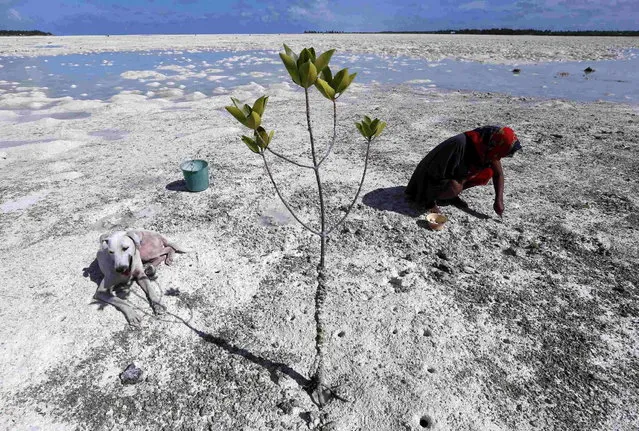
A dog sits in the shade of a mangrove tree as a woman uses a fork to dig for shellfish on the reef-mud flats of a lagoon located at South Tarawa in the central Pacific island nation of Kiribati May 23, 2013. (Photo by David Gray/Reuters)

A dog sits in the shade of a mangrove tree as a woman uses a fork to dig for shellfish on the reef-mud flats of a lagoon located at South Tarawa in the central Pacific island nation of Kiribati May 23, 2013. Kiribati consists of a chain of 33 atolls and islands that stand just metres above sea level, spread over a huge expanse of otherwise empty ocean. With surrounding sea levels rising, Kiribati President Anote Tong has predicted his country will likely become uninhabitable in 30-60 years because of inundation and contamination of its freshwater supplies. (Photo by David Gray/Reuters)
Details
13 Jun 2013 09:23:00
Participants of the techno-parade “Zug der Liebe” (Train of love) dance on a street in Berlin, Germany July 25, 2015. (Photo by Axel Schmidt/Reuters)

Participants of the techno-parade “Zug der Liebe” (Train of love) dance on a street in Berlin, Germany July 25, 2015. The “Zug der Liebe” is the successor to the “Loveparade”, which in its heyday attracted up to 100,000 participants and ended in disaster and tragedy in 2010 when 21 people died and over 500 were injured due to suffocation from overcrowding at the “Loveparade” in Duisburg. (Photo by Axel Schmidt/Reuters)
Details
26 Jul 2015 10:11:00
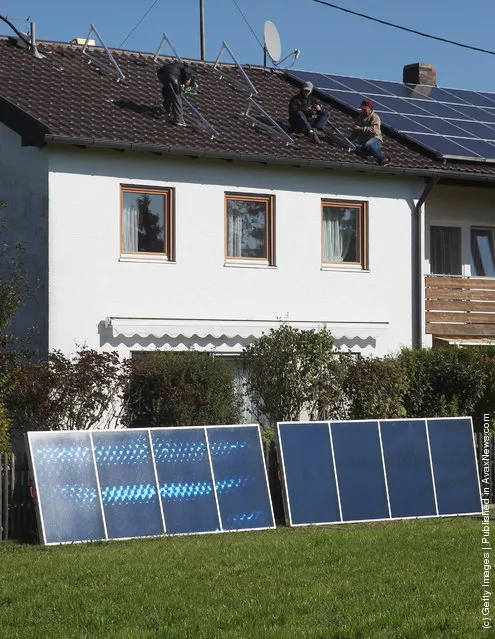
Workers install solar power modules for producing heat on the roof of a house

Workers prepare the roof of a house to get installed solar power modules for producing heat on October 15, 2011 in Wessling, Germany. Germany has and is continuing to invest heavily in solar energy, both in the public and private sectors. The German government introduced a feed-in tariff with its Renewable Energy Act in 2000 that guarantees homeowners a minimum rate for selling electricity from renewable energy sources into the nation's electricity grid. (Photo by Alexandra Beier/Getty Images)
Details
16 Oct 2011 10:58:00
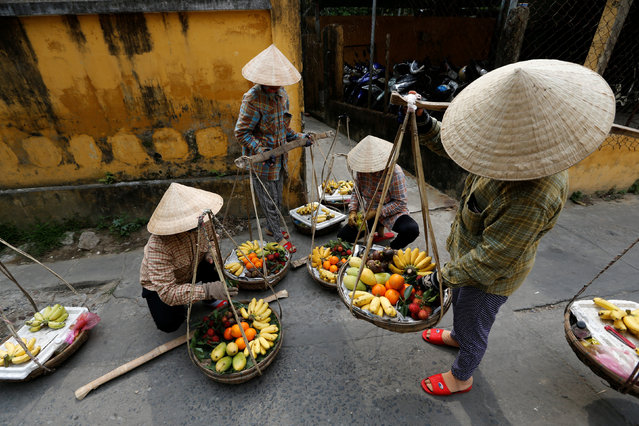
Women wearing traditional hats, known as a non la, sell fruits in Hoi An, Vietnam April 4, 2016. (Photo by Jorge Silva/Reuters)

Women wearing traditional hats, known as a non la, sell fruits in Hoi An, Vietnam April 4, 2016. The non la hats are made of readily available materials such as palm leaves, tree bark and bamboo and are visible everywhere in the city, a UNESCO World Heritage site. Hoi An's history as a busy trading port is evident throughout its architecture, a mix of eras and styles, with traditional wooden Vietnamese houses, Chinese temples and French colonial buildings. (Photo by Jorge Silva/Reuters)
Details
11 May 2016 11:32:00
A woman counts her money as she sells flowers ahead of International Women's Day in central Kiev, Ukraine March 7, 2019. (Photo by Gleb Garanich/Reuters)

A woman counts her money as she sells flowers ahead of International Women's Day in central Kiev, Ukraine on March 7, 2019. (Photo by Gleb Garanich/Reuters)
Details
10 Mar 2019 00:05:00