Loading...
Done
The floret of a Chamomile flower up close and personal. (Photo by Oliver Meckes/Barcroft Media)

These images have been created using a colour scanning electron microscope (SEM) by the award-winning Eye of Science, comprised of snapper Oliver Meckes and biologist Nicole Ottawa. For a decade the pair, based in Reutlingen in the south of Germany, worked with an old SEM they saved from the scrapheap, but for the last five years they have used a £250,000 FEI Quanta Series Field Emission SEM. Oliver said: “Flowers are beautiful in 'normal' view, but when you look closer, some parts get very bizarre and unexpected structures appear – flowers within flowers, worlds within worlds”. Photo: The floret of a Chamomile flower up close and personal. (Photo by Oliver Meckes/Barcroft Media)
Details
26 May 2014 13:51:00
A novice monk holds a book during an inauguration ceremony at Jogye temple in Seoul, May 11, 2015. Ten children on Monday were given the opportunity to experience life as Buddhist monks by staying at the temple until Buddha's birthday in two weeks. The writing on the book reads, “Novice Monk Prayer”. (Photo by Thomas Peter/Reuters)

A novice monk holds a book during an inauguration ceremony at Jogye temple in Seoul, May 11, 2015. Ten children on Monday were given the opportunity to experience life as Buddhist monks by staying at the temple until Buddha's birthday in two weeks. The writing on the book reads, “Novice Monk Prayer”. (Photo by Thomas Peter/Reuters)
Details
12 May 2015 11:41:00
Castles Etched on Grains of Sand

Artist Vik Muniz is known for his gigantic composite installations and sculptures created from thousands of individual objects. In this new collaboration with artist and MIT researcher Marcelo Coelho, Muniz takes the opposite approach and explores the microscopic with a new series of sandcastles etched onto individual grains of sand.
Details
13 Apr 2014 08:55:00
In this October 18, 2015 photo, contestant Carlos Angevil, Miss Gay Vargas, competes in the swimsuit category of the ninth annual Miss Gay Venezuela beauty pageant in Caracas, Venezuela. Miss Gay Venezuela requires contestants be younger than 37 and be at least 1.7 meters (5' 6" feet) tall. (Photo by Ariana Cubillos/AP Photo)

In this October 18, 2015 photo, contestant Carlos Angevil, Miss Gay Vargas, competes in the swimsuit category of the ninth annual Miss Gay Venezuela beauty pageant in Caracas, Venezuela. Miss Gay Venezuela requires contestants be younger than 37 and be at least 1.7 meters (5' 6" feet) tall. (Photo by Ariana Cubillos/AP Photo)
Details
25 Oct 2015 08:06:00
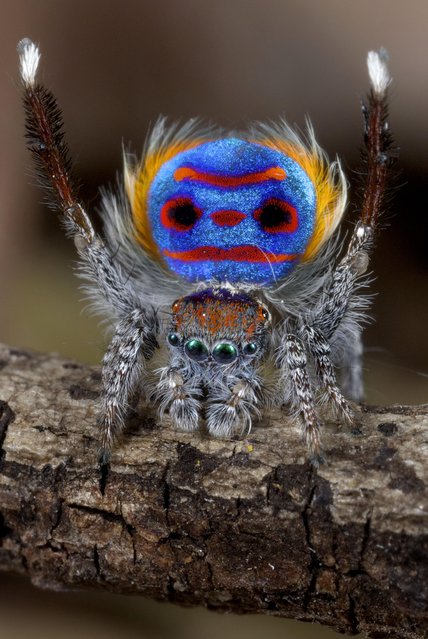
Peacock Spider Maratus Speciosus by Jurgen Otto

Maratus is a spider genus of the Salticidae family (jumping spiders). These spiders are commonly referred to as peacock spiders due to their colorful abdominal flaps that they display during courtship. In at least one species, Maratus vespertilio, the expansion of the flaps also occurs during ritualised contests between males. All described species, except M. furvus, are endemic to Australia. (Photo by Jurgen Otto)
Details
27 Feb 2014 12:20:00
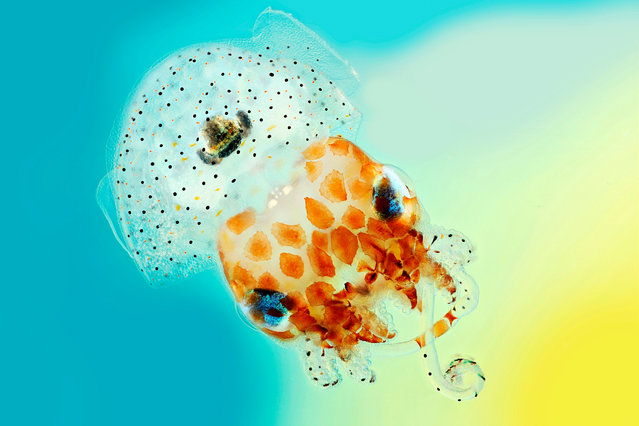
With its huge eyes, comical name and diminutive size, Mark R. Smith’s image of a baby Hawaiian bobtail squid can’t help but raise a smile. A curiously endearing creature, the cephalopod is just 1.5cm across, its mantle cavity bearing more than a passing resemblance to a rather natty shower cap. But it is also a beautiful example of symbiosis – nature’s version of “I’ll scratch your back if you scratch mine” – for on the underside of the squid is a light organ which houses bioluminescent bacteria. The squid offers the bacteria protection and food, while the bacteria emit a glow – a handy trait that the squid uses to offset its silhouette, helping it to evade predators in the depths below. Mark R. Smith’s entry combines several images of a Hawaiian bobtail squid with different focus lengths to create a final picture with greater depth of field than normal. (Photo by Mark R. Smith/Wellcome Images/Macroscopic Solutions)

With its huge eyes, comical name and diminutive size, Mark R. Smith’s image of a baby Hawaiian bobtail squid can’t help but raise a smile. A curiously endearing creature, the cephalopod is just 1.5cm across, its mantle cavity bearing more than a passing resemblance to a rather natty shower cap. But it is also a beautiful example of symbiosis – nature’s version of “I’ll scratch your back if you scratch mine” – for on the underside of the squid is a light organ which houses bioluminescent bacteria. The squid offers the bacteria protection and food, while the bacteria emit a glow – a handy trait that the squid uses to offset its silhouette, helping it to evade predators in the depths below. Mark R. Smith’s entry combines several images of a Hawaiian bobtail squid with different focus lengths to create a final picture with greater depth of field than normal. (Photo by Mark R. Smith/Wellcome Images/Macroscopic Solutions)
Details
08 Mar 2017 00:05:00
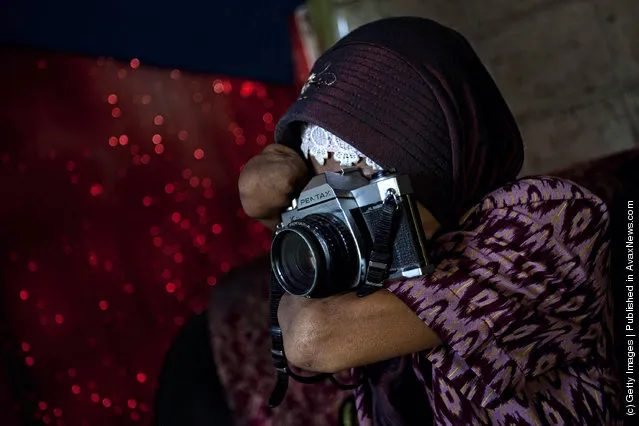
Acid attack survivors wait in the back stage prior to participate in a fashion show titled “Beauty Redefined” organized by ActionAid Bangladesh in Dhaka, Bangladesh, March 7, 2017. (Photo by Mohammad Ponir Hossain/Reuters)

Acid attack survivors wait in the back stage prior to participate in a fashion show titled “Beauty Redefined” organized by ActionAid Bangladesh in Dhaka, Bangladesh, March 7, 2017. Such horrific violence across South Asia is often prompted by insufficient dowries, rejection of advances or land disputes, disfiguring victims for life and ruining their prospects. (Photo by Mohammad Ponir Hossain/Reuters)
Details
10 Mar 2017 00:01:00
Marani Devi Chaudhary (C), aged 40, performs a ritual in front of shaman Paltan Yadav (unseen) at her home in Rajaur village in Dhanusha district, Nepal, 02 November 2017. The shaman identified Marani Devi to be possessed by their lineage god who was dissatisfied by their worship is thought by the family to have caused them misfortune and is even feared lead to their death. Therefore Marani Devi spent 1,500 USD to perform a healing ritual at the Ghost Festival held at the banks of Kamala River in Dhanusha district two days later. Every family or community has their own sacred god, called 'Kuldevta' in Nepali which means family deity or lineage god. Only family members or people within communities of the same caste can worship to the deity. They have their own rules and regulations of worship which varies from one family and community to another. Being unable to follow the rules and regulations or carry out worship is believed to cause misfortune. (Photo by Narendra Shrestha/EPA/EFE)

Marani Devi Chaudhary (C), aged 40, performs a ritual in front of shaman Paltan Yadav (unseen) at her home in Rajaur village in Dhanusha district, Nepal, 02 November 2017. The shaman identified Marani Devi to be possessed by their lineage god who was dissatisfied by their worship is thought by the family to have caused them misfortune and is even feared lead to their death. (Photo by Narendra Shrestha/EPA/EFE)
Details
17 Nov 2017 06:53:00