Loading...
Done
Demonstrators take part in a mass “face-sitting protest” outside the Houses of Parliament in central London on December 12, 2014, as they protest against changes to p*rnography regulations. (Photo by Leon Neal/AFP Photo)

Demonstrators take part in a mass “face-sitting protest” outside the Houses of Parliament in central London on December 12, 2014, as they protest against changes to p*rnography regulations. An amendment to the 2003 Communities Act applies the same strict rules to p*rn bought online as those included in the guidelines set out by the British Board of Film Censors for DVDs. The new laws ban films that feature s*x acts, such as spanking, caning, strangulation, aggressive whipping, humiliation, and face-sitting. Ministers say the rules have been brought in to protect s*x workers. But campaigners say it is an attempt to censor and control the internet. Paid-for videos shot overseas and viewed online in the UK are not affected by the new rules, which were introduced on December 2, 2014. (Photo by Leon Neal/AFP Photo)
Details
14 Dec 2014 11:31:00
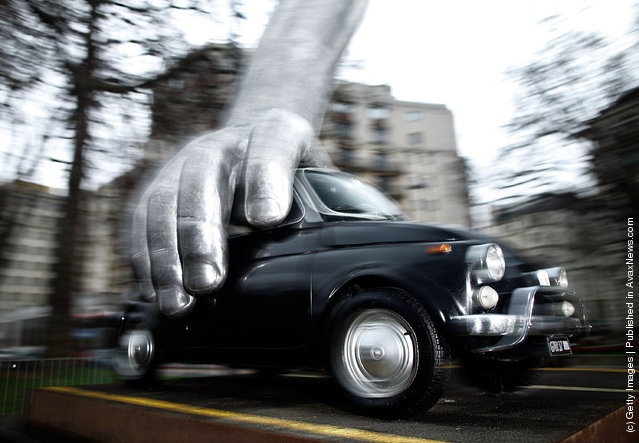
Lorenzo Quinn's Vroom Vroom sculpture

“Lorenzo Quinn (born May 7, 1966) is an Italian artist and sculptor and the fifth son of the actor Anthony Quinn. By the age of 21 he gained the respect of the New York art community when he was commissioned to make an art work for the United Nations of which a stamp was later made. Quinn was later selected to head the Absolut Vodka ad campaign for which only top international artists are chosen”. – Wikipedia

Photo: Lorenzo Quinn's Vroom Vroom sculpture is installed in its new setting on Park Lane on January 23, 2011 in London, England. The four-metre high sculpture, consists of a vintage Fiat 500, the first car that the sculptor ever bought, grasped by an oversized aluminium child's hand modelled from Quinn's son. The exhibition has previously been displayed in Valencia and Abu Dhabi. (Photo by Matthew Lloyd/Getty Images for Halcyon Gallery)
Details
22 Aug 2011 12:30:00
Women labourers work at the construction site of a road in Kolkata January 8, 2015. Across towns and cities in India, it is not uncommon to see women cleaning building sites, carrying bricks and or shoveling gravel - helping construct the infrastructure necessary for the country's economic and social development. (Photo by Rupak De Chowdhuri/Reuters)

Women labourers work at the construction site of a road in Kolkata January 8, 2015. Across towns and cities in India, it is not uncommon to see women cleaning building sites, carrying bricks and or shoveling gravel – helping construct the infrastructure necessary for the country's economic and social development. They help build roads, railway tracks, airports, and offices. They lay pipes for clean water supplies, cables for telecommunications, and dig the drains for sewage systems. But although women make up at least 20 percent of India's 40 million construction workers, they are less recognized than male workers with lower pay and often prone to safety hazards and sexual harassment. They are often unaware of their rights or scared to complain, say activists now trying to campaign for better treatment of women in the construction industry. (Photo by Rupak De Chowdhuri/Reuters)
Details
15 Jan 2015 13:47:00
Barrier tape is tied around 15-month-old Shivani's ankle to prevent her from running away, while her mother Sarta Kalara works at a construction site nearby, in Ahmedabad, India, April 19, 2016. Kalara says she has no option but to tether her daughter Shivani to a stone despite her crying, while she and her husband work for 250 rupees ($3.8) each a shift digging holes for electricity cables in the city of Ahmedabad. There are about 40 million construction workers in India, at least one in five of them women, and the majority poor migrants who shift from site to site, building infrastructure for India's booming cities. Across the country it is not uncommon to see young children rolling in the sand and mud as their parents carry bricks or dig for new roads or luxury houses. (Photo by Amit Dave/Reuters)

Barrier tape is tied around 15-month-old Shivani's ankle to prevent her from running away, while her mother Sarta Kalara works at a construction site nearby, in Ahmedabad, India, April 19, 2016. Kalara says she has no option but to tether her daughter Shivani to a stone despite her crying, while she and her husband work for 250 rupees ($3.8) each a shift digging holes for electricity cables in the city of Ahmedabad. There are about 40 million construction workers in India, at least one in five of them women, and the majority poor migrants who shift from site to site, building infrastructure for India's booming cities. Across the country it is not uncommon to see young children rolling in the sand and mud as their parents carry bricks or dig for new roads or luxury houses. (Photo by Amit Dave/Reuters)
Details
14 Dec 2016 07:39:00
Jim Belushi

Jim Belushi attends the Creative Coalition & friends celebration of the Broadway show 'Born Yesterday' at the Nat Sherman Flagship Store on April 14, 2011 in New York City.
Details
15 Apr 2011 12:53:00
Kissing girls

Fuse TV VJ's Marianela and Juliya attend the store opening of “Nigo's A Bathing Ape” with Pharrell Williams January 11, 2005 in New York City. (Photo by Paul Hawthorne/Getty Images)
Details
29 Aug 2011 14:20:00
A shop assistant creates a window display in a Next store in central London December 30, 2014.  British clothing retailer Next's sales rose 2.9 percent in the run up to Christmas mostly due to online and catalogue purchases, hitting the upper end of its predictions and it said full-year profit would rise by about 11.5 percent. (Photo by Neil Hall/Reuters)

A shop assistant creates a window display in a Next store in central London December 30, 2014. British clothing retailer Next's sales rose 2.9 percent in the run up to Christmas mostly due to online and catalogue purchases, hitting the upper end of its predictions and it said full-year profit would rise by about 11.5 percent. (Photo by Neil Hall/Reuters)
Details
03 Jan 2015 12:38:00
David Pena poses for a photograph with his Lada 2101 built in 1979 on a street in Havana February 9, 2015. Getting parts from the United States is cheaper than in Cuba, where state-run stores sell them at four times the cost, said Pena, a mechanic and president of the Russian Car Club in Havana who drives a souped-up, sporty red 1972 Lada 2101 that he fixed himself. His own Lada has a Fiat engine and an extra Alfa Romeo carburetor. (Photo by Enrique De La Osa/Reuters)

David Pena poses for a photograph with his Lada 2101 built in 1979 on a street in Havana February 9, 2015. Getting parts from the United States is cheaper than in Cuba, where state-run stores sell them at four times the cost, said Pena, a mechanic and president of the Russian Car Club in Havana who drives a souped-up, sporty red 1972 Lada 2101 that he fixed himself. His own Lada has a Fiat engine and an extra Alfa Romeo carburetor. (Photo by Enrique De La Osa/Reuters)
Details
12 Feb 2015 12:55:00