Ukrainian artillery fires towards the frontline during heavy fighting amid Russia's attack on Ukraine, near Bakhmut, Ukraine on April 13, 2023. (Photo by Kai Pfaffenbach/Reuters)
People visit an installation by the American sculptor, Carole Feuerman, during the exhibition of her hyperrealistic sculptures at Pier 17 in the trendy neighbourhood of Seaport in New York City on June 1, 2024. (Photo by Milo Hess/ZUMA Press Wire/Rex Features/Shutterstock)
People swim underwater at Clovelly Beach on December 14, 2023 in Sydney, Australia. A severe heat wave hit Sydney over the weekend, a precursor of hot and dry conditions expected for the rest of the summer which will also bring heightened bushfire risk. The mercury rose to alarming levels again on Thursday. (Photo by Jenny Evans/Getty Images)
Japanese dancers perform the Awa-odori in the pitlane during the driver parade before the 2025 Formula 1 Japanese Grand Prix at the Suzuka Circuit, in Suzuka, Japan, 06 April 2025. (Photo by Franck Robichon/EPA)
Participants compete in the High-Heels Race as part of the Pride celebrations, in the Chueca neighbourhood in Madrid on July 4 29, 2024. MADO (Madrid Pride) is a series of street celebrations that take place during the city´s LGBTIQ (lesbian, gay, bisеxual, transgender, intersеx and queer) Pride week. (Photo by Óscar del Pozo/AFP Photo)
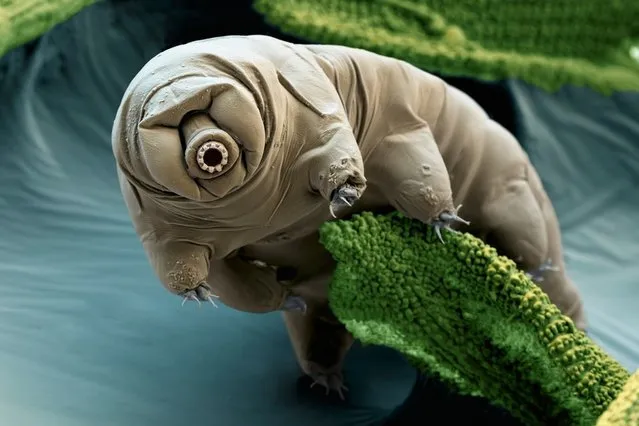
“Tardigrades (commonly known as waterbears or moss piglets) are small, water-dwelling, segmented animals with eight legs. Tardigrades were first discovered in 1773 by Johann August Ephraim Goeze, who called them kleiner Wasserbär, meaning “little water bear” in German. The name Tardigrada means “slow walker” and was given by Lazzaro Spallanzani in 1777. The name water bear comes from the way they walk, reminiscent of a bear's gait. The biggest adults may reach a body length of 1.5 millimetres (0.059 in), the smallest below 0.1 mm. Freshly hatched tardigrades may be smaller than 0.05 mm”. – Wikipedia. Photo: Tardigrades. (Photo by SPL/East News)