Loading...
Done
Mercedes-Benz Unimog Concept

How much do things change in 60 years? Sometimes the best answer to that kind of question is a picture. Here you can see an original Unimog (right), built sometime between the start of production in 1948 and 1951, when Mercedes bought the operation in order to expand it enough to keep up with demand. On the left is a “60th Anniversary” Unimog design concept, celebrating not the actual birth of the Unimog, but its purchase by Mercedes. Needless to say, the contrast between the two is… breathtaking. And if you’re curious about the evolution of this hugely influential vehicle, if you can’t help wondering how it grew from a (relatively) tiny, spartan utility vehicle to a garish, Mercedes-starred behemoth.
Details
31 Oct 2012 11:24:00
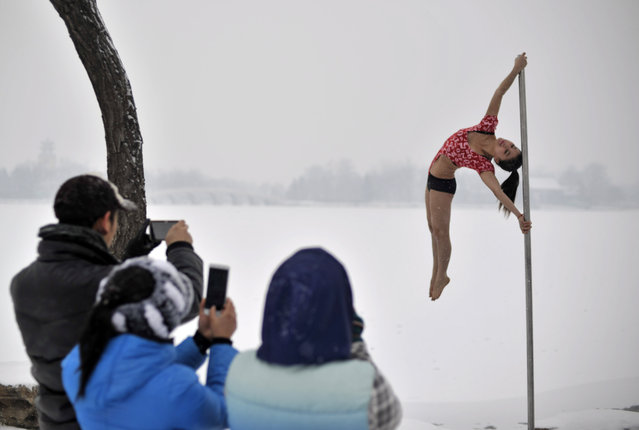
This picture taken on December 17, 2013 shows people taking photos of a pole dancer (R) practising after it snowed in Tianjin during a promotional event by members of China's national pole dancing team and students of the sport. (Photo by AFP Photo)

This picture taken on December 17, 2013 shows people taking photos of a pole dancer (R) practising after it snowed in Tianjin during a promotional event by members of China's national pole dancing team and students of the sport. China set up its first national pole dancing team in Tianjin in 2012 in order to compete in the World Pole Dancing Championships. (Photo by AFP Photo)
Details
20 Dec 2013 09:03:00


People look on as water from the rising Mississippi River is released through the Bonnet Carre Spillway while washing out a road May 9, 2011 in Norco, Louisiana. The Army Corps of Engineers began redirecting part of the Mississippi River through the spillway today to lower river levels and reduce pressure on levees in order to avoid a catastrophic failure. The water will flow nearly 6 miles north before emptying into Lake Pontchartrain as the Mississippi rises close to the highest level ever upriver in Memphis. (Photo by Mario Tama/Getty Images)
Details
11 May 2011 10:11:00
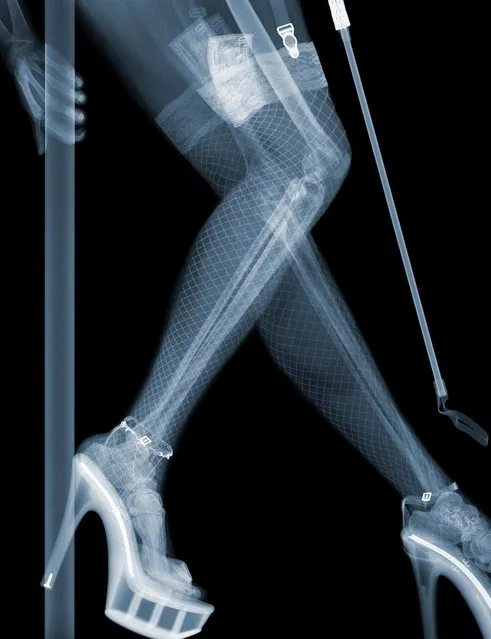
“Stripper”: Has tucked her cash away safely. (Photo by Nick Veasey/Barcroft Media)

British artist Nick Veasey used an X-ray machine to show us exactly what's going on under people's clothes. The equipment took copies of items separately before they were mashed together to create characters and situations. The work is part of Veasey's latest exhibition named “X-ray Voyeurism”. In order to create the work, the 51-year-old has spent the last 20 years exposing himself to harmful radiation in his studio. Photo: “Stripper”: Has tucked her cash away safely. (Photo by Nick Veasey/Barcroft Media)
Details
22 Jun 2014 10:49:00
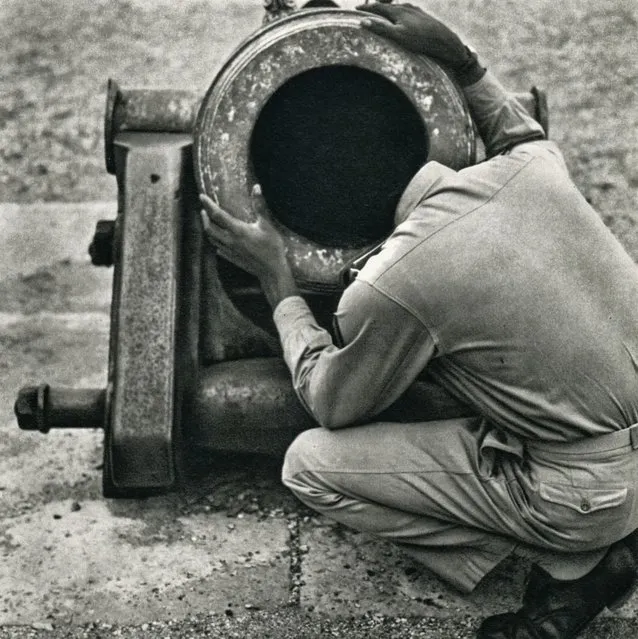
Humour Photography By Rene Maltete

René Maltête was a French photographer and poet. His pictures were based on the element of surprise and incongruity, often having a humorous and even philosophical side to them. At the start of his career, he often had to resort to manual labor as an addition to his to his profession in order to pay the bills. However, René's talent of seeing and being able to capture in time humorous moment of mundane, day-to-day life payed off in the end. Over the years, his works were published in a number of magazines in addition to numerous exhibitions that were held worldwide to popularize his work. (Photo by René Maltête)
Details
23 Oct 2014 11:34:00
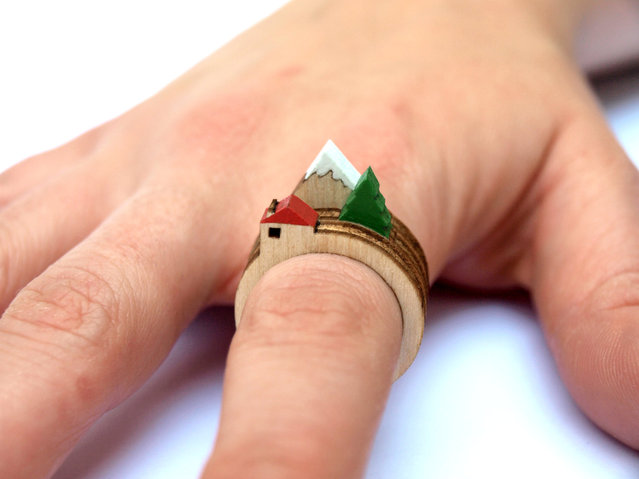
Awesome Ring By Clive Roddy

If you ever wanted to wear houses on your finger, now’s your chance (though it’s hard to imagine that any sane person would have such a desire)! Clive Roddy offers you an opportunity to fulfill your dream of having a ring that features houses, waves, mountains, or trees. In order to create these rings, first the metal is cut using a laser, and then the whole thing is hand painted using colored enamel. Though these rings are very pretty, it is hard to imagine someone wearing such a ring on everyday basis. These types of rings should probably be reserved for special occasions or festivals, rather than for everyday use. (Photo by Clive Roddy)
Details
09 Dec 2014 09:36:00
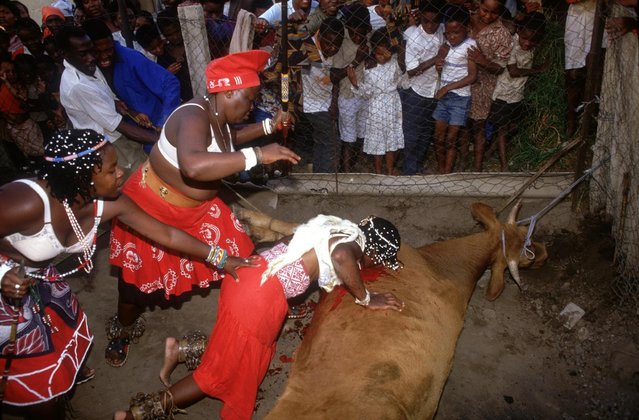
South African Sangomas are wizards and witches who are supposedly chosen by their ancestors to follow a traditional training and go through a rite of passage after which they become Sangomas and can cure and help people. They are so respected and trusted that western medical authorities have actually advised the government of South Africa to develop its cooperation with Sangomas in order to improve hygiene and health among the population. Today is graduation day for Trissa, 25, a Sangoma student in Tembisa, near Pretoria. Thanks to the help of the spirits of her ancestors, she has found a cow that had been hidden. The cow has then been killed by Sangoma Thelma and Trissa is now drinking its blood, thus becoming a Sangoma and changing her name to Nomadlozi. Location: Tembisa, near Pretoria, South Africa. (Photo by Patrick Durand/Sygma via Getty Images)

South African Sangomas are wizards and witches who are supposedly chosen by their ancestors to follow a traditional training and go through a rite of passage after which they become Sangomas and can cure and help people. They are so respected and trusted that western medical authorities have actually advised the government of South Africa to develop its cooperation with Sangomas in order to improve hygiene and health among the population. (Photo by Patrick Durand/Sygma via Getty Images)
Details
24 Feb 2017 00:05:00
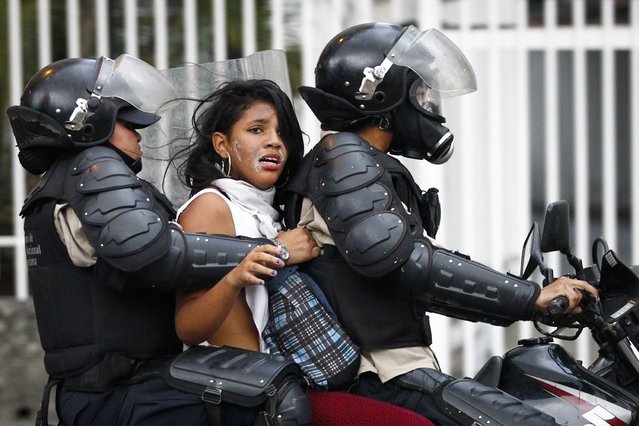
National police transport an anti-government protester detainee during a protest against Nicolas Maduro's government in Caracas March 13, 2014. Venezuela's state prosecutor said on Thursday the death toll from a month of violent protests had risen to 28, after the nation's top court ordered opposition mayors to dismantle barricades set up by street protesters. (Photo by Carlos Garcia Rawlins/Reuters)

National police transport an anti-government protester detainee during a protest against Nicolas Maduro's government in Caracas March 13, 2014. Venezuela's state prosecutor said on Thursday the death toll from a month of violent protests had risen to 28, after the nation's top court ordered opposition mayors to dismantle barricades set up by street protesters. State prosecutor Luisa Ortega Diaz, speaking on the sidelines of the U.N. Human Rights Council in Geneva, also said 1,293 detainees had been released and 104 remained in custody accused of serious crimes during the anti-government demonstrations. (Photo by Carlos Garcia Rawlins/Reuters)
Details
15 Mar 2014 10:46:00