Loading...
Done
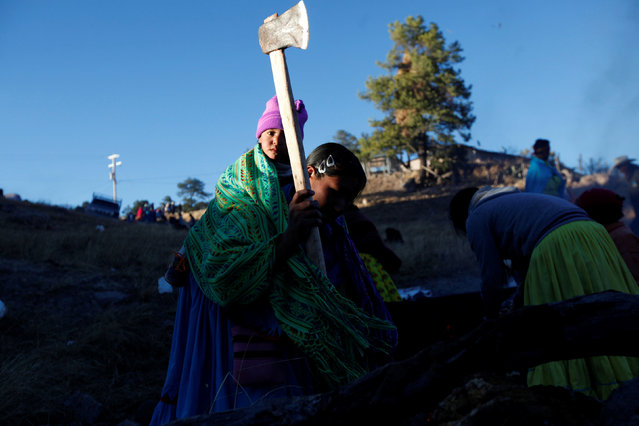
A woman from the Tarahumara ethnic group cuts firewood with an ax while preparing for winter in Caborachi village, in Guachochi, Mexico, December 17, 2016. (Photo by Jose Luis Gonzalez/Reuters)

A woman from the Tarahumara ethnic group cuts firewood with an ax while preparing for winter in Caborachi village, in Guachochi, Mexico, December 17, 2016. (Photo by Jose Luis Gonzalez/Reuters)
Details
19 Dec 2016 10:10:00
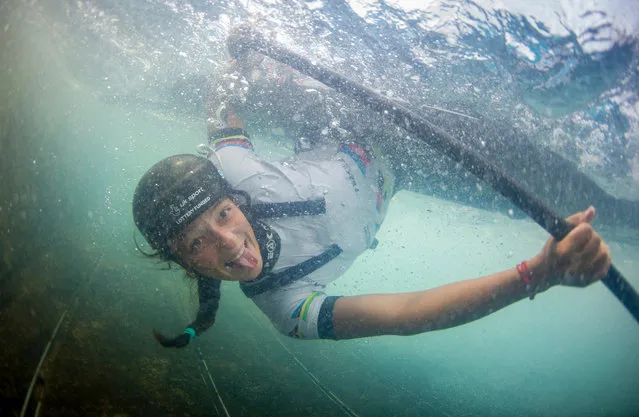
Special Merit Award. Mallory Franklin (2019). The British slalom canoeist has competed internationally since 2009 and won nine medals in total at the ICF Canoe Slalom World Championships with four golds, four silvers and a bronze. She has also won eleven medals at the European Championships. (Photo by Richard Pelham/World Sports Photography Awards 2021)

Special Merit Award. Mallory Franklin (2019). The British slalom canoeist has competed internationally since 2009 and won nine medals in total at the ICF Canoe Slalom World Championships with four golds, four silvers and a bronze. She has also won eleven medals at the European Championships. (Photo by Richard Pelham/World Sports Photography Awards 2021)
Details
05 Jun 2021 09:12:00
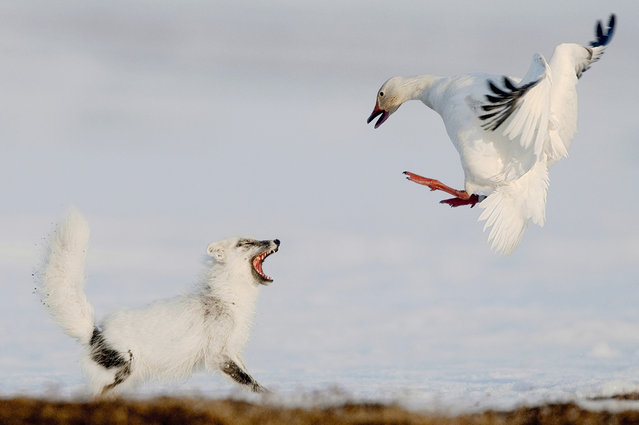
Commended. In late May, about a quarter of a million snow geese arrive from North America to nest on Wrangel Island, in northeastern Russia. They form the world's largest breeding colony of snow geese. Photographer Sergey Gorshkov spent two months on the remote island photographing the unfolding dramas. (Photo by Sergey Gorshkov/Veolia Environnement Wildlife Photographer)

Commended. In late May, about a quarter of a million snow geese arrive from North America to nest on Wrangel Island, in northeastern Russia. They form the world's largest breeding colony of snow geese. Photographer Sergey Gorshkov spent two months on the remote island photographing the unfolding dramas. Arctic foxes take advantage of the abundance of eggs, caching surplus eggs for leaner times. But a goose (here the gander) is easily a match for a fox, which must rely on speed and guile to steal eggs. “The battles were fairly equal”, notes Sergey, “and I only saw a fox succeed in grabbing an egg on a couple of occasions, despite many attempts”. Surprisingly, “the geese lacked any sense of community spirit”, he adds, “and never reacted when a fox harassed a neighboring pair nesting close by”. (Photo by Sergey Gorshkov/Veolia Environnement Wildlife Photographer)
Details
16 Jun 2015 12:30:00
Ocean voyage

Do you think that history is a science? Well, not exactly. First, and foremost, history is the state's “legend of wars”, it’s official regalia. Of course, public historians are not interested in scientific truth – quite the opposite. In this respect, any attempt to present a state’s history as altruistic and benevolent as possible is welcomed and encouraged – as opposed to any revisionism attempts that may be more accurate. In this matter, Chinese have surpassed us all – they revised in highly creative manner (but rather shamelessly) the technology already invented by Europeans, a process that resulted in oldest state on the planet. Here is an interesting paradox: ask any sinologist about the Middle Kingdom during second century B.C., and he will describe it to you in such a vivid manner as if he has been living there all his life – but as soon as you will ask him to describe Chinese history in the 19-20th centuries… let's say, his eagerness will be greatly diminished. However, we will discuss China in a different article, and in the meantime we will try to understand how exactly historic “legend of wars” is formed and functions – based on a specific and well-known example. A great example is Ferdinand Magellan's first voyage around the world.
Details
14 Nov 2011 09:11:00
Restive woman driving. (Photo by Cultura Creative (RF)/Alamy Stock Photo )

Restive woman driving. (Photo by Cultura Creative (RF)/Alamy Stock Photo)
Details
31 May 2017 07:01:00
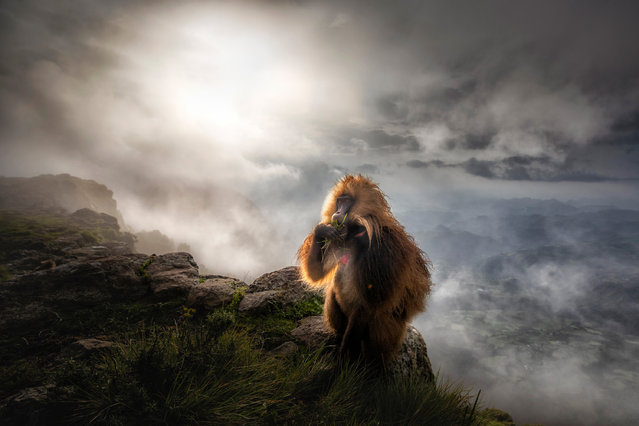
Highly commended, mammals: Gelada after the storm – Marco Gaiotti (Italy). “Gelada baboons are the only monkey species in the world that feed on grasses. They are native to the tableland of Ethiopia. Every morning large family groups wander from their sleeping places in the steep rock face, up to 1,000 metres high, to the feeding grounds at the tablelands. This image clearly depicts their feeding strategy: they pull out bunches of grass, sort the stalks and then lift them to their mouth. This shot was taken towards the end of the rainy season after a heavy storm”. (Photo by Marco Gaiotti/2019 GDT European Wildlife Photographer of the Year)

Highly commended, mammals: Gelada after the storm – Marco Gaiotti (Italy). “Gelada baboons are the only monkey species in the world that feed on grasses. They are native to the tableland of Ethiopia. Every morning large family groups wander from their sleeping places in the steep rock face, up to 1,000 metres high, to the feeding grounds at the tablelands. This image clearly depicts their feeding strategy: they pull out bunches of grass, sort the stalks and then lift them to their mouth. This shot was taken towards the end of the rainy season after a heavy storm”. (Photo by Marco Gaiotti/2019 GDT European Wildlife Photographer of the Year)
Details
31 Oct 2019 00:03:00
In Omdurman, the largest city in Sudan, the Qadiriyya Sufi order meets every Friday outside Sheikh Hamed Al Nil mosque, which houses the tomb of their 19th century Sufi leader. (Photo by Ala Kheir, John Burns and Ibrahim Algrefwi/Brownbook)

In Omdurman, the largest city in Sudan, the Qadiriyya Sufi order meets every Friday outside Sheikh Hamed Al Nil mosque, which houses the tomb of their 19th century Sufi leader. (Photo by Ala Kheir, John Burns and Ibrahim Algrefwi/Brownbook)
Details
21 Feb 2016 11:47:00
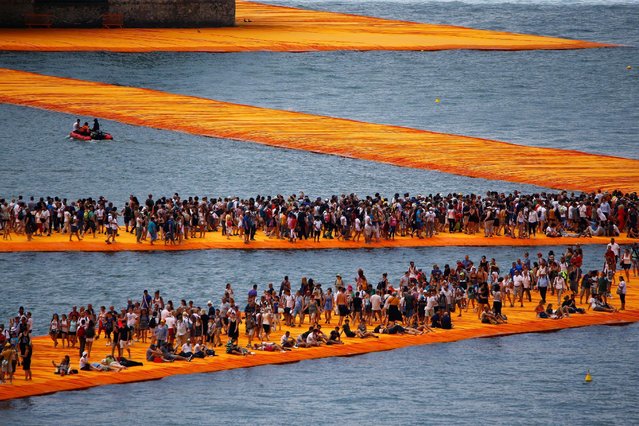
People walk on the installation “The Floating Piers” on Lake Iseo by Bulgarian-born artist Christo Vladimirov Yavachev, known as Christo, at the installation's last weekend near Sulzano, northern Italy, July 2, 2016. (Photo by Wolfgang Rattay/Reuters)

People walk on the installation “The Floating Piers” on Lake Iseo by Bulgarian-born artist Christo Vladimirov Yavachev, known as Christo, at the installation's last weekend near Sulzano, northern Italy, July 2, 2016. (Photo by Wolfgang Rattay/Reuters)
Details
04 Jul 2016 08:27:00