Loading...
Done
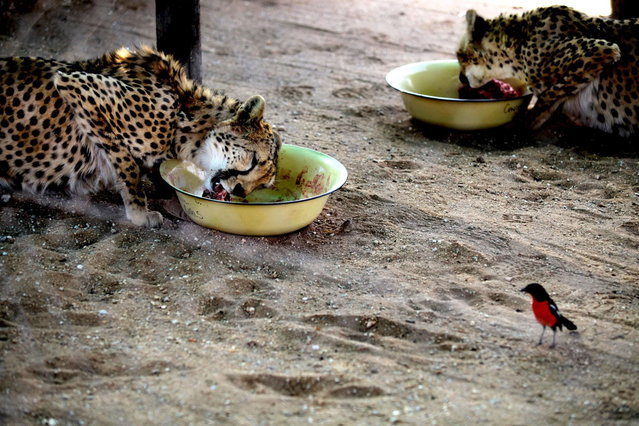
Young cheetahs eat meat at The Cheetah Conservation Fund (CCF) center in Otjiwarongo, Namibia, on August 13, 2013. The CCF started breeding Anatolian livestock dogs to promote cheetah-friendly farming after some 10,000 big cats – the current total worldwide population – were killed or moved off farms in the 1980s.  Up to 1,000 cheetahs were being killed a year, mostly by farmers who saw them as livestock killers. But the use of dogs has slashed losses for sheep and goat farmers and led to less retaliation against the vulnerable cheetah. (Photo by Jennifer Bruce/AFP Photo)

Young cheetahs eat meat at The Cheetah Conservation Fund (CCF) center in Otjiwarongo, Namibia, on August 13, 2013. The CCF started breeding Anatolian livestock dogs to promote cheetah-friendly farming after some 10,000 big cats – the current total worldwide population – were killed or moved off farms in the 1980s. Up to 1,000 cheetahs were being killed a year, mostly by farmers who saw them as livestock killers. But the use of dogs has slashed losses for sheep and goat farmers and led to less retaliation against the vulnerable cheetah. (Photo by Jennifer Bruce/AFP Photo)
Details
29 Aug 2013 10:56:00
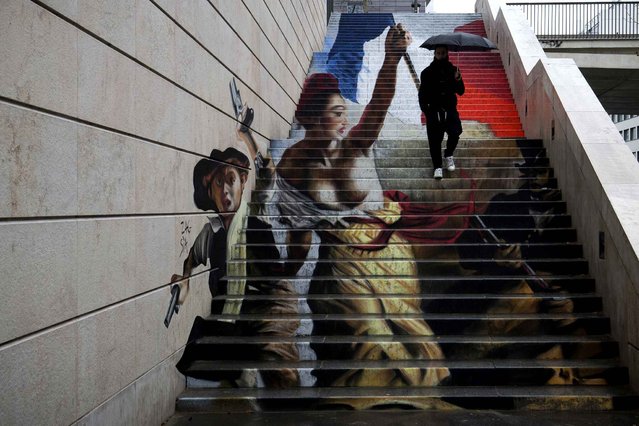
A man passes by an unfinished street art graffiti made in a stairway by French street artists Zag and Sia in Paris on March 1, 2016. The two artists drew inspiration from famous “Liberty Leading the People” (La Liberte guidant le peuple) painting by French Eugene Delacroix commemorating the July Revolution of 1830 and viewed as a symbol of the French Republic. (Photo by Joel Saget/AFP Photo)

A man passes by an unfinished street art graffiti made in a stairway by French street artists Zag and Sia in Paris on March 1, 2016. The two artists drew inspiration from famous “Liberty Leading the People” (La Liberte guidant le peuple) painting by French Eugene Delacroix commemorating the July Revolution of 1830 and viewed as a symbol of the French Republic. (Photo by Joel Saget/AFP Photo)
Details
04 Mar 2016 12:31:00
This artist image released from Japan's airline All Nippon Airways (ANA) on April 17, 2015 shows ANA's Boeing 787-9 aircraft into the colors of R2-D2 robot of Star Wars. Japanese air carrier ANA will place the special colored jetliner in service in this autumn. (Photo by AFP Photo/All Nippon Airways)

This artist image released from Japan's airline All Nippon Airways (ANA) on April 17, 2015 shows ANA's Boeing 787-9 aircraft into the colors of R2-D2 robot of Star Wars. Japanese air carrier ANA will place the special colored jetliner in service in this autumn. (Photo by AFP Photo/All Nippon Airways)
Details
18 Apr 2015 10:24:00
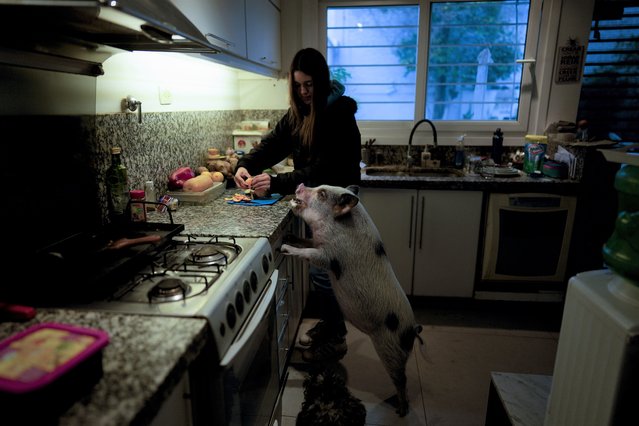
Luciana Benetti, 16, feeds her pet pig Chanchi, given to her for a birthday present the previous year in Buenos Aires, Argentina, Saturday, September 4, 2021. As the new coronavirus began to circulate last year, Benetti found her plans for a big traditional 15th birthday party scrapped. In its place, her parents gave her a pig. (Photo by Natacha Pisarenko/AP Photo)

Luciana Benetti, 16, feeds her pet pig Chanchi, given to her for a birthday present the previous year in Buenos Aires, Argentina, Saturday, September 4, 2021. As the new coronavirus began to circulate last year, Benetti found her plans for a big traditional 15th birthday party scrapped. In its place, her parents gave her a pig. (Photo by Natacha Pisarenko/AP Photo)
Details
03 Oct 2021 03:40:00
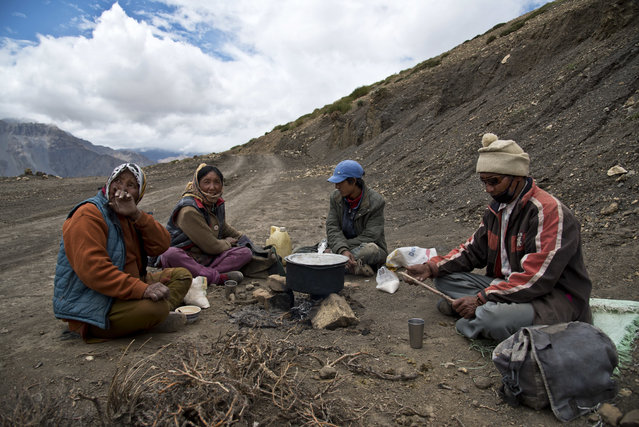
In this August 17, 2016, photo, from left to right, Chhering Chodom, 60, Tashi Yangzom, 50, Lobsang Chhering, 27, and Dorje Tandup, 58, drink milk tea on the side of the road. For centuries, the sleepy valley nestled in the Indian Himalayas remained a hidden Buddhist enclave forbidden to outsiders. Enduring the harsh year-round conditions of the high mountain desert, the people of Spiti Valley lived by a simple communal code – share the Earth's bounty, be hospitable to neighbors, and eschew greed and temptation at all turns. That's all starting to change, for better or worse. Since India began allowing its own citizens as well as outsiders to visit the valley in the early 1990s, tourism and trade have boomed. And the marks of modernization, such as solar panels, asphalt roads and concrete buildings, have begun to appear around some of the villages that dot the remote landscape at altitudes above 4,000 meters (13,000 feet). (Photo by Thomas Cytrynowicz/AP Photo)

In this August 17, 2016, photo, from left to right, Chhering Chodom, 60, Tashi Yangzom, 50, Lobsang Chhering, 27, and Dorje Tandup, 58, drink milk tea on the side of the road. For centuries, the sleepy valley nestled in the Indian Himalayas remained a hidden Buddhist enclave forbidden to outsiders. Enduring the harsh year-round conditions of the high mountain desert, the people of Spiti Valley lived by a simple communal code – share the Earth's bounty, be hospitable to neighbors, and eschew greed and temptation at all turns. That's all starting to change, for better or worse. (Photo by Thomas Cytrynowicz/AP Photo)
Details
15 Sep 2016 09:22:00


“Kumbh Mela is a mass Hindu pilgrimage in which Hindus gather at the Ganges river. The normal Kumbh Mela is celebrated every 3 years, the Ardh (half) Kumbh Mela is celebrated every six years at Haridwar and Prayag, the Purna (complete) Kumbh takes place every twelve years, at four places (Prayag (Allahabad), Haridwar, Ujjain, and Nashik). The Maha (great) Kumbh Mela which comes after 12 “Purna Kumbh Melas”, or 144 years, is held at Allahabad.

The last Ardh Kumbh Mela was held over a period of 45 days beginning in January 2007, more than 70 million Hindu pilgrims took part in the Ardh Kumbh Mela at Prayag, and on January 15, the most auspicious day of the festival of Makar Sankranti, more than 5 million participated. The previous Maha Kumbh Mela, held in 2001, was attended by around 60 million people, making it at the time the largest gathering anywhere in the world in recorded history”. – Wikipedia

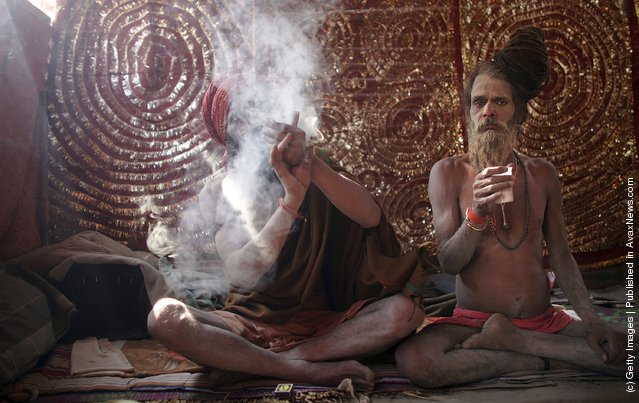
Photo: Sadhus (holy men) smoke at their camp near the ritual site at Sangam, the confluence of the Ganges, Yamuna and mythical Saraswati rivers during the Ardh Kumbh Mela festival (Half Pitcher festival) January 18, 2007 in Allahabad, India. Millions of Hindu pilgrims have flocked to the largest religious gathering in the world which lasts for 45 days in northern India. The festival commemorates the mythical conflict between gods and demons over a pitcher filled with the “nectar of immortality”. Devotees believe that taking a holy dip in the Ganges at this time washes away their sins and paves the path to salvation. (Photo by Mario Tama/Getty Images)

Details
30 Jun 2011 10:27:00
 Mini Coca-Cola In Mini Kiosk

Coca-cola mini kiosks by ogilvy & mather Berlin promote tiny coke cans. To promote the launch of its tiny coke cans, coca-cola and advertising agency ogilvy & mather berlin deployed and installed a series of miniature kiosks throughout five different major cities in Germany.
Details
12 Sep 2014 09:59:00
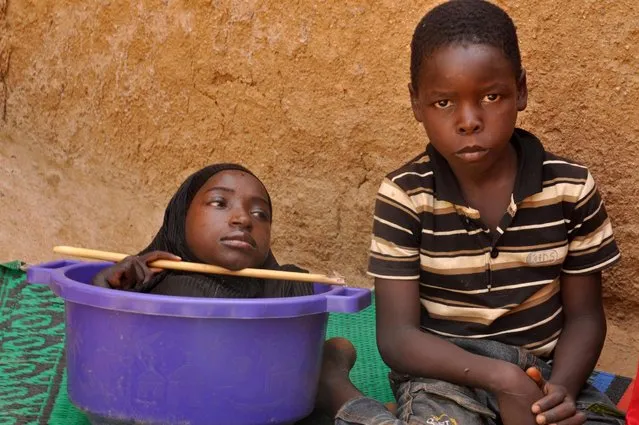
Rahma, 19, pictured with her 10-year old brother Fahad on June 21, 2016 in Kano, Nigeria. A teenage girl born without limbs lives her life in a plastic bowl. Rahma Haruna is a bright, happy girl, despite suffering from a mystery condition that stopped her arms and legs developing properly – leaving her practically limbless and in constant pain. The 19-year- old, from Kano, Nigeria, was born a healthy baby but when she turned six months old her growth came to a sudden halt and she stopped hitting key development milestones. Rahma’s family do their best to provide her with a fulfilling life and transport her around the village in a plastic bowl. Rahma said: “They help me a lot. How do they? They give me anything I need”. Rahma died on 25 December 2016. (Photo by Sani Maikatanga/Barcroft Images)

Rahma, 19 (L), pictured with her 10-year old brother Fahad on June 21, 2016 in Kano, Nigeria. A teenage girl born without limbs lives her life in a plastic bowl. Rahma Haruna is a bright, happy girl, despite suffering from a mystery condition that stopped her arms and legs developing properly – leaving her practically limbless and in constant pain. The 19-year- old, from Kano, Nigeria, was born a healthy baby but when she turned six months old her growth came to a sudden halt and she stopped hitting key development milestones. Rahma’s family do their best to provide her with a fulfilling life and transport her around the village in a plastic bowl. Rahma said: “They help me a lot. How do they? They give me anything I need”. Rahma died on 25 December 2016. (Photo by Sani Maikatanga/Barcroft Images)
Details
30 Dec 2016 10:52:00