Loading...
Done
 Paper Anatomy By Lisa Nilsson

These pieces are made of Japanese mulberry paper and the gilded edges of old books. They are constructed by a technique of rolling and shaping narrow strips of paper called quilling or paper filigree. Quilling was first practiced by Renaissance nuns and monks who are said to have made artistic use of the gilded edges of worn out bibles, and later by 18th century ladies who made artistic use of lots of free time. I find quilling exquisitely satisfying for rendering the densely squished and lovely internal landscape of the human body in cross section.
Details
14 Apr 2013 11:07:00
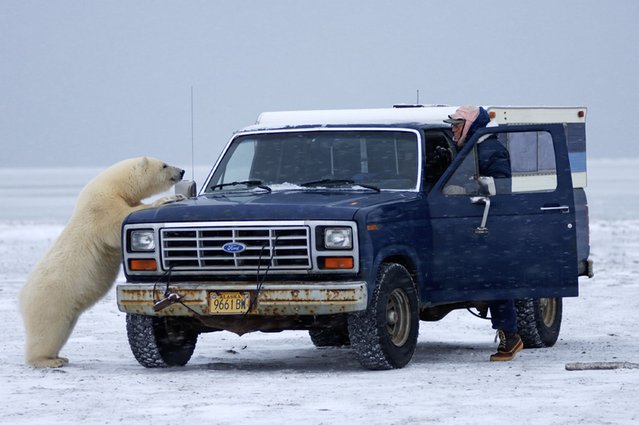
“Awright mate, any chance of a lift to the North Pole?” (Photo by Steven Kazlowski/Barcroft Media)

“This cheeky polar bear tried to hitch a lift off an unsuspecting driver by clambering into the back of his pick-up truck. The curious creature spent about half an hour inspecting the vehicle and its owner before casually trying to climb aboard. However, the truck must not have been up to scratch because the 7ft bear, weighing approximately 300lbs, promptly jumped back out and sauntered off”. – Barcroft Media. Photo: “Awright mate, any chance of a lift to the North Pole?” (Photo by Steven Kazlowski/Barcroft Media)
Details
03 Nov 2013 09:22:00
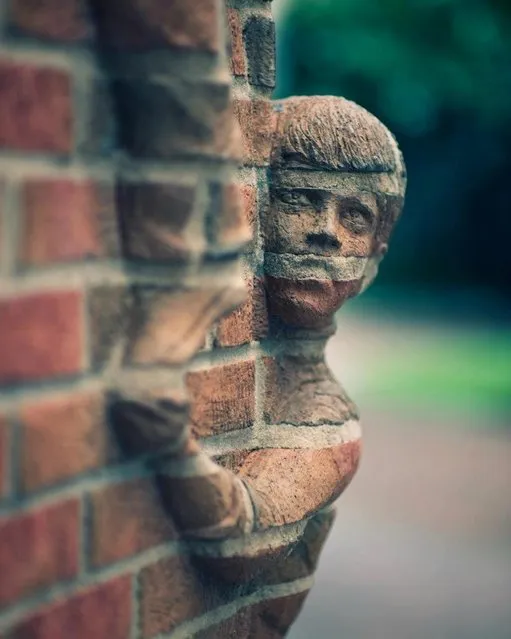
Brick Sculptures By Brad Spencer

Brad Says “Brick sculpture can be dated back to ancient Babylon but remains a fresh and interesting enhancement to any building, wall or environment. The brick medium has all the same characteristics of durability and low maintenance as a brick building, blends well in settings where other brick construction is present, looks good with landscaping and has a familiarity which is comforting to people. Brick sculpture adds intrigue and interest to a commonly understood material as viewers try to figure out the techniques by which it was created.”
Details
20 Feb 2014 13:32:00
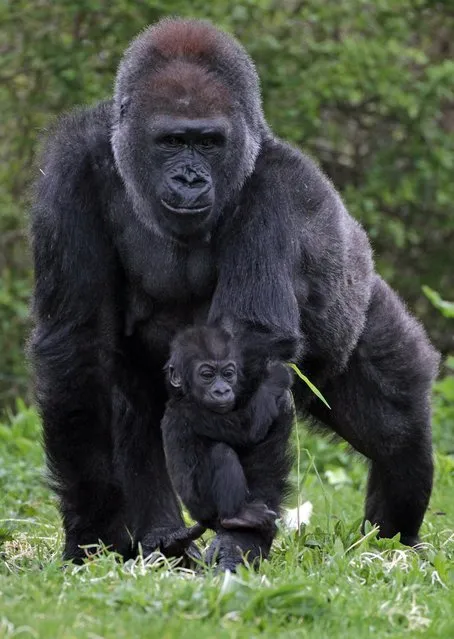
Bristol Zoo's baby gorilla Kukena

Bristol Zoo's baby gorilla Kukena holds onto his mother's arm as he ventures out of his enclosure at Bristol Zoo's Gorilla Island on May 4, 2012 in Bristol, England. The seven-month-old western lowland gorilla is starting to find his feet as he learns to walk having been born at the zoo in September. Kukena joins a family of gorillas at the zoo that are part of an international conservation breeding programme for the western lowland gorilla, which is a critically endangered species. (Photo by Matt Cardy)
Details
09 May 2012 02:26:00
Karl Lagerfeldt

A couple of months ago I came up with an idea I have had in mind for years. I just did not know what I could use it for. But then I did a test with sunglasses, and it really turned out great. So I sent an image with the test to Plaza Magazine, and a week later I started shooting. ...
Details
16 Jun 2012 09:46:00
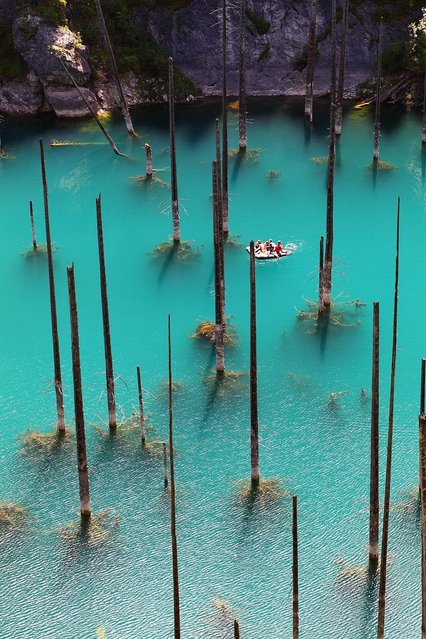
Kaindy Lake in Kazakhstan

Kaindy Lake (Kazakh: Қайыңды көлі, Qayındı köli) is a 400 metre long lake in Kazakhstan that reaches depths near 30 metres in some areas. It is located 129 km ESE of the city of Almaty and is 2,000 metres above sea level. It was created by the result of an enormous limestone landslide, triggered by the 1911 Kebin earthquake. The track to Kaindy lake has many scenic views to the Saty Gorge, the Chilik River valley and the Kaindy Gorge. Dried-out trunks of submerged Picea schrenkiana trees rise above the surface.
Details
06 Aug 2012 09:58:00
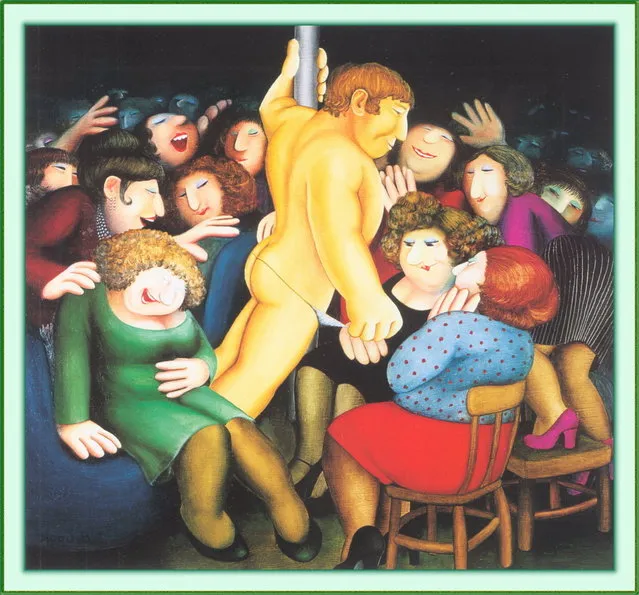
Ladies Night. Artwork by Beryl Cook

“Beryl Cook, (10 September 1926 – 28 May 2008) was an English artist best known for her original and instantly recognisable paintings of people enjoying themselves in pubs,girls shopping or out on a hen night. Drag shows or a family picnicing by the seaside or abroad – tangoing in Buenos Aires or gambling in Las Vegas. She had no formal training and did not take up painting until middle age”. – Wikipedia. Photo: “Ladies Night”, 1991. Artwork by Beryl Cook.
Details
10 Sep 2012 10:45:00


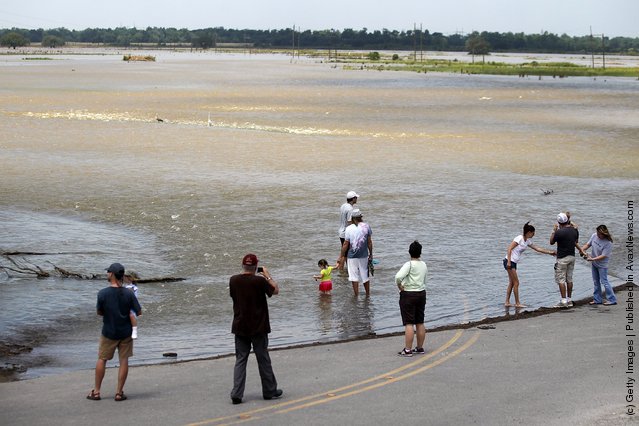
People look on as water from the rising Mississippi River is released through the Bonnet Carre Spillway while washing out a road May 9, 2011 in Norco, Louisiana. The Army Corps of Engineers began redirecting part of the Mississippi River through the spillway today to lower river levels and reduce pressure on levees in order to avoid a catastrophic failure. The water will flow nearly 6 miles north before emptying into Lake Pontchartrain as the Mississippi rises close to the highest level ever upriver in Memphis. (Photo by Mario Tama/Getty Images)
Details
11 May 2011 10:11:00