Loading...
Done
A newly-married couple takes a nap before their mass wedding ceremony at the CheongShim Peace World Center in Gapyeong, South Korea, Sunday, February 17, 2013. Some 3,500 South Korean and foreign couples exchanged or reaffirmed marriage vows in the Unification Church's mass wedding arranged by Hak Ja Han Moon, a wife of the late Rev. Sun Myung Moon, the controversial founder of the Unification Church. (Photo by Lee Jin-man/AP Photo)

A newly-married couple takes a nap before their mass wedding ceremony at the CheongShim Peace World Center in Gapyeong, South Korea, Sunday, February 17, 2013. Some 3,500 South Korean and foreign couples exchanged or reaffirmed marriage vows in the Unification Church's mass wedding arranged by Hak Ja Han Moon, a wife of the late Rev. Sun Myung Moon, the controversial founder of the Unification Church. (Photo by Lee Jin-man/AP Photo)
Details
18 Feb 2013 11:15:00
A Shiite fighter from the Hashed al-Shaabi (Popular Mobilisation) patrols in the village of Ayn Nasir, south of Mosul, on October 29, 2016, after recapturing it from Islamic State group jihadists in an ongoing operation to retake the city of Mosul. Iraqi paramilitary forces launched an operation to cut the Islamic State group's supply lines between its Mosul bastion and neighbouring Syria, opening a new front in the nearly two-week-old offensive. (Photo by Ahmad Al-Rubaye/AFP Photo)

A Shiite fighter from the Hashed al-Shaabi (Popular Mobilisation) patrols in the village of Ayn Nasir, south of Mosul, on October 29, 2016, after recapturing it from Islamic State group jihadists in an ongoing operation to retake the city of Mosul. Iraqi paramilitary forces launched an operation to cut the Islamic State group's supply lines between its Mosul bastion and neighbouring Syria, opening a new front in the nearly two-week-old offensive. (Photo by Ahmad Al-Rubaye/AFP Photo)
Details
31 Oct 2016 11:20:00
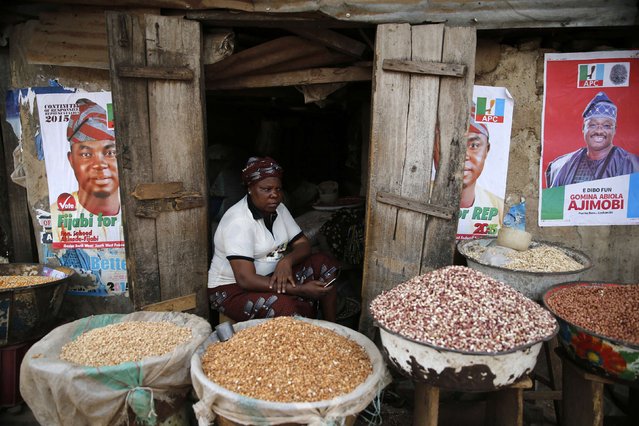
Latefat Alao, 56, a ethnic Yoruba Muslim woman, waits for customers in front of her in Beere market in Ibadan, southwest Nigeria, January 29, 2015. Much of the grain and wheat traders like Alao sell comes from the north and Boko Haram's campaign has negatively affected farmers and food markets. (Photo by Akintunde Akinleye/Reuters)

Latefat Alao, 56, a ethnic Yoruba Muslim woman, waits for customers in front of her in Beere market in Ibadan, southwest Nigeria, January 29, 2015. Much of the grain and wheat traders like Alao sell comes from the north and Boko Haram's campaign has negatively affected farmers and food markets. Reuters photographer Akintunde Akinleye photographed Nigerians and asked them about their views on the elections as well as their hopes and concerns for the country. (Photo by Akintunde Akinleye/Reuters)
Details
12 Feb 2015 12:44:00
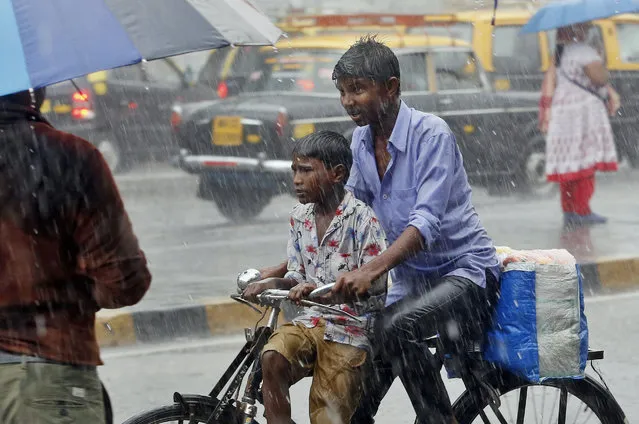
An Indian cyclist pedals with a child during heavy rain in Mumbai, Maharashtra state, India, Friday, July 24, 2015. Several parts of the city witnessed heavy rain Friday. The monsoon rains which usually hit India from June to September are crucial for farmers whose crops feed hundreds of millions of people. (Photo by Rajanish Kakade/AP Photo)

An Indian cyclist pedals with a child during heavy rain in Mumbai, Maharashtra state, India, Friday, July 24, 2015. Several parts of the city witnessed heavy rain Friday. The monsoon rains which usually hit India from June to September are crucial for farmers whose crops feed hundreds of millions of people. (Photo by Rajanish Kakade/AP Photo)
Details
27 Jul 2015 11:00:00
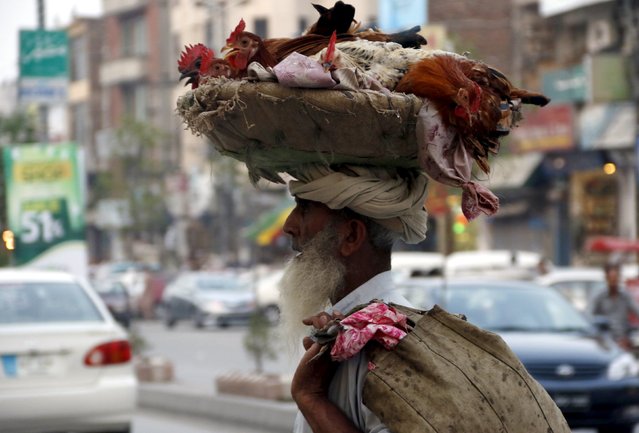
A chicken seller carries his chickens on his head in the market in Peshawar, Pakistan, August 20, 2015. (Photo by Khuram Parvez/Reuters)

A chicken seller carries his chickens on his head in the market in Peshawar, Pakistan, August 20, 2015. (Photo by Khuram Parvez/Reuters)
Details
22 Aug 2015 13:02:00
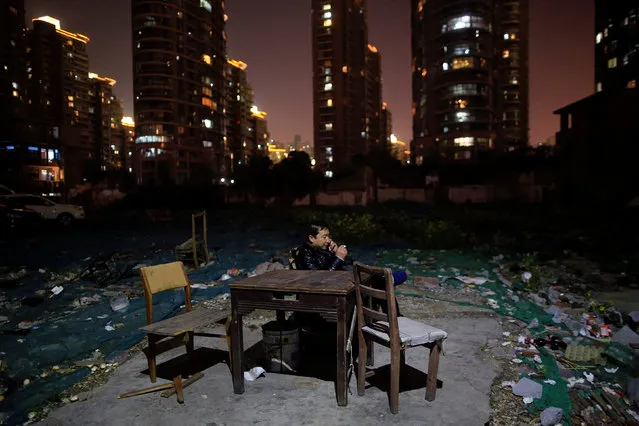
Li Guoqiang talks on his phone outside his house at Guangfuli neighbourhood, in Shanghai, China, April 1, 2016. Li, 38, is a deliveryman who rents a place at Guangfuli. (Photo by Aly Song/Reuters)

Li Guoqiang talks on his phone outside his house at Guangfuli neighbourhood, in Shanghai, China, April 1, 2016. Li, 38, is a deliveryman who rents a place at Guangfuli. In a corner of Shanghai, surrounded by a cement wall, lies one of the world's most valuable fields of debris and garbage. On paper, the Guangfuli neighbourhood is a real estate investor's dream: a plot in the middle of one of the world's most expensive and fast-rising property markets. But the reality is more like a developer's nightmare, thanks to hundreds of people living there who have refused to budge from their ramshackle homes for nearly 16 years as the local authority sought to clear the land for new construction. (Photo by Aly Song/Reuters)
Details
06 May 2016 13:54:00
Highly commended birds : Crested guan by Tim Hunt (UK). ‘This photo shows a crested guan in the cloud forests of Costa Rica as it pauses while foraging on a lone branch. Due to the clouds that are so typical for this habitat, I could often only photograph the bird’s silhouette against a grey sky. (Photo by Tim Hunt/GDT European Wildlife Photographer of the Year 2015)

Highly commended birds : Crested guan by Tim Hunt (UK). ‘This photo shows a crested guan in the cloud forests of Costa Rica as it pauses while foraging on a lone branch. Due to the clouds that are so typical for this habitat, I could often only photograph the bird’s silhouette against a grey sky. But then, for a short moment only, the sun broke through the clouds, and I overexposed the image by over two stops in order to blow out the background and allow this beautifully marked bird to stand out’. (Photo by Tim Hunt/GDT European Wildlife Photographer of the Year 2015)
Details
24 Nov 2015 08:01:00
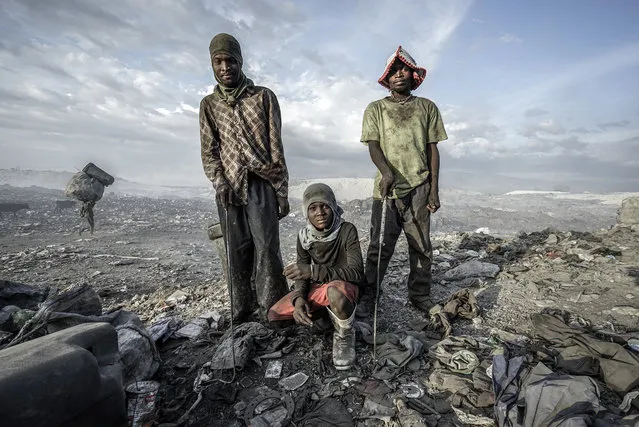
In a 200-acre-plus dump 5 kilometers north of Haiti’s capital, Port-au-Prince, hundreds of men, women and children scavenge day and night through the burning wasteland. They earn $12 to $15 a day – on a good day – for recycling plastics as well as clothing, household items and aluminum (for smelting). Some 5,000 tons of waste is created each day in the Port-au-Prince area. (Photo and caption by Giles Clarke/Getty Images Reportage)

In a 200-acre-plus dump 5 kilometers north of Haiti’s capital, Port-au-Prince, hundreds of men, women and children scavenge day and night through the burning wasteland. They earn $12 to $15 a day – on a good day – for recycling plastics as well as clothing, household items and aluminum (for smelting). Some 5,000 tons of waste is created each day in the Port-au-Prince area. (Photo and caption by Giles Clarke/Getty Images Reportage)
Details
02 Feb 2015 11:21:00