Loading...
Done
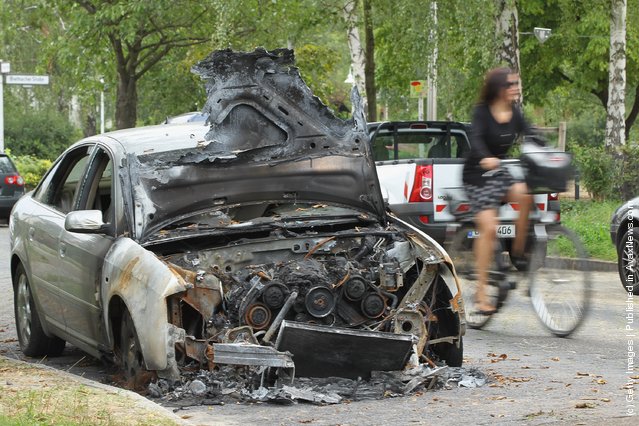
Arson Attacks Against Cars In Berlin Continue

A woman on a bicycle rides past the remains of an Audi sedan set afire by an arsonist recently in Zehlendorf district in a street where two more cars were torched on August 23, 2011 in Berlin, Germany. Police have so far made no arrests in a series of arson attacks that have destroyed at least 70 cars within the last week and show no signs of abating. In recent years several hundred cars have been torched annually and police suspect left-wing radicals. The recent series of attacks, averaging about 10 a day, has been particularly severe. (Photo by Sean Gallup/Getty Images)
Details
23 Aug 2011 12:39:00


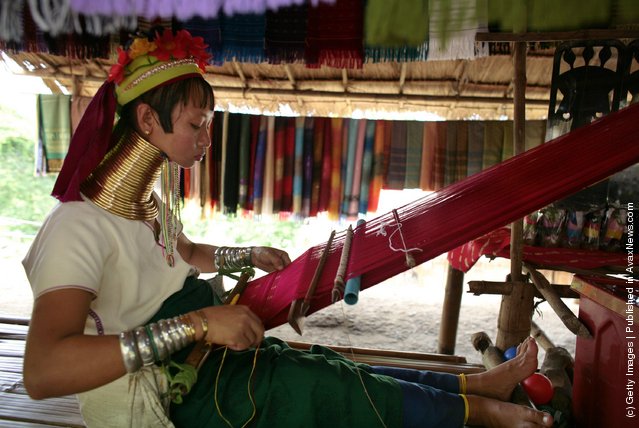
Mah Chan, a Long Neck Padaung hill tribe woman weaves a scraf for sale to tourists in a small village where 30 familes live July 13, 2006 in Chiang Dao, Thailand. All the Long Neck villages are set up for tourists and just over a year ago the hill tribe members were hand picked to move closer to Chiang Mai from more remote communities so that they could be more accessible. The Padaung women famously wear brass rings around their necks, beginning at five-years-old, to distort the growth of their collarbones and making them look like they have long necks. They are originally from eastern Burma near the Thailand border. (Photo by Paula Bronstein/Getty Images)
Details
19 Apr 2011 11:56:00


In this photo distributed by the Israeli Defense Forces (IDF) May 23, 2005, woman soldiers wear branches in their helmets as their infantry instructors' course learns about camouflage during the field craft week of their training May 19, 2005 at an army base near Beersheva in Israel's southern desert. It takes the IDF more than 2 months to teach these 18-year-old female recruits the basic arts of warfare before they assigned to pass on their newly-acquired skills to the army's male and female draftees. (Photo by Abir Sultan/IDF via Getty Images)
Details
18 Apr 2011 10:22:00


A woman walks past a painting by Jenny Saville entitled “Red Stare Head IV” on display in the Royal Academy of Arts' Summer Exhibition on June 2, 2011 in London, England. The Summer Exhibition is the world's largest open submission contemporary art show, now in its 243rd year, with over 12,000 entries received from 27 countries. The exhibition features over 1100 works of art including: painting, sculpture, photography, architecture and film, it officially opens to the public on June 7, 2011. (Photo by Oli Scarff/Getty Images)
Details
03 Jun 2011 08:34:00
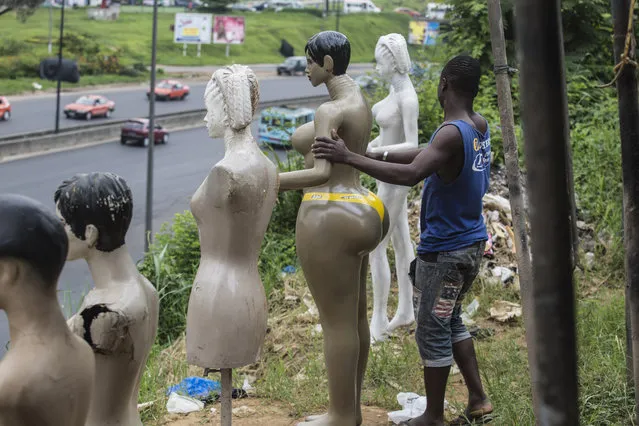
A curvy woman is considered prosperous, healthy and s*xy in Ivory Coast, photographer Joana Choumali explains. Here: An apprentice lines up his work on a roadside. (Photo by Joana Choumali)

Photographer Joana Choumali’s latest project explores body image and beauty by documenting the men building Abidjan’s clothing models. The “Awoulaba” mannequin is a customised model designed with the African ideal of beauty in mind, curvier than the stick-thin examples usually seen in the west. They first appeared in 2011, and have since become a familiar sight outside the numerous clothing shops dotted throughout Ivory Coast’s capital, Abidjan. Here: An apprentice lines up his work on a roadside. (Photo by Joana Choumali)
Details
06 Jun 2016 11:05:00
3D Models By Rebeca Puebla

One glance at the 3D models created by Rebeca Puebla is enough to realize that this artist has a soft spot for BDSM. The finely detailed model of a nun with heavily tattooed hands and a ball gag in her mouth or an Asian woman in a latex suit of a horse leave no doubt about it. At first, Rebeca Puebla has started out as a traditional illustrator. However, in later years she became a 3D character artist for films, TV, and video games. Though she has many regular-looking 3D models and illustrations, many of her works are quite controversial featuring 3D models of ladies in latex suits or wearing Nazi uniforms. (Photo by Rebeca Puebla)
Details
26 Oct 2014 12:09:00


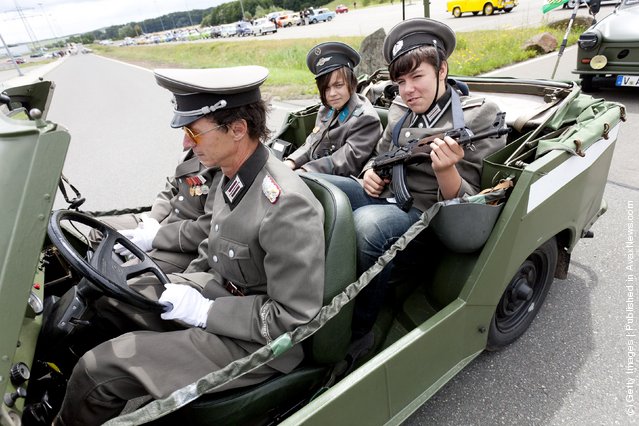
“The Trabant is a car that was produced by former East German auto maker VEB Sachsenring Automobilwerke Zwickau in Zwickau, Sachsen. It was the most common vehicle in East Germany, and was also exported to countries both inside and outside the communist bloc. The main selling points was that it had room for four adults and luggage in a compact, light and durable shell and that it was fast (when introduced) and durable. With its mediocre performance, smoky two-stroke engine, and production shortages, the Trabant is often cited as an example of the disadvantages of centralized planning; on the other hand, it is regarded with derisive affection as a symbol of the failed former East Germany and of the fall of communism (in former West Germany, as many East Germans streamed into West Berlin and West Germany in their Trabants after the opening of the Berlin Wall in 1989). It was in production without any significant changes for nearly 30 years with 3,096,099 Trabants produced in total”. – Wikipedia

Photo: Enthusiasts weared in uniforms of the former eastern german army trive in a military Trabant car as fans and owners of East German-era Trabant cars gather at the 2011 International Trabantfahrer Treffen (International Trabant Drivers Meeting) on June 26, 2011 in Zwickau, Germany. The Trabant, also known as the Trabi, was among the main cars produced in communist East Germany and built by VEB Sachsenring Automobilwerke in Zwickau for 30 years until 1989. Today the car has cult status for many followers and one company, IndiKar, is even seeking to revive the brand in a modern, electric version. (Photo by Carsten Koall/Getty Images)

Details
27 Jun 2011 12:21:00
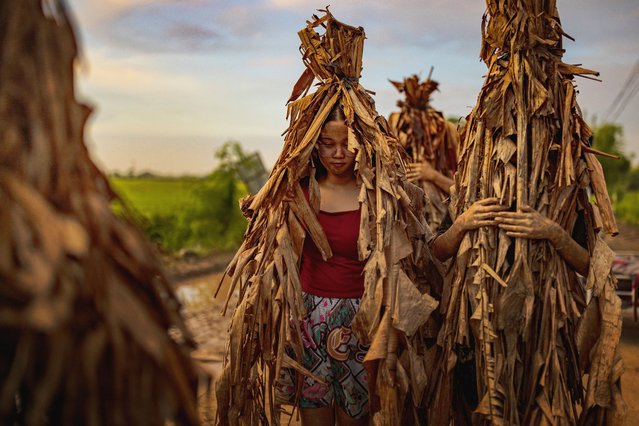
Devotees of the small farming village of Bibiclat celebrate the Feast of Saint John the Baptist while covered in banana leaves and mud on June 24, 2025 in Aliaga, Philippines. Known as the “Taong Putik” (mud people), the ritual happens yearly in this small farming village as their own version of expressing their faith and celebrating the feast of Saint John the Baptist whom the survivors of the Japanese occupation in 1944 in their area prayed to for rain to save their fellow villagers. A marker near the church entrance of the village tells a story of a heavy torrential rain that happened that day that forced the Japanese military to call off the execution of 14 villagers. The Philippines is the only predominantly Catholic country in Southeast Asia after more than 300 years of Spanish rule. (Photo by Ezra Acayan/Getty Images)

Devotees of the small farming village of Bibiclat celebrate the Feast of Saint John the Baptist while covered in banana leaves and mud on June 24, 2025 in Aliaga, Philippines. Known as the “Taong Putik” (mud people), the ritual happens yearly in this small farming village as their own version of expressing their faith and celebrating the feast of Saint John the Baptist whom the survivors of the Japanese occupation in 1944 in their area prayed to for rain to save their fellow villagers. (Photo by Ezra Acayan/Getty Images)
Details
29 Aug 2025 03:18:00