Loading...
Done
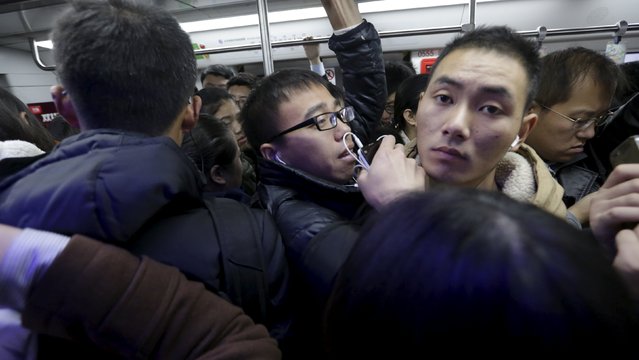
An Zi, is squashed amongst other commuters in a subway train on his way to work in Beijing, China, November 12, 2015. An, a movie producer, moved to Dongsanqi village in Changping this year. His commute to work can take about 2 hours, with transportation costs topping 200 yuan a month, or about a fifth of his monthly rent. (Photo by Jason Lee/Reuters)

An Zi, is squashed amongst other commuters in a subway train on his way to work in Beijing, China, November 12, 2015. An, a movie producer, moved to Dongsanqi village in Changping this year. His commute to work can take about 2 hours, with transportation costs topping 200 yuan a month, or about a fifth of his monthly rent. (Photo by Jason Lee/Reuters)
Details
28 Nov 2015 08:00:00
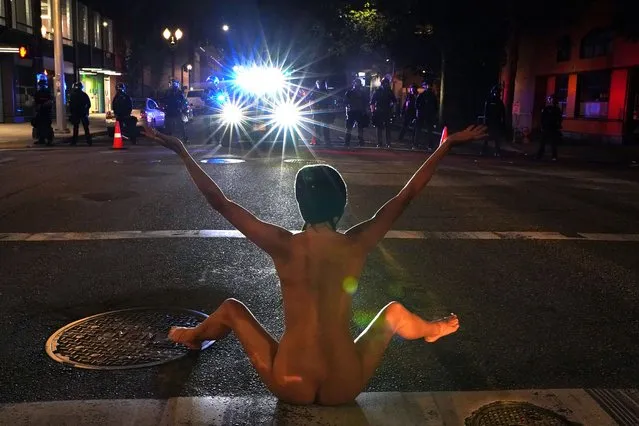
A nude protester faces off against Federal law enforcement officers, deployed under the Trump administration's new executive order to protect federal monuments and buildings, during a protest against racial inequality in Portland, Oregon, U.S. July 18, 2020. (Photo by Nathan Howard/Reuters)

A nude protester faces off against Federal law enforcement officers, deployed under the Trump administration's new executive order to protect federal monuments and buildings, during a protest against racial inequality in Portland, Oregon, U.S. July 18, 2020. (Photo by Nathan Howard/Reuters)
Details
22 Jul 2020 00:05:00
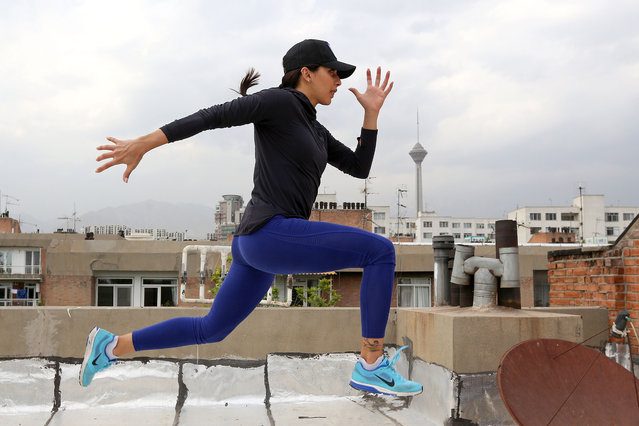
Iranian athlete Maryam Toosi practises on the rooftop of her apartment building following  the closure of sports facilities as part of measures aimed at containing the COVID-19 coronavirus, in Iran's capital Tehran on May 19, 2020. The coronavirus pandemic has forced the world's athletes to keep fit in confinement. The novel coronavirus has claimed the lives of nearly 7,200 people in Iran, making it the deadliest outbreak in the Middle East. The government ordered the closure of sports facilities in mid-March as part of measures aimed at containing the virus. (Photo by Atta Kenare/AFP Photo)

Iranian athlete Maryam Toosi practises on the rooftop of her apartment building following the closure of sports facilities as part of measures aimed at containing the COVID-19 coronavirus, in Iran's capital Tehran on May 19, 2020. The coronavirus pandemic has forced the world's athletes to keep fit in confinement. The novel coronavirus has claimed the lives of nearly 7,200 people in Iran, making it the deadliest outbreak in the Middle East. The government ordered the closure of sports facilities in mid-March as part of measures aimed at containing the virus. (Photo by Atta Kenare/AFP Photo)
Details
29 Jul 2020 00:01:00
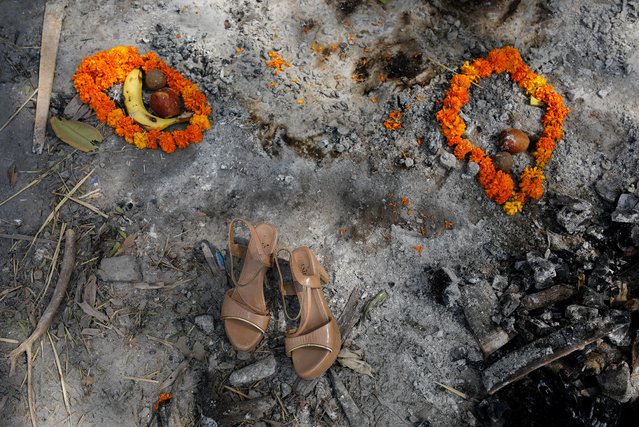
Flower garlands, fruits and a pair of sandals of a woman who died from the coronavirus disease (COVID-19), are placed by her relatives on the spot where she was cremated, as part of a ritual at a crematorium in New Delhi, India, April 30, 2021. (Photo by Adnan Abidi/Reuters)

Flower garlands, fruits and a pair of sandals of a woman who died from the coronavirus disease (COVID-19), are placed by her relatives on the spot where she was cremated, as part of a ritual at a crematorium in New Delhi, India, April 30, 2021. (Photo by Adnan Abidi/Reuters)
Details
04 May 2021 10:01:00
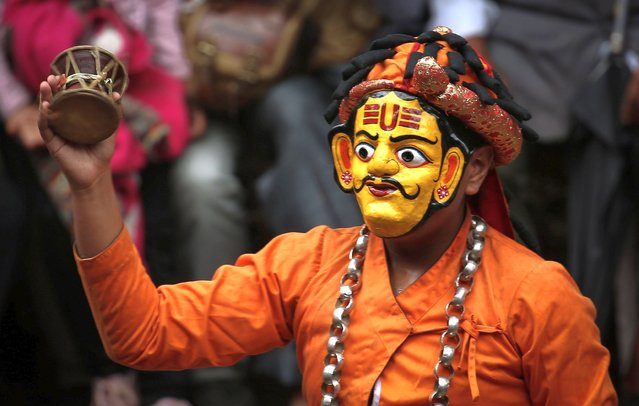
A masked dancer performs as part of “Devi Pyankha” (Devi Dance) to mark the beginning of the Indra Jatra Festival in Kathmandu, Nepal on September 15, 2021. Nepali celebrate the Indra Jatra festival to worship “Indra”, the god of rain and to mark the end of monsoon season. (Photo by Sunil Sharma/ZUMA Press Wire/Rex Features/Shutterstock)

A masked dancer performs as part of “Devi Pyankha” (Devi Dance) to mark the beginning of the Indra Jatra Festival in Kathmandu, Nepal on September 15, 2021. Nepali celebrate the Indra Jatra festival to worship “Indra”, the god of rain and to mark the end of monsoon season. (Photo by Sunil Sharma/ZUMA Press Wire/Rex Features/Shutterstock)
Details
23 Sep 2021 08:21:00
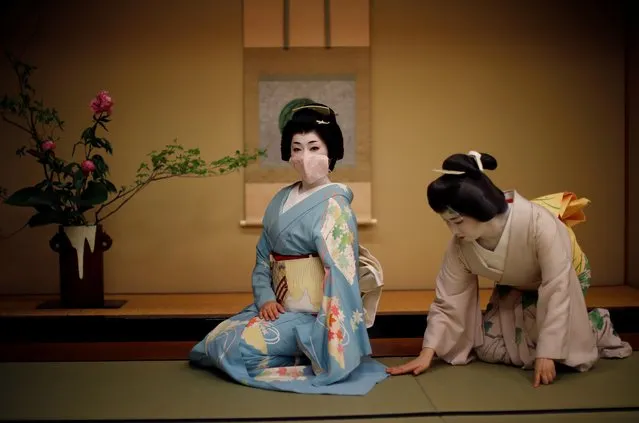
Mayu adjusts Koiku’s kimono, as Koiku wears a protective face mask while posing for a photograph, before they work at a party where they will entertain with other geisha at Japanese luxury restaurant Asada in Tokyo, Japan, June 23, 2020. The coronavirus pandemic has made Tokyo's geisha fear for their centuries-old profession as never before. Though the number of geisha - famed for their witty conversation, beauty and skill at traditional arts - has been falling for years, they were without work for months due to Japan's state of emergency and now operate under awkward social distancing rules. Engagements are down 95 percent, and come with new rules: no pouring drinks for customers or touching them even to shake hands, and sitting 2 meters apart. Masks are hard to wear with their elaborate wigs, so they mostly don't. “I was just full of anxiety”, said Mayu, 47. “I went through my photos, sorted my kimonos ... The thought of a second wave is terrifying”. (Photo by Kim Kyung-Hoon/Reuters)

Mayu adjusts Koiku’s kimono, as Koiku wears a protective face mask while posing for a photograph, before they work at a party where they will entertain with other geisha at Japanese luxury restaurant Asada in Tokyo, Japan, June 23, 2020. (Photo by Kim Kyung-Hoon/Reuters)
Details
23 Jul 2020 00:03:00
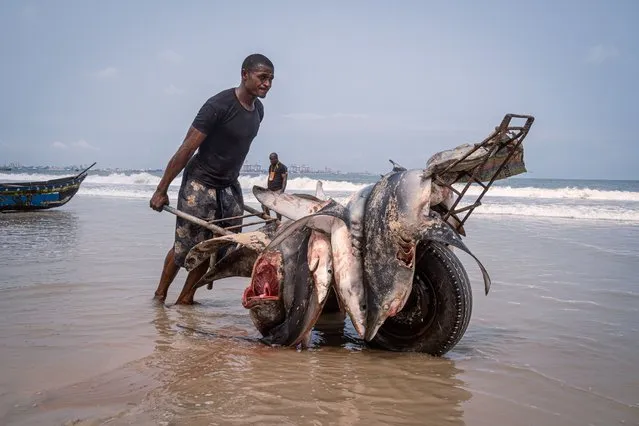
A fisherman struggles to push a wheelbarrow full of sharks that have just been dropped off a pirogue on the beach of Songolo, the fishing district of Pointe-Noire in the Republic of the Congo in November 2021. Many artisanal fishing crews on the Congolese coast specialise in shark fishing (Photo by Marco Simoncelli/Al Jazeera)

A fisherman struggles to push a wheelbarrow full of sharks that have just been dropped off a pirogue on the beach of Songolo, the fishing district of Pointe-Noire in the Republic of the Congo in November 2021. Many artisanal fishing crews on the Congolese coast specialise in shark fishing (Photo by Marco Simoncelli/Al Jazeera)
Details
09 Dec 2021 08:47:00
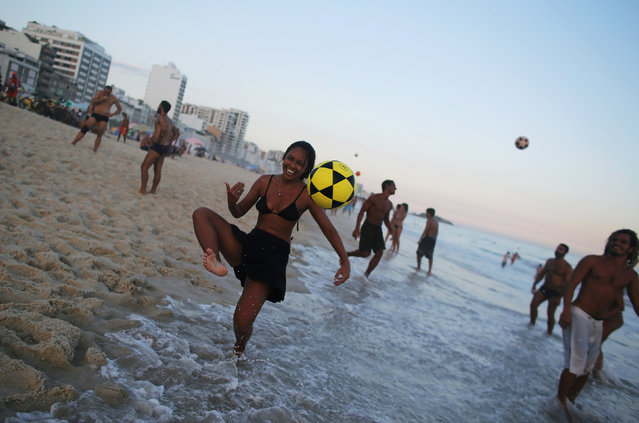
A woman controls a ball on Ipanema beach in Rio de Janeiro, Brazil, April 14, 2016. (Photo by Nacho Doce/Reuters)

A woman controls a ball on Ipanema beach in Rio de Janeiro, Brazil, April 14, 2016. As hundreds of thousands of tourists begin descending on Rio de Janeiro for the Olympics that start August 5, the headlines have focused on the street violence, the Zika virus, the water pollution and the rush to finish venues and transport. But Rio, known by Brazilians as the “Marvelous City”, glistens despite it all. The beach is a way of life here. (Photo by Nacho Doce/Reuters)
Details
19 Jul 2016 13:10:00