Loading...
Done
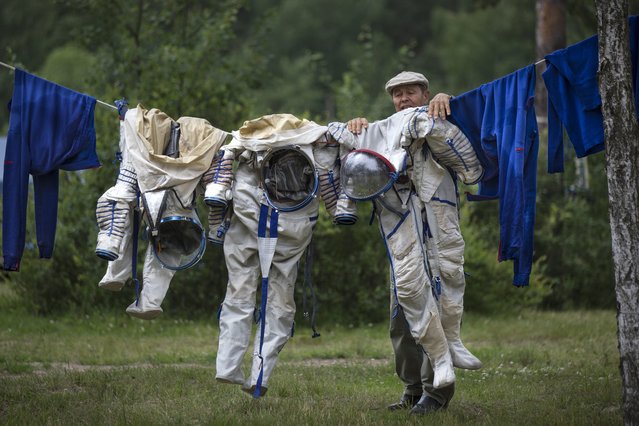
An employe of Russian Space Training Center hangs out to dry space suits of Russian cosmonaut Anatoly Ivanishin, NASA's U.S. flight engineer Kathleen Rubins, and Japanese space agency's flight engineer Takuya Onishi, right, after their undergoing  training near in Noginsk, 60 km (38 miles) east of Moscow, Russia, Wednesday, July 2, 2014. (Photo by Alexander Zemlianichenko/AP Photo)

An employe of Russian Space Training Center hangs out to dry space suits of Russian cosmonaut Anatoly Ivanishin, NASA's U.S. flight engineer Kathleen Rubins, and Japanese space agency's flight engineer Takuya Onishi, right, after their undergoing training near in Noginsk, 60 km (38 miles) east of Moscow, Russia, Wednesday, July 2, 2014. The training was intended to simulate the capsule landing on water. Russian cosmonaut Anatoly Ivanishin, Japanese space agency's flight engineer Takuya Onishi, and NASA's U.S. flight engineer Kathleen Rubins are being trained for a future mission to the International Space Station. (Photo by Alexander Zemlianichenko/AP Photo)
Details
05 Jul 2014 11:47:00
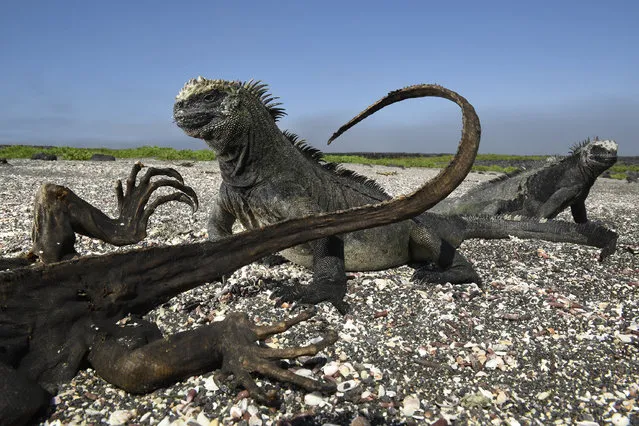
Galapagos – Rocking the Cradle: Four major ocean currents converge along the Galapagos archipelago, creating the conditions for an extraordinary diversity of animal life, April 25, 2016. The islands are home to at least 7,000 flora and fauna species, of which 97 percent of the reptiles, 80 percent of the land birds, 50 percent of the insects and 30 percent of the plants are endemic. The local ecosystem is highly sensitive to the changes in temperature, rainfall and ocean currents that characterize the climatic events known as El Niño and La Niña. These changes cause marked fluctuations in weather and food availability. Many scientists expect the frequency of El Niño and La Niña to increase as a result of climate change, making the Galapagos a possible early-warning location for its effects. (Photo by Thomas P. Peschak for National Geographic/World Press Photo)

Galapagos – Rocking the Cradle: Four major ocean currents converge along the Galapagos archipelago, creating the conditions for an extraordinary diversity of animal life, April 25, 2016. The islands are home to at least 7,000 flora and fauna species, of which 97 percent of the reptiles, 80 percent of the land birds, 50 percent of the insects and 30 percent of the plants are endemic. (Photo by Thomas P. Peschak for National Geographic/World Press Photo)
Details
16 Apr 2018 00:01:00
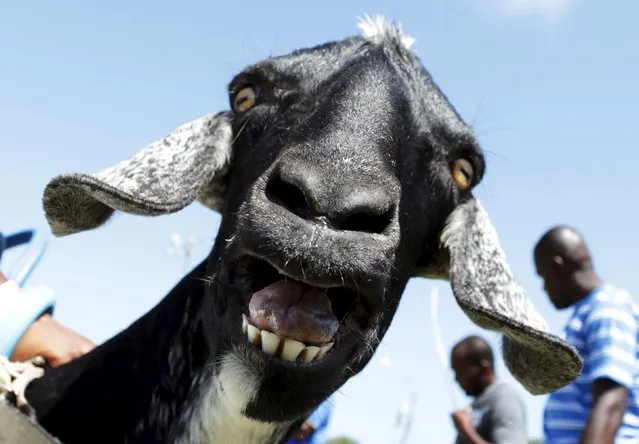
A goat named “White On The Right” bleats as it is paraded with other goats prior to a race during the annual Easter goat racing event at the Mount Pleasant recreation ground in Tobago April 6, 2015. (Photo by Andrea De Silva/Reuters)

A goat named “White On The Right” bleats as it is paraded with other goats prior to a race during the annual Easter goat racing event at the Mount Pleasant recreation ground in Tobago April 6, 2015. (Photo by Andrea De Silva/Reuters)
Details
11 Apr 2015 10:24:00
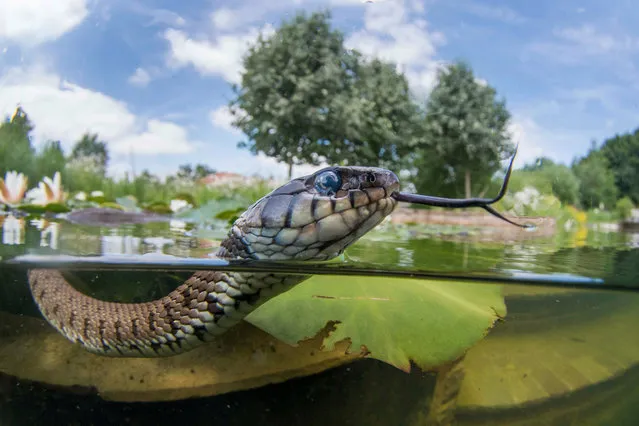
British Waters Wide Angle category runner-up. Grass snake swimming along a garden pond by Jack Perks (UK)in Nottinghamshire, UK. “I’m always on the lookout for unusual freshwater subjects and grass snakes are a species I’ve been after for years. I was told about a pond where the odd grass snake hangs around the lilly pads for frogs. I put my drysuit on and got into the water and could see one slithering along the surface. Slowly making my way towards it with my head only just poking above I got the spilt shot”. (Photo by Jack Perks/Underwater Photographer of the Year 2019)

British Waters Wide Angle category runner-up. Grass snake swimming along a garden pond by Jack Perks (UK)in Nottinghamshire, UK. “I’m always on the lookout for unusual freshwater subjects and grass snakes are a species I’ve been after for years. I was told about a pond where the odd grass snake hangs around the lilly pads for frogs. I put my drysuit on and got into the water and could see one slithering along the surface. Slowly making my way towards it with my head only just poking above I got the spilt shot”. (Photo by Jack Perks/Underwater Photographer of the Year 2019)
Details
28 Feb 2019 00:03:00
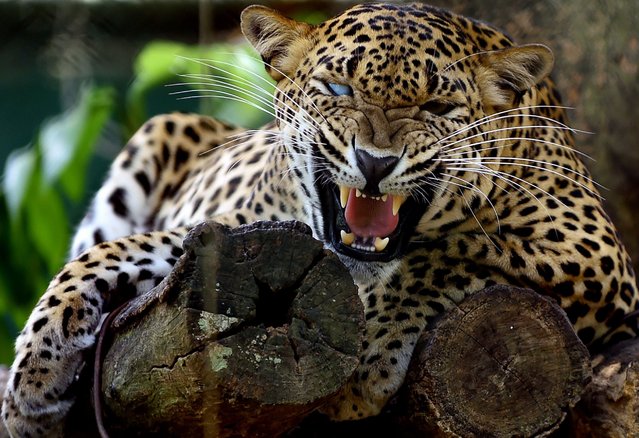
A Sri Lankan leopard is pictured at a zoo in Dehiwala near Colombo on March 3, 2016, on World Wildlife Day. (Photo by Ishara S. Kodikara/AFP Photo)

A Sri Lankan leopard is pictured at a zoo in Dehiwala near Colombo on March 3, 2016, on World Wildlife Day. (Photo by Ishara S. Kodikara/AFP Photo)
Details
06 Mar 2016 09:07:00
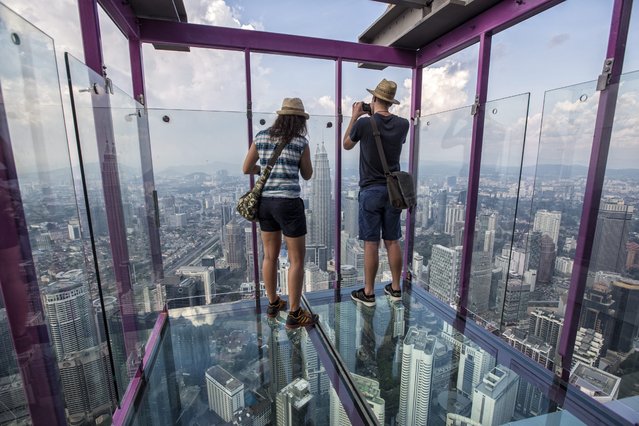
Tourists take a panoramic view of Kuala Lumpur from a skybox during a media preview at Kuala Lumpur Tower in Kuala Lumpur, Malaysia, 05 May 2016. Skybox, 421 metres above ground level will be the latest tourists attraction at Kuala Lumpur Tower, the 7th tallest freestanding tower in the world. (Photo by Ahmad Yusni/EPA)

Tourists take a panoramic view of Kuala Lumpur from a skybox during a media preview at Kuala Lumpur Tower in Kuala Lumpur, Malaysia, 05 May 2016. Skybox, 421 metres above ground level will be the latest tourists attraction at Kuala Lumpur Tower, the 7th tallest freestanding tower in the world. (Photo by Ahmad Yusni/EPA)
Details
06 May 2016 14:01:00
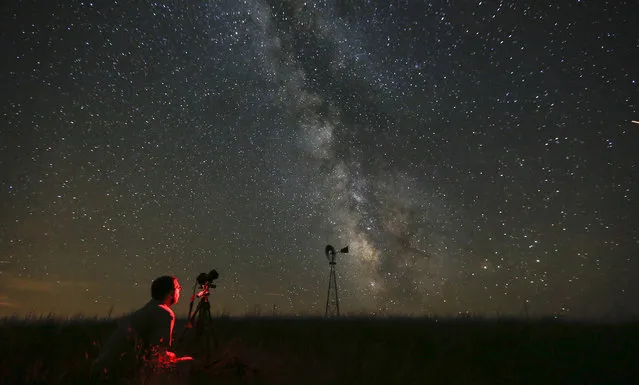
In this Wednesday, July 23, 2014 file photo, Omaha photographer Lane Hickenbottom photographs the night sky in a pasture near Callaway, Neb. With no moon in the sky, the Milky Way was visible to the naked eye. More than one-third of the world’s population can no longer see the Milky Way because of man-made lights, according to a scientific paper by Light Pollution Science and Technology Institute's Fabio Falchi and his team members, published on Friday, June 10, 2016. (Photo by Travis Heying/The Wichita Eagle via AP Photo)

In this Wednesday, July 23, 2014 file photo, Omaha photographer Lane Hickenbottom photographs the night sky in a pasture near Callaway, Neb. With no moon in the sky, the Milky Way was visible to the naked eye. More than one-third of the world’s population can no longer see the Milky Way because of man-made lights, according to a scientific paper by Light Pollution Science and Technology Institute's Fabio Falchi and his team members, published on Friday, June 10, 2016. (Photo by Travis Heying/The Wichita Eagle via AP Photo)
Details
11 Jun 2016 12:37:00
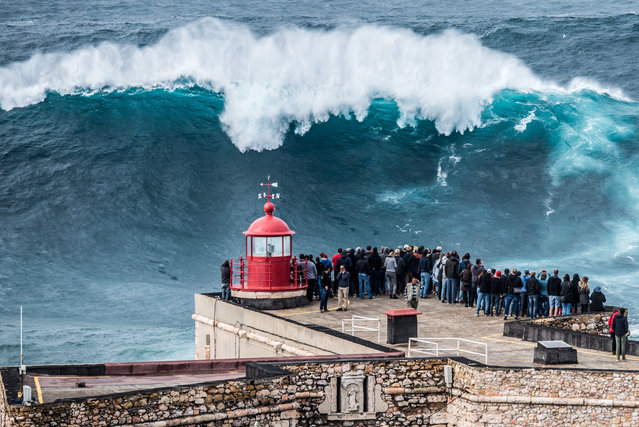
Crowds watch surfers as the first big swell of the year arrives in Nazaré, Portugal on October 28, 2015. (Photo by Pedro Miranda/Demotix/Corbis)

Crowds watch surfers as the first big swell of the year arrives in Nazaré, Portugal on October 28, 2015. (Photo by Pedro Miranda/Demotix/Corbis)
Details
30 Oct 2015 08:07:00