Loading...
Done
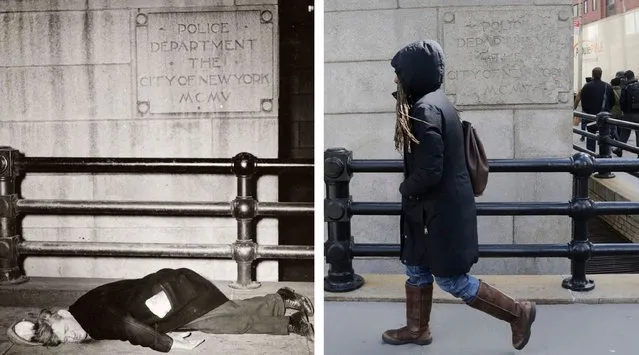
A new book of photos by legendary photographer Weegee shows what industrialized, pre-gentrified New York looked like in the mid-20th century, before the city was crammed with towers and billboards. (Photo by AP Photo/Copyright Weegee/The International Center of Photography, Mark Lennihan)

A new book of photos by legendary photographer Weegee shows what industrialized, pre-gentrified New York looked like in the mid-20th century, before the city was crammed with towers and billboards. Here: this combination shows the 1945 photo “Derelict sleeping on the sidewalk outside police headquarters” by Weegee, provided by the International Center of Photography in New York, and a woman walking on the same spot on Wednesday, March 18, 2015. (Photo by AP Photo/Copyright Weegee/The International Center of Photography, Mark Lennihan)


Details
27 Mar 2015 13:16:00
Bosnian men urge their  horses to pull logs up  a hill during a competition in the Bosnian town of Sokolac 50 kms west of Sarajevo, Bosnia,on Monday, April, 13, 2015. The annual festival celebrates the centuries old tradition of pulling logs honoring the owners of the strongest horses. Owners of the horses gather from all over Bosnia and beyond, and compete in a show of horse strength. (Photo by Amel Emric/AP Photo)

Bosnian men urge their horses to pull logs up a hill during a competition in the Bosnian town of Sokolac 50 kms west of Sarajevo, Bosnia,on Monday, April, 13, 2015. The annual festival celebrates the centuries old tradition of pulling logs honoring the owners of the strongest horses. Owners of the horses gather from all over Bosnia and beyond, and compete in a show of horse strength. (Photo by Amel Emric/AP Photo)
Details
14 Apr 2015 10:54:00
A Parisian dances at the installation Electronica, a unique look at the great classics of 20th century electronic music, played under the vaults at the Collège des Bernardins part of Nuit Blanche, an annual evening festival of culture and art on October 03, 2020 in Paris, France. Scaled down this year because of the Covid-19 pandemic, the festival is split across the left and right banks of the city with many outdoor exhibitions to enable social distancing. (Photo by Kiran Ridley/Getty Images)

A Parisian dances at the installation Electronica, a unique look at the great classics of 20th century electronic music, played under the vaults at the Collège des Bernardins part of Nuit Blanche, an annual evening festival of culture and art on October 03, 2020 in Paris, France. Scaled down this year because of the Covid-19 pandemic, the festival is split across the left and right banks of the city with many outdoor exhibitions to enable social distancing. (Photo by Kiran Ridley/Getty Images)
Details
06 Nov 2020 00:03:00
Carnival participants dressed in costume and wearing body paint pose for a group picture during the annual Zambo carnival held in Lebanon's northern city of Tripoli on March 14, 2021, marking the last period of excess on the eve of the Christian Greek Orthodox lent. The inspiration of the annual Zambo celebration is unclear, despite it being a tradition that stretches back over a century to when an emigrant to Brazil returned to his native Tripoli bringing the carnival with him. (Photo by Ibrahim Chalhoub/AFP Photo)

Carnival participants dressed in costume and wearing body paint pose for a group picture during the annual Zambo carnival held in Lebanon's northern city of Tripoli on March 14, 2021, marking the last period of excess on the eve of the Christian Greek Orthodox lent. The inspiration of the annual Zambo celebration is unclear, despite it being a tradition that stretches back over a century to when an emigrant to Brazil returned to his native Tripoli bringing the carnival with him. (Photo by Ibrahim Chalhoub/AFP Photo)
Details
27 Mar 2021 08:59:00
Lord Roscoe the cat runs through the crocuses on the lawns at the National Trust's 17th-century Ham House and Garden in Richmond, London on Monday, March 6, 2023. In recent years more than 500,000 bulbs have been planted to create a spectacle for visitors and to attract bees, butterflies and other pollinating insects. (Photo by Kirsty O'Connor/PA Images via Getty Images)

Lord Roscoe the cat runs through the crocuses on the lawns at the National Trust's 17th-century Ham House and Garden in Richmond, London on Monday, March 6, 2023. In recent years more than 500,000 bulbs have been planted to create a spectacle for visitors and to attract bees, butterflies and other pollinating insects. (Photo by Kirsty O'Connor/PA Images via Getty Images)
Details
26 Apr 2023 02:59:00
A Summer Activity time Can't Touch By William Holt_Part2

With temperatures soaring and summer well underway, countless Americans will be spending their Independence Day weekend at the beach. Here we revisit some classic images from the turn-of-the-century to the 1930's of vacations by the sea, from Coney Island to Santa Monica.
Details
23 Aug 2013 14:04:00
Prayer flags fly at Namgyal Tsemo Monastery above the town of Leh in Ladakh, India September 24, 2016. (Photo by Cathal McNaughton/Reuters)

Prayer flags fly at Namgyal Tsemo Monastery above the town of Leh in Ladakh, India September 24, 2016. High in the Indian Himalayas, young novice monks in maroon robes take their lessons inside the 15th-century Thiksey monastery. (Photo by Cathal McNaughton/Reuters)
Details
06 Jan 2017 14:13:00
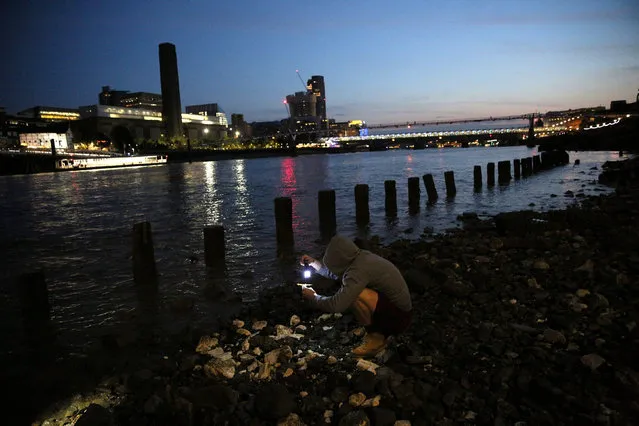
A mudlark uses a torch to look for items on the bank of the River Thames in London, Britain June 06, 2016. Mudlarking is believed to trace its origins to the 18th and 19th century, when scavengers searched the Thames' shores for items to sell. These days, history and archaeology fans are the ones hoping to find old relics such as coins, ceramics, artifacts or everyday items from across centuries. They wait for the low tide and then scour specific areas of exposed shores. "If you're in a field you could be out all day long, with the river you're restricted to about two or three hours," mudlark Nick Stevens said. While many just use the naked eye for their searches, others rely on metal detectors for which a permit from the Port of London Authority is needed. Digging also requires consent. (Photo by Neil Hall/Reuters)

A mudlark uses a torch to look for items on the bank of the River Thames in London, Britain June 06, 2016. Mudlarking is believed to trace its origins to the 18th and 19th century, when scavengers searched the Thames' shores for items to sell. These days, history and archaeology fans are the ones hoping to find old relics such as coins, ceramics, artifacts or everyday items from across centuries. their finds with the Portable Antiquities Scheme. Any item over 300 years old must be recorded. (Photo by Neil Hall/Reuters)
Details
27 Aug 2016 10:43:00