Loading...
Done
The Cygnus Wall is in the southern  area of NGC7000 also known as the North America Nebula. It is approximately 1800 light years from Earth, and is in the constellation Cygnus. The Wall is an energized shock front and contains the most concentrated star formations in the nebula. The size of the North America Nebula is about 4 full moons. (Bill Snyder)

Amateur astronomer Bill Snyder has been involved with astrophotography since 2007. Photo: The Cygnus Wall is in the southern area of NGC7000 also known as the North America Nebula. It is approximately 1800 light years from Earth, and is in the constellation Cygnus. The Wall is an energized shock front and contains the most concentrated star formations in the nebula. The size of the North America Nebula is about 4 full moons. (Photo and caption by Bill Snyder)
Details
30 Oct 2013 09:15:00
In this February 26, 1962 file photo, Mercury astronaut John Glenn, and his wife, Annie, ride in the back of an open car with Vice-President Johnson during a parade in Glenn's honor in Washington. The Capitol is seen in the background. Glenn, the first American to orbit Earth who later spent 24 years representing Ohio in the Senate, died Thursday, Dec. 8, 2016, at the age of 95. (Photo by AP Photo)

In this February 26, 1962 file photo, Mercury astronaut John Glenn, and his wife, Annie, ride in the back of an open car with Vice-President Johnson during a parade in Glenn's honor in Washington. The Capitol is seen in the background. Glenn, the first American to orbit Earth who later spent 24 years representing Ohio in the Senate, died Thursday, Dec. 8, 2016, at the age of 95. (Photo by AP Photo)
Details
09 Dec 2016 11:35:00
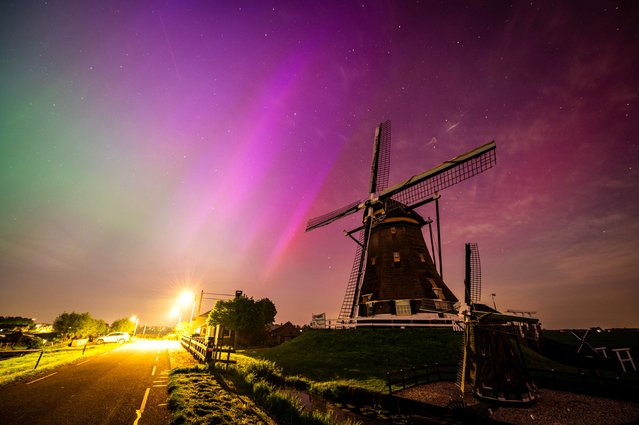
The Northern lights (aurora borealis) lights up the night sky above the Molenviergang in Aarlanderveen, the Netherlands, early on 11 May 2024. The National Oceanic and Atmospheric Administration (NOAA) of America has warned that the strongest geomagnetic storm for 20 years is set to hit Earth, making the Aurora Borealis, or Northern Lights, visible at much lower geomagnetic latitudes than usual. (Photo by Josh Walet/EPA/EFE/Rex Features/Shutterstock)

The Northern lights (aurora borealis) lights up the night sky above the Molenviergang in Aarlanderveen, the Netherlands, early on 11 May 2024. The National Oceanic and Atmospheric Administration (NOAA) of America has warned that the strongest geomagnetic storm for 20 years is set to hit Earth, making the Aurora Borealis, or Northern Lights, visible at much lower geomagnetic latitudes than usual. (Photo by Josh Walet/EPA/EFE/Rex Features/Shutterstock)
Details
17 Aug 2024 04:31:00
Air New Zealand's 'Most Epic' Safety Video

As the official airline of Middle-earth, Air New Zealand has gone all out to celebrate the third and final film in The Hobbit Trilogy – The Hobbit: The Battle of the Five Armies. Starring Elijah Wood and Sir Peter Jackson; we're thrilled to unveil The Most Epic Safety Video Ever Made
Details
23 Oct 2014 12:48:00
 Refractions In Water Drops By Markus Reugels

German photographer Markus Reugels. Using large satellite photos as a backdrop and a high speed camera he captures the background’s refraction through water drops. The perfectly timed shots result in these spherical representations of the Earth, Moon and Jupiter. See much more of his work here and also here. Thanks Markus for sharing your work with Colossal!
Details
21 Feb 2013 11:00:00
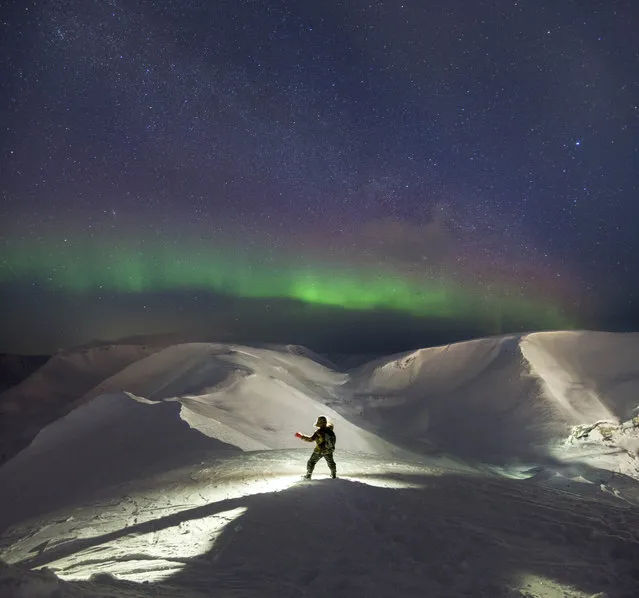
“I spend time trying to get the exposure right”, Vitaly Istomin explained. (Photo by Vitaly Istomin/Caters News Agency)

These Northern Lights “rainbows” have turned the sky greener than the Earth below. Vitaly Istomin, 26, spent several nights in freezing conditions under the stars in northern Russia’s Khibiny Mountains to capture the aurora’s “rainbows”. (Photo by Vitaly Istomin/Caters News Agency)
Details
22 Feb 2018 00:02:00
This artist's scoreboard displays a fictional game between Mars and Earth, with Mars in the lead. (Image by NASA/JPL-Caltech)

This artist's scoreboard displays a fictional game between Mars and Earth, with Mars in the lead. It refers to the success rate of sending missions to Mars, both as orbiters and landers. Of the previous 39 missions targeted for Mars from around the world, 15 have been successes and 24 failures. For baseball fans, that's a batting average of .385. The United States has had 13 successes out of 18 attempts, or a “batting average” of .722. NASA's Curiosity rover, set to land on the Red Planet the evening of Aug. 5, 2012 PDT (morning of Aug. 6 EDT), will mark the United States' 19th attempt to tackle the challenge of Mars, and the world's 40th attempt. (Image by NASA/JPL-Caltech)
Details
06 Aug 2012 09:47:00
This undated image provided by World View shows World View capsule and balloon spacecraft that will rise to 100,000 feet above Earth for passengers to see the curvature of the planet and the blackness of space. (Photo by World View via AP Photo)

This undated image provided by World View shows World View capsule and balloon spacecraft that will rise to 100,000 feet above Earth for passengers to see the curvature of the planet and the blackness of space. Space tourism companies are employing designs including winged vehicles, vertical rockets with capsules and high-altitude balloons. While developers envision ultimately taking people to orbiting habitats, the moon or beyond, the immediate future involves short flights into or near the lowest reaches of space without going into orbit. (Photo by World View via AP Photo)
Details
15 Feb 2016 10:28:00