Loading...
Done
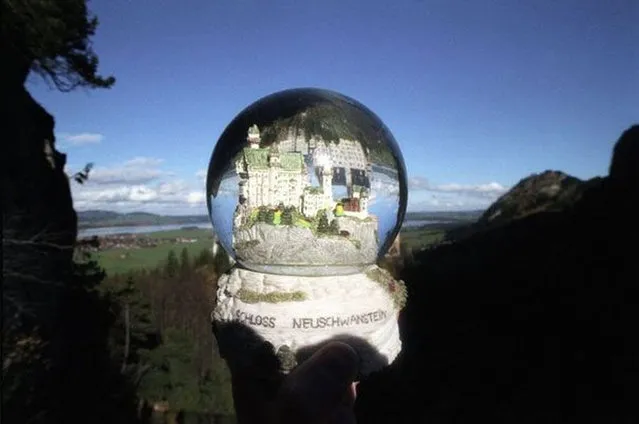
Optical Illusions By Michael Hughes

Michael Hughes creates cool optical illusions by placing cheap souvenirs in front of famous landmarks. Michael has discovered the technique back in 1998 when he held up a postcard he bought for his daughter on the tourist platform at the Lorelei cliffs next to the river Rhine. “I was amazed because it just seemed to fill a massive grey hole that was in the sky and it was the exact position the photographer had taken the picture from,” said Michael to Daily Mail.
Details
14 Dec 2013 11:35:00


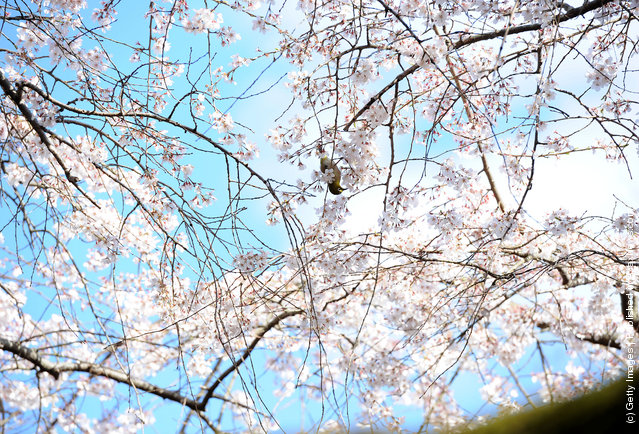
A Japanese white-eye is seen on a branch of cherry blossoms at Kyoto Imperial Palace on March 26, 2010 in Kyoto, Japan. (Photo by Akihiro I/Getty Images)
Details
26 Mar 2011 11:11:00
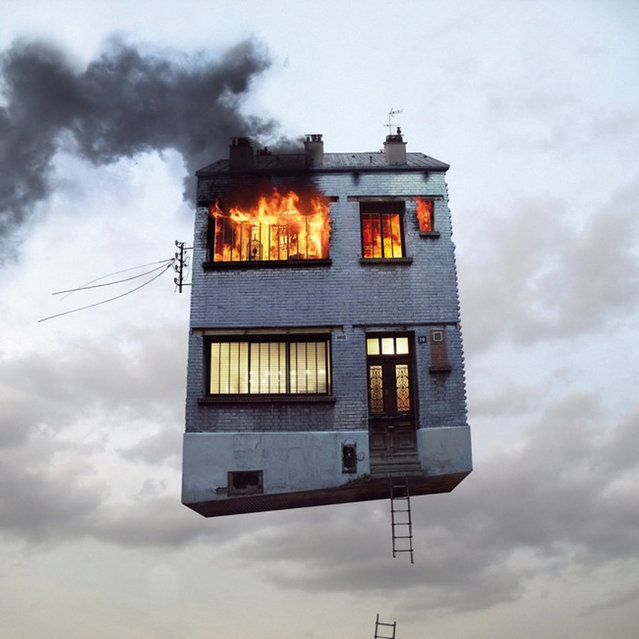
Laurent Chéhère by Flying Houses

One of the most creative photoseries I’ve seen so far is definitely this one from the French photographer Laurent Chéhère and his Flying Houses. The serie has a sur-real but still very realistic out-come, with ofcourse, some help of our great friend Photoshop.
Details
14 Jan 2013 14:42:00


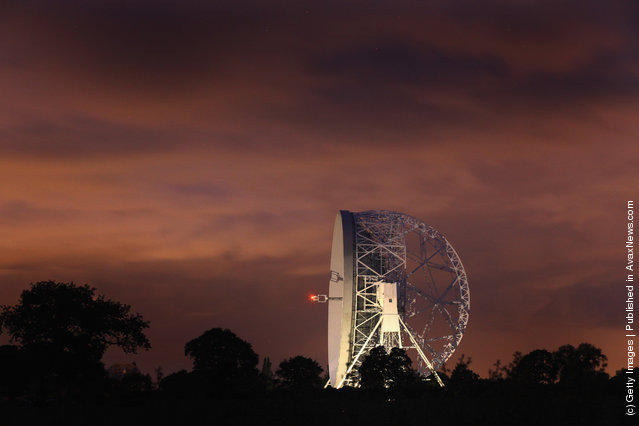
“The Lovell Telescope is a radio telescope at Jodrell Bank Observatory, near Goostrey, Cheshire in the north-west of England. When it was constructed in 1955, the telescope was the largest steerable dish radio telescope in the world at 76.2 m (250 ft) in diameter; it is now the third largest, after the Green Bank telescope in West Virginia, USA, and the Effelsberg telescope in Germany. It was originally known as the 250 ft (76 m) telescope or the Radio Telescope at Jodrell Bank, before becoming the Mark I telescope around 1961 when future telescopes (the Mark II, III, and IV) were being discussed. It was renamed to the Lovell Telescope in 1987 after Bernard Lovell, and became a Grade I listed building in 1988. The telescope forms part of the MERLIN and European VLBI Network arrays of radio telescopes”. – Wikipedia

Photo: The Lovell Telescope listens to the night sky for radio signals from space at Jodrell Bank on June 22, 2011 in Holmes Chapel, England. Jodrell Bank Centre for Astrophysics and it's world famous Lovell Telescope is on the shortlist of Britain's submission for Unesco World Heritage Site status. (Photo by Christopher Furlong/Getty Images)

Details
24 Jun 2011 09:34:00
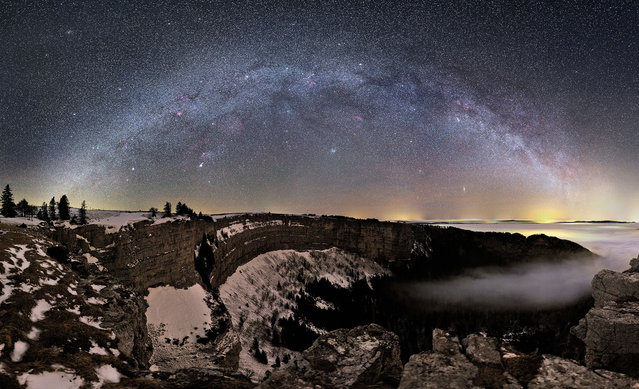
Milky Way over Switzerland

Milky Way over Switzerland

The Milky Way is the galaxy in which Earth is contained. This name derives from its appearance as a dim “milky” glowing band arching across the night sky, in which the naked eye cannot distinguish individual stars. The term “Milky Way” is a translation of the Classical Latin via lactea, from the Hellenistic Greek γαλαξίας κύκλος (pr. galaxías kýklos, “milky circle”). The Milky Way appears like a band because it is a disk-shaped structure being viewed from inside. The fact that this faint band of light is made up of stars was proven in 1610 when Galileo Galilei used his telescope to resolve it into individual stars. In the 1920s, observations by astronomer Edwin Hubble showed that the Milky Way is just one of many galaxies.


Details
20 Jun 2012 10:11:00
Cooling-down gold ingot. March 14, 2013; Tien Shan mountains, Kyrgyzstan. (Photo by Shamil Zhumatov/Reuters)

“I have seen batches of banknotes worth more than $2.6 million, but beyond all doubt, gold bars look much more attractive!”. – Shamil Zhumatov. Photo: Cooling-down gold ingot. March 14, 2013; Tien Shan mountains, Kyrgyzstan. (Photo by Shamil Zhumatov/Reuters)
Details
04 May 2013 11:14:00
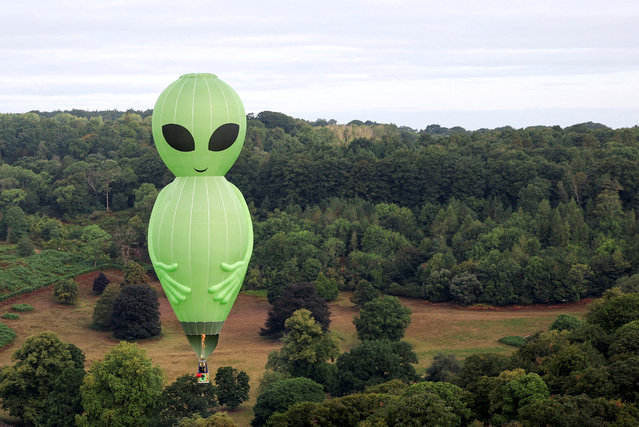
An alien-shaped hot air balloon flies during a mass launch at the annual Bristol International Balloon Fiesta, near Bristol, Britain, on August 8, 2025. (Photo by Toby Melville/Reuters)

An alien-shaped hot air balloon flies during a mass launch at the annual Bristol International Balloon Fiesta, near Bristol, Britain, on August 8, 2025. (Photo by Toby Melville/Reuters)
Details
10 Oct 2025 04:33:00
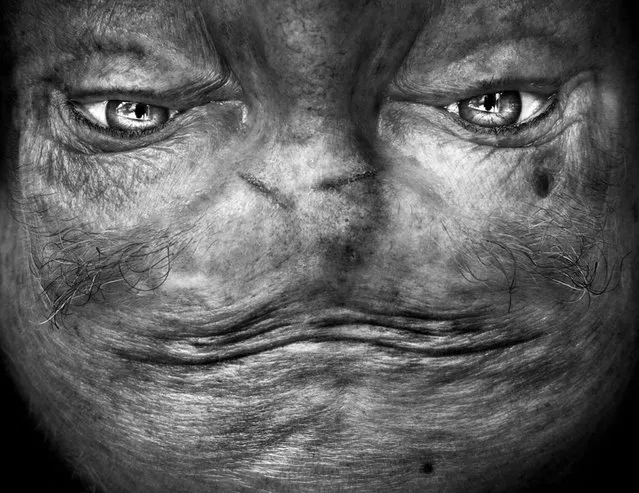
Upside-Down Portrait Photos By Anelia Loubser

This latest photo series by Anelia Loubser, a photographer in Cape Town, reminds us that even the simplest change in perspective can change how things look drastically. By selectively cropping and flipping the dark portraits in her “Alienation” series, Loubser makes basic human portraits look like creepy alien close-ups.
Details
12 Sep 2014 16:54:00