Loading...
Done
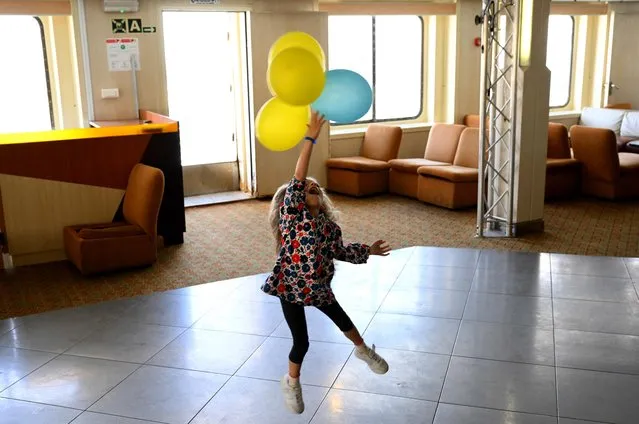
A Ukrainian girl plays with balloons with the colours of her country's flag aboard the Corsica Linea ferry “Mediterranee” in Marseille, southern France, on April 26, 2022. Anna and her children enjoy the sun on the deck of a ferry moored in Marseille: they are not vacationers but Ukrainian refugees who, on this boat, have finally found safety, “like in a village”, with 700 others compatriots. The “Mediterranean” usually serves Algeria, for the Corsica Linea. But it is now docked, at the Joliette ferry terminal in Marseille, with its unusual passengers. (Photo by Nicolas Tucat/AFP Photo)

A Ukrainian girl plays with balloons with the colours of her country's flag aboard the Corsica Linea ferry “Mediterranee” in Marseille, southern France, on April 26, 2022. Anna and her children enjoy the sun on the deck of a ferry moored in Marseille: they are not vacationers but Ukrainian refugees who, on this boat, have finally found safety, “like in a village”, with 700 others compatriots. The “Mediterranean” usually serves Algeria, for the Corsica Linea. But it is now docked, at the Joliette ferry terminal in Marseille, with its unusual passengers. (Photo by Nicolas Tucat/AFP Photo)
Details
28 Apr 2022 05:49:00
Cute sеxy caucasian brunette young woman dressed as Mrs. Santa Claus, smiling with joy, biting a candy cane with eyes closed, Christmas or New Years Eve 2022 concept. (Photo by Cryptographer/Rex Features/Shutterstock)

Cute sеxy caucasian brunette young woman dressed as Mrs. Santa Claus, smiling with joy, biting a candy cane with eyes closed, Christmas or New Years Eve 2022 concept. (Photo by Cryptographer/Rex Features/Shutterstock)
Details
07 Dec 2022 06:12:00
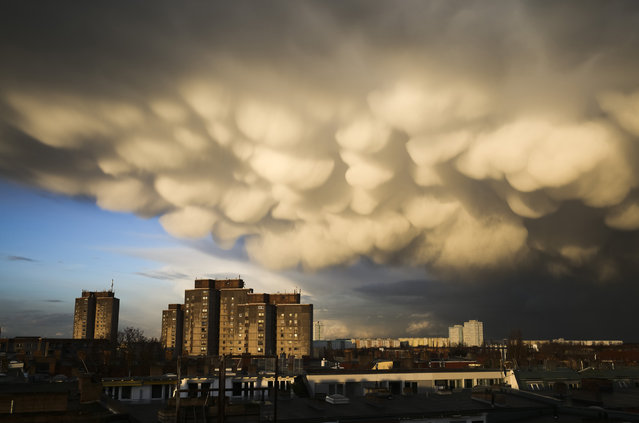
Clouds cover the sky over the Ernst-Taehlmann-Park housing estate after a thunderstorm in Berlin, Germany, Thursday, March 11, 2021. (Photo by Markus Schreiber/AP Photo)

Clouds cover the sky over the Ernst-Taehlmann-Park housing estate after a thunderstorm in Berlin, Germany, Thursday, March 11, 2021. (Photo by Markus Schreiber/AP Photo)
Details
14 Jul 2021 09:41:00
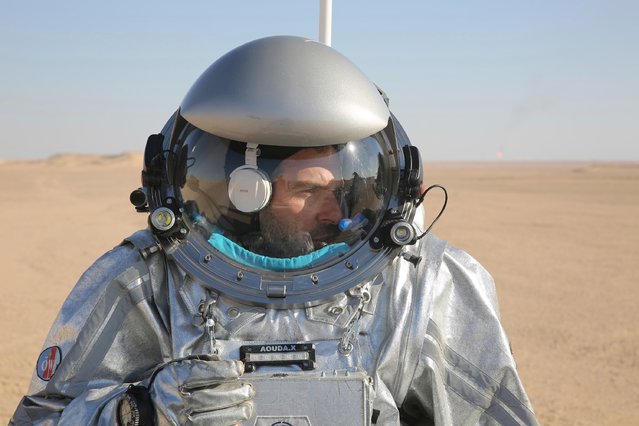
This February 7, 2018, photo shows João Lousada, a flight controller for the International Space Station, wearing an experimental space suit during a simulation of a future Mars mission in the Dhofar desert of southern Oman. (Photo by Sam McNeil/AP Photo)

This February 7, 2018, photo shows João Lousada, a flight controller for the International Space Station, wearing an experimental space suit during a simulation of a future Mars mission in the Dhofar desert of southern Oman. The desolate desert in southern Oman resembles Mars so much that more than 200 scientists from 25 nations organized by the Austrian Space Forum are using it for the next four weeks to field-test technology for a manned mission to Mars. (Photo by Sam McNeil/AP Photo)
Details
10 Feb 2018 07:02:00
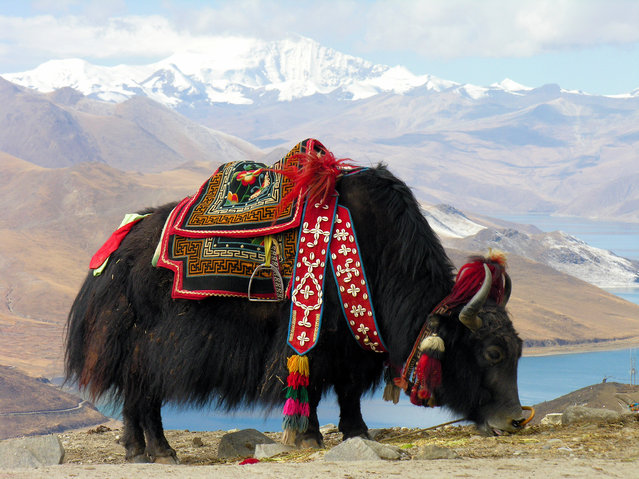
Yak near Yamdrok lake, Tibet. It is a long-haired bovinae found throughout the Himalayan region of south Central Asia, the Tibetan Plateau and as far north as Mongolia and Russia. The Tibetan economy is dominated by subsistence agriculture. Due to limited arable land, the primary occupation of the Tibetan Plateau is raising livestock, such as sheep, cattle, goats, camels, yaks, dzo, and horses. The Tibetan yak is an integral part of Tibetan life. (Photo by Dennis Jarvis)

Yak near Yamdrok lake, Tibet. It is a long-haired bovinae found throughout the Himalayan region of south Central Asia, the Tibetan Plateau and as far north as Mongolia and Russia. The Tibetan economy is dominated by subsistence agriculture. Due to limited arable land, the primary occupation of the Tibetan Plateau is raising livestock, such as sheep, cattle, goats, camels, yaks, dzo, and horses. The Tibetan yak is an integral part of Tibetan life. (Photo by Dennis Jarvis)
Details
10 Jun 2015 10:48:00
This image provided by NASA shows parts of Europe and Africa very easily recognizable in this night time image shot by one of the Expedition 25 crew members aboard the International Space Station flying 220 miles above Earth on Thursday Oct. 28, 2010. The view “looks” northward over Sicily and the “boot” of Italy, with the Mediterranean Sea representing most of the visible water in the view and the Adriatic Sea to the right of center. Tunisia is partially visible at left. Part of a docked Russian spacecraft and other components of the ISS are in the foreground. (Photo by AP photo/NASA)

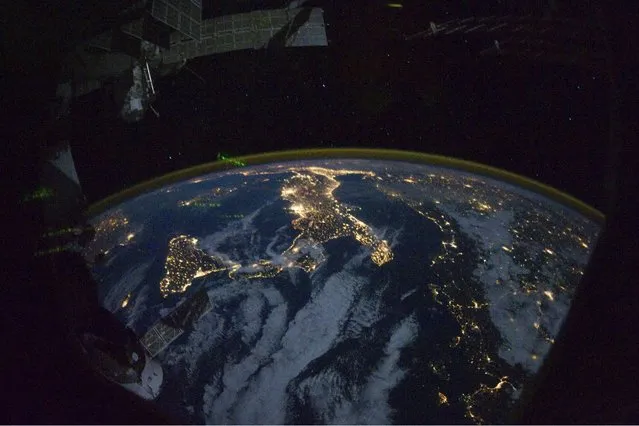
This image provided by NASA shows parts of Europe and Africa very easily recognizable in this night time image shot by one of the Expedition 25 crew members aboard the International Space Station flying 220 miles above Earth on Thursday October 28, 2010. The view “looks” northward over Sicily and the “boot” of Italy, with the Mediterranean Sea representing most of the visible water in the view and the Adriatic Sea to the right of center. Tunisia is partially visible at left. Part of a docked Russian spacecraft and other components of the ISS are in the foreground. (Photo by AP Photo/NASA)
Details
11 May 2013 12:29:00
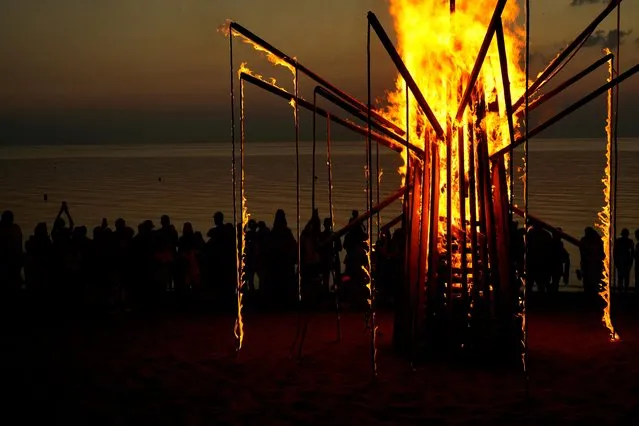
People attend The Night of Ancient Bonfires event in Saulkrasti, Latvia on August 27, 2022. During The Night of Ancient Bonfires people light bonfires along the coastline of the Baltic Sea. (Photo by Ints Kalnins/Reuters)

People attend The Night of Ancient Bonfires event in Saulkrasti, Latvia on August 27, 2022. During The Night of Ancient Bonfires people light bonfires along the coastline of the Baltic Sea. (Photo by Ints Kalnins/Reuters)
Details
07 Nov 2022 04:24:00
On August 31, 2012, a long filament of solar material that had been hovering in the sun's atmosphere, the corona, erupted out into space at 4:36 p.m. EDT. The coronal mass ejection, or CME, traveled at over 900 miles per second. The CME did not travel directly toward Earth, but did connect with Earth's magnetic environment, or magnetosphere, causing aurora to appear on the night of Monday, September 3. (Photo by NASA/GSFC/SDO)

On August 31, 2012, a long filament of solar material that had been hovering in the sun's atmosphere, the corona, erupted out into space at 4:36 p.m. EDT. The coronal mass ejection, or CME, traveled at over 900 miles per second. The CME did not travel directly toward Earth, but did connect with Earth's magnetic environment, or magnetosphere, causing aurora to appear on the night of Monday, September 3. (Photo by NASA/GSFC/SDO via The Atlantic)
Details
14 Sep 2012 09:01:00