Loading...
Done
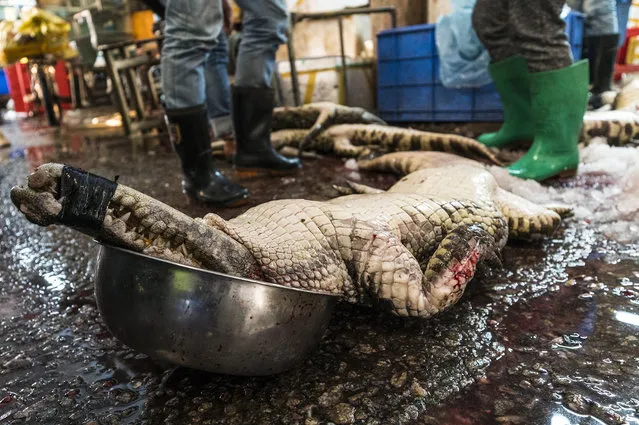
A dead crocodile is seen on Huangsha Seafood Market in Guangzhou, Guandong Province, China, 22 January 2018. Tsukiji Market of China or Huangsha Seafood Market is biggest one in Southern China and one of the biggest in China, as there are literally hundreds of different varieties of fish and seafood scattered throughout the market. Since the proximity of the fish market is so close to the Zhujiang River, it's quite easy for the large fishing vessels and fishermen to unload their fresh catch right at the market, which ensures that the fish and seafood remain fresh. Fish and other seafood are coming there from all around the globe. Seafood Market is full of different kinds of live fish, live shellfish, and live seafood on display in crystal clear tanks and it's common to see 5-star chefs, retailers and expats to source for fresh and high-quality seafood supplies for reasonable prices. While it is a wholesale fish market, since many Guangzhou restaurants and businesses come to purchase their seafood here, the public is welcome to come and even purchase. Many local Chinese have the vendors slice up fresh salmon fillets to take home or carry seafood into one of the nearby specialty restaurants, where they will cook if for them and serve it with vegetables and other side dishes of their choice. One of the biggest attractions for both, tourists and buyers, on market are crocodiles, which are brought there alive in wooden cases with taped jaws so they can?t accidentally bite. They are from crocodile farms from Guangdong, China and from Vietnam. Crocodile meat is popular in most Asian countries and it is consider as delicate one. Crocodiles weight from 10 to 25 kg and bigger ones are about 2 years old. They cost about 70 RMB (8.90 EURO) when bout as whole, or if you buy as parts most expensive and appreciated parts are paws 120 RMB (15.26 EURO) per kg, and tail 100 RMB (12.72 EURO) per kg. (Photo by Aleksandar Plavevski/EPA/EFE)

A dead crocodile is seen on Huangsha Seafood Market in Guangzhou, Guandong Province, China, 22 January 2018. Tsukiji Market of China or Huangsha Seafood Market is biggest one in Southern China and one of the biggest in China, as there are literally hundreds of different varieties of fish and seafood scattered throughout the market. (Photo by Aleksandar Plavevski/EPA/EFE)
Details
17 Apr 2020 00:05:00
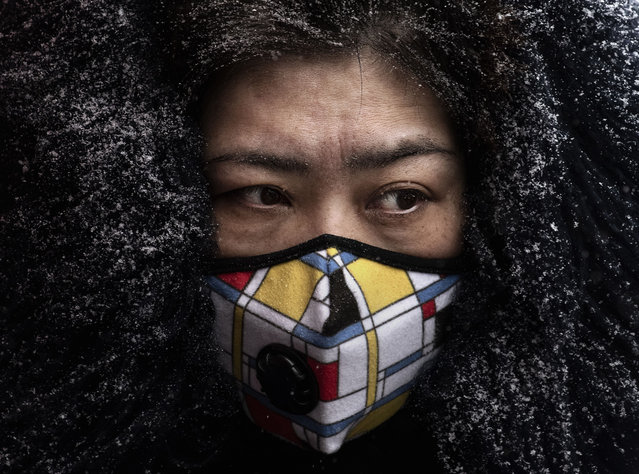
A Chinese woman wears a protective mask as she shops in a market on February 6, 2020 in Beijing, China. The number of cases of a deadly new coronavirus rose to more than 28000 in mainland China Thursday, days after the World Health Organization (WHO) declared the outbreak a global public health emergency. China continued to lock down the city of Wuhan in an effort to contain the spread of the pneumonia-like disease which medicals experts have confirmed can be passed from human to human. In an unprecedented move, Chinese authorities have put travel restrictions on the city which is the epicenter of the virus and municipalities in other parts of the country affecting tens of millions of people. The number of those who have died from the virus in China climbed to over 564 on Thursday, mostly in Hubei province, and cases have been reported in other countries including the United States, Canada, Australia, Japan, South Korea, India, the United Kingdom, Germany, France and several others. The World Health Organization has warned all governments to be on alert and screening has been stepped up at airports around the world. Some countries, including the United States, have put restrictions on Chinese travelers entering and advised their citizens against travel to China. (Photo by Kevin Frayer/Getty Images)

A Chinese woman wears a protective mask as she shops in a market on February 6, 2020 in Beijing, China. The number of cases of a deadly new coronavirus rose to more than 28000 in mainland China Thursday, days after the World Health Organization (WHO) declared the outbreak a global public health emergency. (Photo by Kevin Frayer/Getty Images)
Details
09 Feb 2020 00:07:00
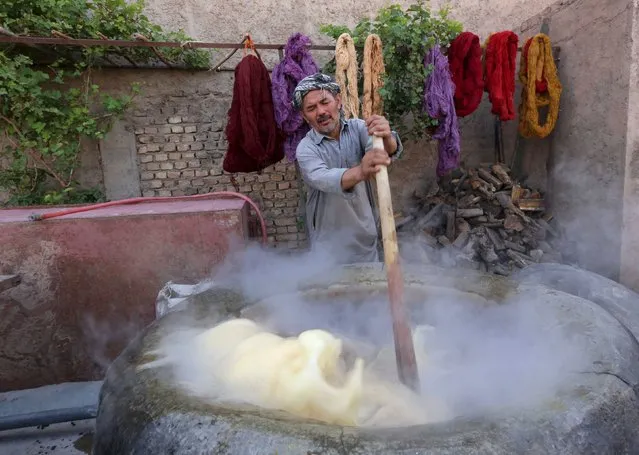
An Afghan man works at a traditional yarn factory in Heart province, Afghanistan July 28, 2015. (Photo by Mohammad Shoib/Reuters)

An Afghan man works at a traditional yarn factory in Heart province, Afghanistan July 28, 2015. (Photo by Mohammad Shoib/Reuters)
Details
14 Aug 2015 13:02:00
A changing of the honor guard ceremony by the Tomb of the Unknown Soldier in Alexander Garden by the Kremlin Wall in Moscow, Russia on May 29, 2020. (Photo by Vladimir Gerdo/TASS)

A changing of the honor guard ceremony by the Tomb of the Unknown Soldier in Alexander Garden by the Kremlin Wall in Moscow, Russia on May 29, 2020. (Photo by Vladimir Gerdo/TASS)
Details
02 Jun 2020 00:01:00
Street animators wearing fancy costumes take a break on a bench in a park in Stavropol, Russia on March 14, 2021. (Photo by Eduard Korniyenko/Reuters)

Street animators wearing fancy costumes take a break on a bench in a park in Stavropol, Russia on March 14, 2021. (Photo by Eduard Korniyenko/Reuters)
Details
21 Mar 2021 08:45:00
Students wearing masks rest amid the coronavirus disease (COVID-19) pandemic in Seoul, South Korea, August 25, 2020. (Photo by Kim Hong-Ji/Reuters)

Students wearing masks rest amid the coronavirus disease (COVID-19) pandemic in Seoul, South Korea, August 25, 2020. (Photo by Kim Hong-Ji/Reuters)
Details
04 Sep 2020 00:01:00
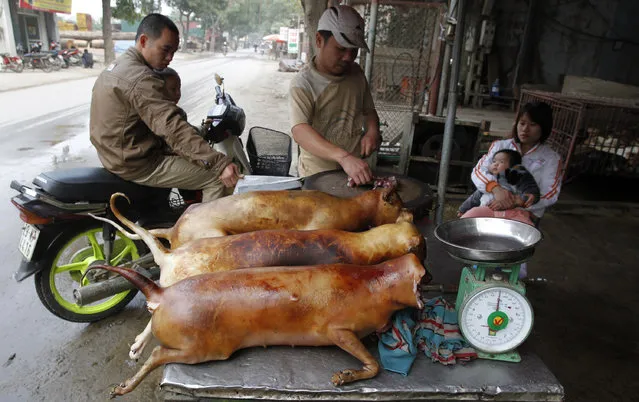
A vendor (C) cuts slaughtered dogs for sale at his roadside stall in Duong Noi village, outside Hanoi December 16, 2011. While animal rights activists have condemned eating dog meat as cruel treatment of the animals, it is still an accepted popular delicacy for some Vietnamese, as well in some other Asian countries. (Photo by Reuters/Kham)

A vendor (C) cuts slaughtered dogs for sale at his roadside stall in Duong Noi village, outside Hanoi December 16, 2011. While animal rights activists have condemned eating dog meat as cruel treatment of the animals, it is still an accepted popular delicacy for some Vietnamese, as well in some other Asian countries. Duong Noi is well-known as a dog-meat village, where hundreds of dogs are killed each day for sale as popular traditional food. Dog-eating as a custom is rooted in Vietnam and was developed as a result of poverty. One kilogram of dog meat costs about 130,000 dongs ($6.2). (Photo by Reuters/Kham)
Details
16 Jul 2013 11:40:00
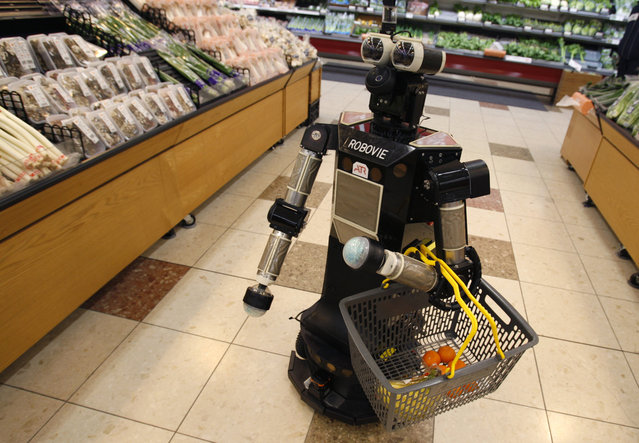
A robot named “Robovie-II”, developed by Japanese robotics research institution ATR, moves around at a grocery store during a shopping assisting experiment by utilizing the robot in an ubiquitous network technology platform in Kyoto, western Japan January 6, 2010. The robot greets the shopper at the entrance of the store, follows him to the shelves while holding a grocery basket and reminds him of the items on a shopping list, which the shopper would have entered beforehand in a specialized mobile device. The experiment is aimed to gather data in order to provide livelihood support for the elderly by using robots and network technologies, ATR's researcher Satoshi Koizumi said. (Photo by Yuriko Nakao/Reuters)

A robot named “Robovie-II”, developed by Japanese robotics research institution ATR, moves around at a grocery store during a shopping assisting experiment by utilizing the robot in an ubiquitous network technology platform in Kyoto, western Japan January 6, 2010. (Photo by Yuriko Nakao/Reuters)
Details
02 Feb 2018 06:54:00