Loading...
Done
Ocean voyage

Do you think that history is a science? Well, not exactly. First, and foremost, history is the state's “legend of wars”, it’s official regalia. Of course, public historians are not interested in scientific truth – quite the opposite. In this respect, any attempt to present a state’s history as altruistic and benevolent as possible is welcomed and encouraged – as opposed to any revisionism attempts that may be more accurate. In this matter, Chinese have surpassed us all – they revised in highly creative manner (but rather shamelessly) the technology already invented by Europeans, a process that resulted in oldest state on the planet. Here is an interesting paradox: ask any sinologist about the Middle Kingdom during second century B.C., and he will describe it to you in such a vivid manner as if he has been living there all his life – but as soon as you will ask him to describe Chinese history in the 19-20th centuries… let's say, his eagerness will be greatly diminished. However, we will discuss China in a different article, and in the meantime we will try to understand how exactly historic “legend of wars” is formed and functions – based on a specific and well-known example. A great example is Ferdinand Magellan's first voyage around the world.
Details
14 Nov 2011 09:11:00


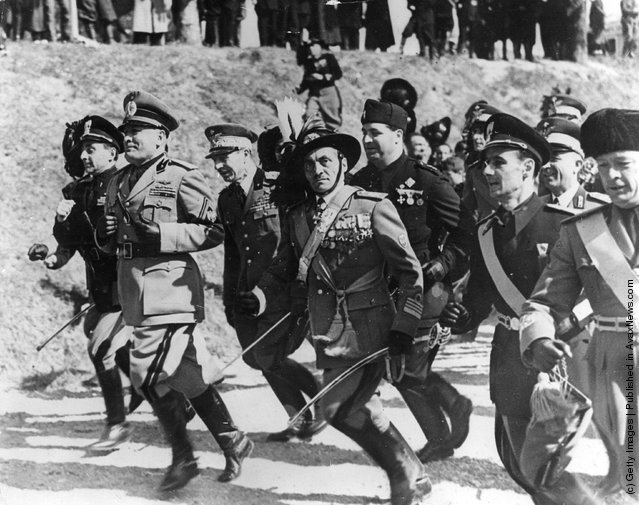
“Benito Amilcare Andrea Mussolini (29 July 1883 – 28 April 1945) was an Italian politician who led the National Fascist Party and is credited with being one of the key figures in the creation of Fascism”. – Wikipedia

Photo: Italian fascist dictator Benito Mussolini leads his officers in a spirited run in full military regalia. (Photo by Keystone/Getty Images). Circa 1940
Details
25 Jul 2011 12:24:00
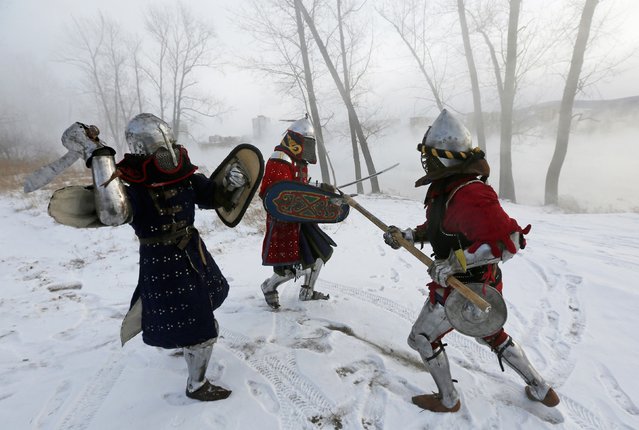
Members of the “Avalon” team wearing 14th century knight costumes fight against each other on the bank of the Yenisei River during the regional amateurs tournament of clubs of historical reconstruction, “The Battle of the Nations 2015. Siberia”, in Krasnoyarsk January 24, 2015. (Photo by Ilya Naymushin/Reuters)

Members of the “Avalon” team wearing 14th century knight costumes fight against each other on the bank of the Yenisei River during the regional amateurs tournament of clubs of historical reconstruction, “The Battle of the Nations 2015. Siberia”, in Krasnoyarsk January 24, 2015. (Photo by Ilya Naymushin/Reuters)
Details
31 Jan 2015 13:09:00
A reveller takes part in an annual block party known as “Cordao de Prata Preta”, one of the many carnival parties to take place in the neighbourhoods of Rio de Janeiro, February 6, 2016. (Photo by Pilar Olivares/Reuters)

A reveller takes part in an annual block party known as “Cordao de Prata Preta”, one of the many carnival parties to take place in the neighbourhoods of Rio de Janeiro, February 6, 2016. (Photo by Pilar Olivares/Reuters)
Details
07 Feb 2016 07:22:00
Yolaina Chavez Talavera, 31, a firefighter, poses for a photograph in front of a truck at a fire station in Managua, Nicaragua, February 22, 2017. “In my early days as a female firefighter, men, my team mates, thought that I would not last long in the organisation due to the hard training. However, in practice I showed them that I am able to take on tasks at the same level as men. I think women must fight to break through in all areas, in the midst of the machismo that still persists in Nicaragua and in Hispanic countries”, Talavera said. (Photo by Oswaldo Rivas/Reuters)

Wednesday March 8 marks International Women's Day, with festivals, concerts and exhibitions among the numerous events planned around the world to celebrate the achievements of women in society. The annual event has been held since the early 1900s and traditionally promotes a different theme each year, with this year's edition calling on people to #BeBoldForChange and push for a more gender-inclusive working world. Reuters photographers have been speaking with women in a range of professions around the world about their experiences of gender inequality. Here: Yolaina Chavez Talavera, 31, a firefighter, poses for a photograph in front of a truck at a fire station in Managua, Nicaragua, February 22, 2017. (Photo by Oswaldo Rivas/Reuters)
Details
04 Mar 2017 00:06:00
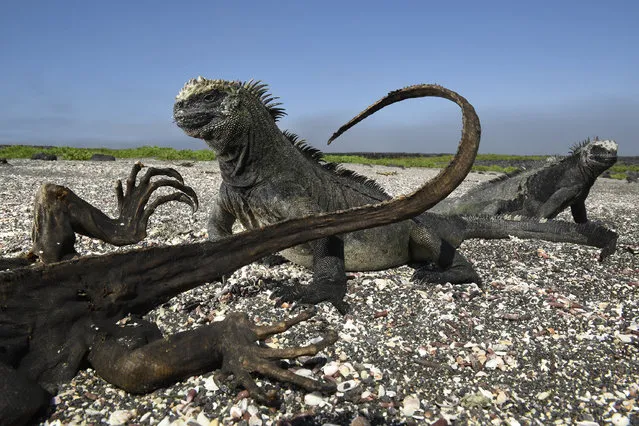
Galapagos – Rocking the Cradle: Four major ocean currents converge along the Galapagos archipelago, creating the conditions for an extraordinary diversity of animal life, April 25, 2016. The islands are home to at least 7,000 flora and fauna species, of which 97 percent of the reptiles, 80 percent of the land birds, 50 percent of the insects and 30 percent of the plants are endemic. The local ecosystem is highly sensitive to the changes in temperature, rainfall and ocean currents that characterize the climatic events known as El Niño and La Niña. These changes cause marked fluctuations in weather and food availability. Many scientists expect the frequency of El Niño and La Niña to increase as a result of climate change, making the Galapagos a possible early-warning location for its effects. (Photo by Thomas P. Peschak for National Geographic/World Press Photo)

Galapagos – Rocking the Cradle: Four major ocean currents converge along the Galapagos archipelago, creating the conditions for an extraordinary diversity of animal life, April 25, 2016. The islands are home to at least 7,000 flora and fauna species, of which 97 percent of the reptiles, 80 percent of the land birds, 50 percent of the insects and 30 percent of the plants are endemic. (Photo by Thomas P. Peschak for National Geographic/World Press Photo)
Details
16 Apr 2018 00:01:00
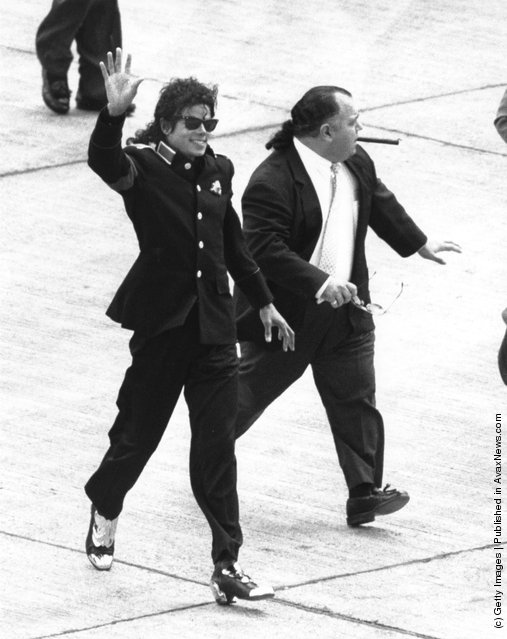
American singer Michael Jackson (1958 - 2009) arrives at Heathrow Airport with his manager Frank DiLeo, on his Bad World Tour, 11th July 1988

American singer Michael Jackson (1958–2009) arrives at Heathrow Airport with his manager Frank DiLeo, on his Bad World Tour, 11th July 1988. (Photo by Dave Hogan/Getty Images)
Details
23 Nov 2011 12:44:00
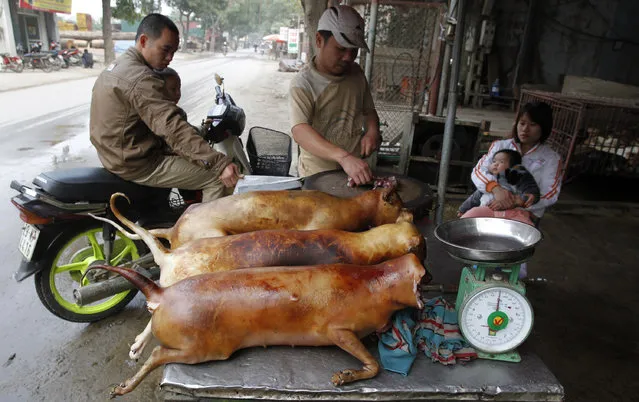
A vendor (C) cuts slaughtered dogs for sale at his roadside stall in Duong Noi village, outside Hanoi December 16, 2011. While animal rights activists have condemned eating dog meat as cruel treatment of the animals, it is still an accepted popular delicacy for some Vietnamese, as well in some other Asian countries. (Photo by Reuters/Kham)

A vendor (C) cuts slaughtered dogs for sale at his roadside stall in Duong Noi village, outside Hanoi December 16, 2011. While animal rights activists have condemned eating dog meat as cruel treatment of the animals, it is still an accepted popular delicacy for some Vietnamese, as well in some other Asian countries. Duong Noi is well-known as a dog-meat village, where hundreds of dogs are killed each day for sale as popular traditional food. Dog-eating as a custom is rooted in Vietnam and was developed as a result of poverty. One kilogram of dog meat costs about 130,000 dongs ($6.2). (Photo by Reuters/Kham)
Details
16 Jul 2013 11:40:00