Loading...
Done
TomTato Plant Grows Both Tomatoes And Potatoes

Nowadays, crossbreeding and gene splicing are creating things that would never have occurred in nature. Thanks to gene splicing, modern man can witness mice that glow in the dark, goats that produce milk which is then used to make bulletproof vests, and even cows that produce milk that is almost identical to human breast milk. One of the latest feats of human genius is the creation of Thompson and Morgan. By combining the genes of tomatoes and potatoes they were able to create a “TomTato”, which is essentially a plant that grows tomatoes and potatoes at the same time. With creations such as this, the world’s hunger problem may be resolved in a few decades.
Details
12 Dec 2014 12:43:00
A boy poses for a photo as he plays with a homemade toy gun in Qayara, south of Mosul, Iraq, Tuesday, November 22, 2016. (Photo by Felipe Dana/AP Photo)

A boy poses for a photo as he plays with a homemade toy gun in Qayara, south of Mosul, Iraq, Tuesday, November 22, 2016. For months, residents of the Iraqi town of Qayara have lived in the darkness from a cloud of toxic fumes released by oil fields lit by retreating Islamic State fighters. (Photo by Felipe Dana/AP Photo)
Details
23 Nov 2016 11:33:00
The underbelly of fetish parties has been exposed in photographs captured by Belgian photographer MagLau. The photographer dedicated three years to capturing the obsession with leather and chains, visiting fetish parties through Europe and Japan. The photographer told: “I just took pictures, always finding some beauty in the dark side”. He said that most people were happy to be photographed for the project, with the images included in a new book Fetish Ballad. Aiming to capture the candid moments, he said he never judged but instead wanted to simply observe and understand. Here: Picture from Fetish Ballad book. (Photo by MagLau/Laurent Muschel)

The underbelly of fetish parties has been exposed in photographs captured by Belgian photographer MagLau. The photographer dedicated three years to capturing the obsession with leather and chains, visiting fetish parties through Europe and Japan. The photographer told: “I just took pictures, always finding some beauty in the dark side”. He said that most people were happy to be photographed for the project, with the images included in a new book Fetish Ballad. Aiming to capture the candid moments, he said he never judged but instead wanted to simply observe and understand. Here: Picture from Fetish Ballad book. (Photo by MagLau/Laurent Muschel)
Details
16 Oct 2016 10:49:00


“Echus Chasma is a chasma in the Lunae Planum high plateau north of the Valles Marineris canyon system of Mars. Clay has been found in Echus Chasma that means that water once sat there for a time. Echus Chasma is approximately 100 km long and 10 km wide, with valleys ranging in depth from around 1 km to 4 km”. – Wikipedia

Photo: In this handout image supplied by the European Space Agency (ESA) on July 16, 2008, The Echus Chasma, one of the largest water source regions on Mars, is pictured from ESA's Mars Express. The data was acquired on September 25, 2005. The dark material shows a network of light-coloured, incised valleys that look similar to drainage networks known on Earth. It is still debated whether the valleys originate from precipitation, groundwater springs or liquid or magma flows on the surface. (Photo by ESA via Getty Images)
Details
18 Jul 2011 11:47:00
Tibetan Mastiff

“The Tibetan Mastiff also known as Do-khyi (variously translated as “home guard”, “door guard”, “dog which may be tied”, “dog which may be kept”), reflects its use as a guardian of herds, flocks, tents, villages, monasteries, and palaces, much as the old English ban-dog (also meaning tied dog) was a dog tied outside the home as a guardian. However, in nomad camps and in villages, the Do-khyi is traditionally allowed to run loose at night and woe be unto the stranger who walks abroad after dark”. – Wikipedia

Photo: A man displays a Tibetan Mastiff he raised during the Tibetan Mastiff exposition on April 7, 2007 in Langfang of Hebei Province, China. (Photo by China Photos/Getty Images)
Details
05 Oct 2011 14:27:00
Portal To Hell

If we were to burn NH4Cr2O7 with HgSCN in the Dark Ages in Europe and show it to anyone, it is us who would be burning next on a fiery cross of Inquisition. And it’s no wonder, since this experiment produces a truly marvelous result. At first, as you ignite the mixture of NH4Cr2O7 and HgSCN, all you can see is that it is slowly burning with a reddish flame. After a while, however, a crater is formed in the middle of the burning pile, and then, suddenly, tentacle-like appendages start sprouting from the burning mixture. And you can almost hear the scream of the mad occultist – “Come forth, Kraken! Come forth!” But of course, this is simply a chemical reaction that is called the "Pharoah's Serpent". It was also often sold in firework stores until people realized that it was toxic.
Details
01 Dec 2014 13:51:00
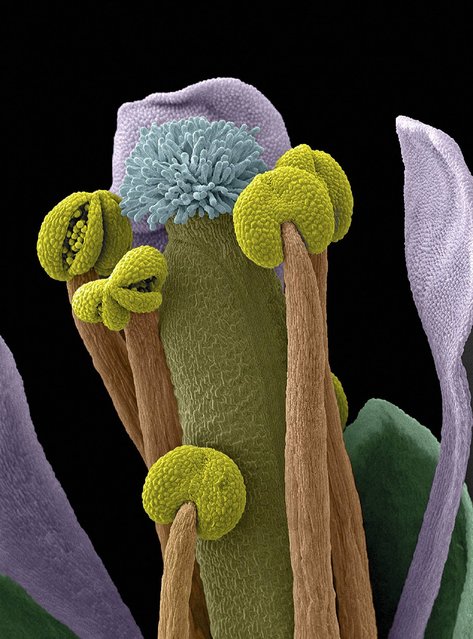
Scanning electron micrograph (SEM) of an Arabidopsis thaliana flower, also commonly known as thale cress. Some of the anthers are open, revealing pollen grains ready for dispersal. Arabidopsis was the first plant to have its entire genome sequenced and is widely used as a model organism in molecular and plant biology. Horizontal width of image is 1200 microns. Magnification 100x. (Photo by Stefan Eberhard/Wellcome Images)

Beautiful, strange and occasionally alarming pictures from the shortlist for this year’s Wellcome image awards – which celebrate the very best in science photography and imaging – from an x-ray of a bat to a micrograph of a kidney stone. The exhibition opens on 12 March at three science centres and the Museum of Science and Industry in Manchester. Photo: Scanning electron micrograph (SEM) of an Arabidopsis thaliana flower, also commonly known as thale cress. Some of the anthers are open, revealing pollen grains ready for dispersal. Arabidopsis was the first plant to have its entire genome sequenced and is widely used as a model organism in molecular and plant biology. Horizontal width of image is 1200 microns. Magnification 100x. (Photo by Stefan Eberhard/Wellcome Images)
Details
11 Mar 2014 05:58:00
These black-and-white photos are taken from the new book “Armoured Warfare in the First World War 1916 – 1918” by Anthony Tucker-Jones and published by Pen & Sword Military. “Interestingly the British, French and Germans took completely different approaches with varying results”. The British military produced “Little Willie” in Autumn 1915 weighing 18 tonnes, which had a crew of two plus four gunners. “Inspired by a tracked artillery tractor “Little Willie” was referred to as a water tank – hence the name tank – to ensure secrecy”, said Anthony. “This led to the strange looking Mark I with its peculiar rhomboid shape, designed to cross trenches with guns in sponsons on either side. The Germans saw the tank as unchivalrous and were slow to grasp its utility. They favoured the Stormtrooper (specialist soldiers used to infiltrate enemy trenches) and artillery, not the tank”, said Anthony. “However, they didn’t hesitate to make use of captured British tanks. Although the tank helped secure victory and German soldiers dubbed it “Germany’s Downfall” the country was ultimately brought to its knees by the Allies blockade”. Here: British troops hitch a ride on a Mark IV after the massed tank fleet spearheading attack at Cambrai on November 20, 1917. (Photo by Anthony Tucker-Jones/Mediadrumworld.com)

These black-and-white photos are taken from the new book “Armoured Warfare in the First World War 1916 – 1918” by Anthony Tucker-Jones and published by Pen & Sword Military. Here: British troops hitch a ride on a Mark IV after the massed tank fleet spearheading attack at Cambrai on November 20, 1917. (Photo by Anthony Tucker-Jones/Mediadrumworld.com)
Details
23 Feb 2017 00:02:00