Loading...
Done
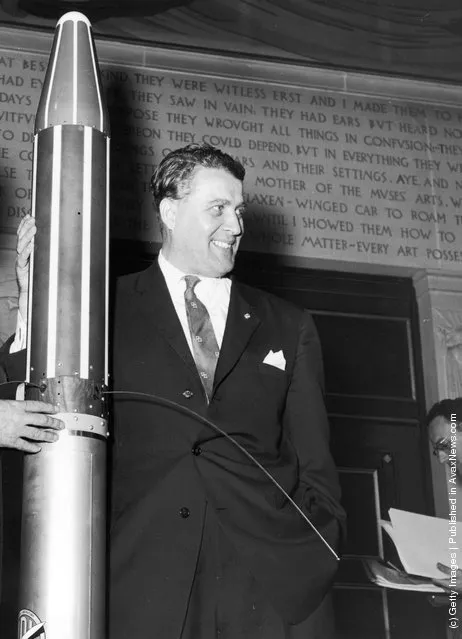
German-born American engineer Dr Wernher von Braun (1912 - 1977) with a model of the Explorer orbiting space satellite which he designed, 1958

“Wernher Magnus Maximilian Freiherr von Braun (March 23, 1912 – June 16, 1977) was a German-born rocket scientist, aerospace engineer, space architect, and one of the leading figures in the development of rocket technology in Nazi Germany during World War II and, subsequently, the United States”. – Wikipedia

Photo: German-born American engineer Dr. Wernher von Braun with a model of the Explorer orbiting space satellite which he designed. (Photo by Keystone/Getty Images). 1958
Details
22 Mar 2012 11:18:00
Kamchatka

Kamchatka

Oleg Valeriyevich Kotov was born October 27, 1965, in Simferopol, Crimean oblast in Ukrainian SSR. After a career as a physican assigned to space program, he joined the Russian cosmonaut corps. He has flown two long duration spaceflight on the International Space Station logging just short of a year in space. Kotov is currently assigned to the Soyuz TMA-10M/Expedition 37/Expedition 38 long duration spaceflight scheduled for 2013-2014.
Details
03 Apr 2015 09:25:00
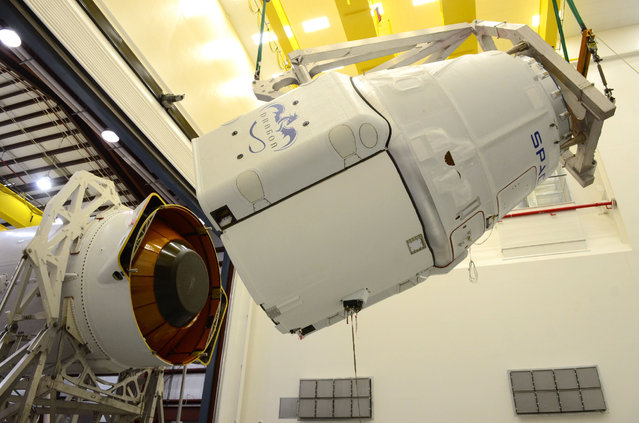
SpaceX’s Dragon spacecraft, March 6, 2014. SpaceX's Falcon 9 rocket and Dragon spacecraft launched from Launch Complex 40 at the Cape Canaveral Air Force Station, Florida, for their third official Commercial Resupply (CRS) mission to the orbiting lab on April 18, 2014. Dragon is the only operational spacecraft capable of returning a significant amount of supplies back to Earth, including experiments. (Photo by Ron Lin/SpaceX Photos)

SpaceX’s Dragon spacecraft, March 6, 2014. SpaceX's Falcon 9 rocket and Dragon spacecraft launched from Launch Complex 40 at the Cape Canaveral Air Force Station, Florida, for their third official Commercial Resupply (CRS) mission to the orbiting lab on April 18, 2014. Dragon returned to Earth with a parachute-assisted splashdown off the coast of southern California on May 14, 2014. Dragon is the only operational spacecraft capable of returning a significant amount of supplies back to Earth, including experiments. (Photo by Ron Lin/SpaceX Photos)
Details
30 Mar 2015 13:11:00
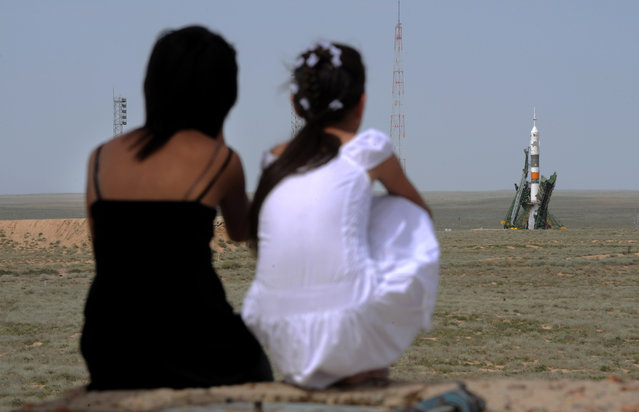
Kazakh girls watch as the Russian Soyuz TMA-15 rocket carrying Canadian astronaut Robert Thirsk, European Space Agency (ESA) astronaut Frank De Winne of Belgium and Russian cosmonaut Roman Romanenko readies for take-off from the Baikonur cosmodrome, in Kazakhstan on May 27, 2009. Three astronauts, from Canada, Belgium and Russia, blasted off for the International Space Station in a landmark mission that will double its crew to six for the first time. (Photo by Dmitry Kostyukov/AFP Photo)

Kazakh girls watch as the Russian Soyuz TMA-15 rocket carrying Canadian astronaut Robert Thirsk, European Space Agency (ESA) astronaut Frank De Winne of Belgium and Russian cosmonaut Roman Romanenko readies for take-off from the Baikonur cosmodrome, in Kazakhstan on May 27, 2009. Three astronauts, from Canada, Belgium and Russia, blasted off for the International Space Station in a landmark mission that will double its crew to six for the first time. (Photo by Dmitry Kostyukov/AFP Photo)
Details
21 Jun 2020 00:01:00
A girl in a military uniform poses for a photo after the see-off ceremony before the launch in Jiuquan, Gansu province, China, 25 April 2024. China's Shenzhou-18 manned spaceflight mission with three astronauts is the third manned spaceflight mission of China Space Station's development phase. The mission will last for about six months and the crew will carry out tasks such as installation, commissioning, maintenance, repair, and experiments in space. (Photo by Wu Hao/EPA/EFE)

A girl in a military uniform poses for a photo after the see-off ceremony before the launch in Jiuquan, Gansu province, China, 25 April 2024. China's Shenzhou-18 manned spaceflight mission with three astronauts is the third manned spaceflight mission of China Space Station's development phase. The mission will last for about six months and the crew will carry out tasks such as installation, commissioning, maintenance, repair, and experiments in space. (Photo by Wu Hao/EPA/EFE)
Details
20 May 2024 02:15:00
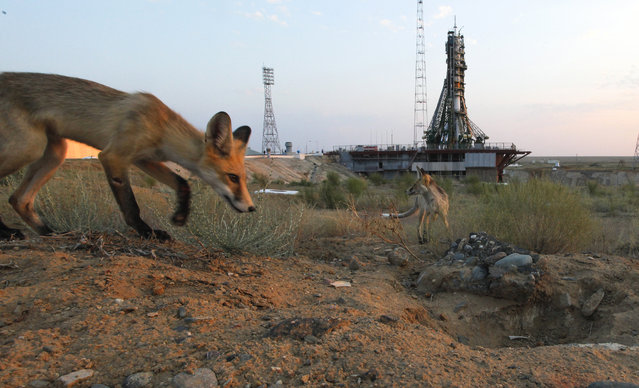
Wild foxes walk in front of a launch pad prior the launch of the Soyuz-FG rocket booster with Soyuz MS space ship carrying a new crew to the International Space Station, ISS at the Russian leased Baikonur cosmodrome, Kazakhstan, Thursday, July 7, 2016. The Russian rocket carries U.S. astronaut Kate Rubins, Russian cosmonaut Anatoly Ivanishin, and Japan astronaut Takuya Onishi. (Photo by Dmitri Lovetsky/AP Photo)

Wild foxes walk in front of a launch pad prior the launch of the Soyuz-FG rocket booster with Soyuz MS space ship carrying a new crew to the International Space Station, ISS at the Russian leased Baikonur cosmodrome, Kazakhstan, Thursday, July 7, 2016. The Russian rocket carries U.S. astronaut Kate Rubins, Russian cosmonaut Anatoly Ivanishin, and Japan astronaut Takuya Onishi. (Photo by Dmitri Lovetsky/AP Photo)

Details
08 Jul 2016 11:43:00
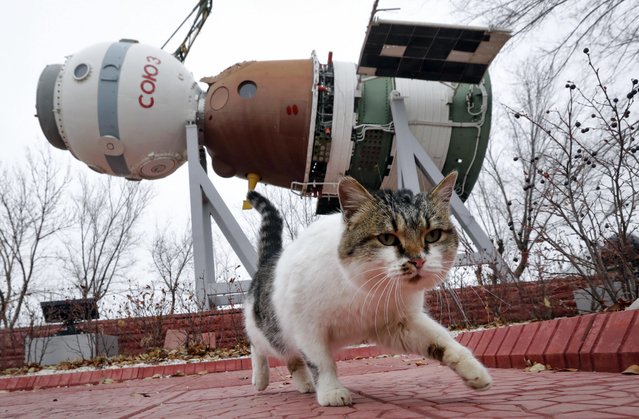
A cat walks past a Soyuz space ship installed at a museum, at the Russian leased Baikonur cosmodrome, Kazakhstan, Tuesday, November 15, 2016. The start of the new Soyuz mission to the International Space Station (ISS) is scheduled on early Friday, Nov. 18 local time. The Russian rocket will carry French astronaut Thomas Pesquet, Russian cosmonaut Oleg Novitsky and U.S. astronaut Peggy Annette Whitson. (Photo by Dmitri Lovetsky/AP Photo)

A cat walks past a Soyuz space ship installed at a museum, at the Russian leased Baikonur cosmodrome, Kazakhstan, Tuesday, November 15, 2016. The start of the new Soyuz mission to the International Space Station (ISS) is scheduled on early Friday, Nov. 18 local time. The Russian rocket will carry French astronaut Thomas Pesquet, Russian cosmonaut Oleg Novitsky and U.S. astronaut Peggy Annette Whitson. (Photo by Dmitri Lovetsky/AP Photo)
Details
16 Nov 2016 11:25:00


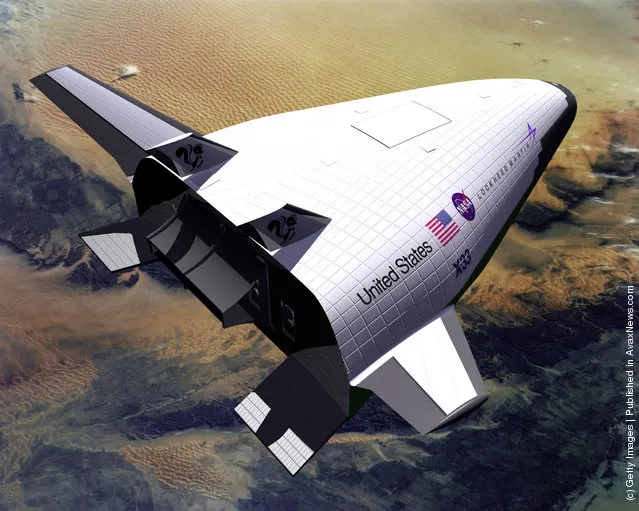
“The Lockheed Martin X-33 is an unmanned, sub-scale technology demonstrator suborbital spaceplane developed in the 1990s under the U.S. government-funded Space Launch Initiative program”. – Wikipedia

Photo: An Artist's Rendering Shows How Nasa's X-33 Technology Demonstrator, A Cost-Cutting Fully Reusable Single-Stage-To-Orbit Space Vehicle, Will Look Upon Completion. The 67 Foot-Long, 278,600 Pound, Twin Engine Space Vehicle, Capable Of Reaching Speeds In Excess Of Mach 15, Will Lead To The Construction Of A 127 Foot-Long, 2,186,000 Pound Version With Seven Engines And A 50,000 Pound Payload Capacity Called The “Venturestar”. (Photo By Nasa/Getty Images)
Details
22 Mar 2011 12:05:00